North American metal fabricators have embraced high-tech solutions and wily strategies to remain viable in the face of low-cost offshore competition. Existing technologies including robotics, laser cutters, and specialty software have been complemented by Artificial Intelligence (AI), which offers possibilities for the shop floor and office alike. Domestic fabricators also have a competitive advantage over their offshore rivals thanks to geography and an affinity for custom work.
While machining processes remove material from metal pieces to create parts, fabrication is all about shaping and joining metal. Fabrication services include cutting (with lasers, saws, and waterjets), forming (manipulating metal with press brakes or other machines), assembly (putting the pieces together, often through welding), and finishing (deburring, polishing, and adding coatings to enhance the surface of the metal). These actions are typically performed on steel plates and sheets, bars, and tubes.
An important application for many sectors, metal fabrication is an absolute necessity in the defence, aerospace, construction, and energy industries. In such sectors, performance is paramount and a part failure could have catastrophic consequences. Components on airplanes, submarines, and ships need to work perfectly under the most extreme conditions imaginable (cold, heat, intense water pressure, wind, hail, rain, et cetera). Reliability and durability are crucial under such circumstances.
Within the energy sector, fabricated steel structures and components are integral to power stations, oil refineries, oil drilling operations (on land or at sea), wind turbine towers, and hydroelectric facilities. These structures and parts must also be built to endure brutal weather, protecting personnel and the site. In a similar fashion, oil and gas pipelines must be able to withstand corrosion, high internal pressure, ultra-cold or hot temperatures, windstorms, floods, and more.
In construction projects, steel fabrication is central to the creation of structural framing, staircases, HVAC systems, metal façades, and other elements. Pre-fabrication (in which large segments of a building are manufactured offsite then put together onsite) is becoming more common in construction circles.
Metal fabrication frequently entails a high degree of customization (hydroelectric dams and drilling platforms, after all, come in a variety of shapes and sizes, requiring some specialty touches) and is often performed by relatively small companies. In fact, it’s safe to say that small fab shops punch way above their weight class.
“Not many industries can say they’re dominated by small business these days—but metal fabrication can. Operations employing fewer than 50 people make up the vast majority of fabricators in North America,” writes Tim Heston in Building a Diverse Platform to Scale in Metal Fabrication for The Fabricator, official magazine of the Illinois-based Fabricators & Manufacturers Association (FMA).
Regardless of their size, many fab shops are employing future-forward technologies, including AI. Legacy shops can integrate such programs with existing technology such as vision sensor systems and Internet of Things (IoT) networks to augment performance monitoring and data collection. AI algorithms can analyze production stats and make predictions about upcoming machine failures as well as wear and tear on tools.
AI can also be utilized to create and run “a digital twin,” a computer simulation of a machine tool’s processes, assets, and procedures. These digital replicas let operators address issues and smooth out glitches without wasting material.
Artificial Intelligence might make fabrication shops safer as well. “Machine vision and navigation algorithms are widely used by autonomous mobile robots, which use AI-powered technologies to navigate themselves about a facility. These algorithms aid autonomous robots in avoiding hazards and floor workers, while lessening the chance of collisions,” states a recent Motion Automation Intelligence blog post, The Impact of Automation on Metal Fabrication.
If using AI on the shop floor is still a work in progress, the technology can be readily applied for internal purposes. Pundits recommend against using AI to write emails to clients, a process fraught with the potential for embarrassing gaffes and clunky phrasing. Instead, they suggest adopting AI solutions for behind-the-scenes work, such as gleaning and compiling production and sales data. AI-enabled programs can review previous emails and texts to and from clients to gauge response rates and determine what messaging works best. AI solutions can also gather and summarize data regarding labour costs, material prices, production times, and other factors, which is helpful when preparing estimates.
While AI is the new kid on the block, there are plenty of other tech tools that can greatly augment metal fabrication methods. Fab shops have long used robots, for example, to perform cutting, quality inspection, material handling, and especially welding. There is a growing trend toward integrating collaborative robots or “cobots” within fabrication outfits. Cobots can work next to humans without any safety issues, and are ideally suited for repetitive, tiring tasks such as materials handling. As a result, shops can save on labour costs and free up staff to tackle more demanding duties.
Like other manufacturing and industrial plants across North America, metal fabrication shops have been impacted by ongoing labour shortages. As has been widely reported, younger people are not flocking to join the skilled trades to replace existing workers who are reaching retirement age. Cobots and other high-tech solutions can help shops address this labour shortage.
CNC (Computer Numerical Control) systems are another metalworking mainstay. Simply put, a CNC automates the control of a machine tool. Engineers or staff will develop a 3D design using CAD (Computer Aided Design) software, import the design into a CAM (Computer Aided Manufacturing) program to create toolpaths and then enter the resulting instructions into a CNC controller. A CNC lathe or mill then executes the toolpath and creates parts, under human guidance.
“Computer aided design (CAD) software has become an essential tool in steel fabrication, enabling engineers to create detailed blueprints and simulate stress tests before production begins,” says the article Why Steel Fabrication is Essential for the Energy Sector posted on the website of Benchmark Fabricated Steel.
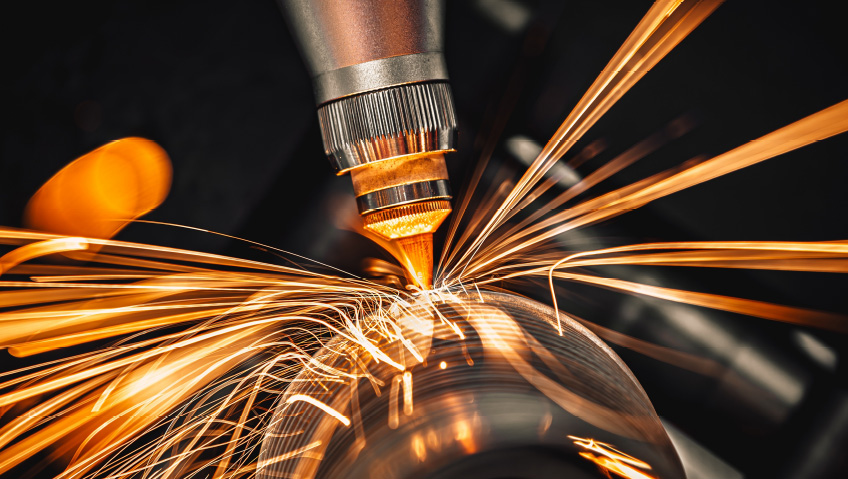
Laser cutters, meanwhile, offer speed, accuracy, and consistency in metal fabrication work. Computer controlled laser cutters focus an intense beam of light on metal surfaces, which melts or vaporizes material. Laser systems have the added advantage of minimizing material waste while performing extremely precise cutting.
Other developments aiding metal fabrication include 5-axis machining. While 3-axis machines have been commonly used in the past, a 5-axis machining centre allows the cutting tool to contact the workpiece from all directions. The machining of complicated parts can be accomplished in a single setup (operators don’t need to manually maneuver the part multiple times, which makes for greater productivity and less opportunity for human error). Some fab shops have also introduced Augmented Reality (AR) or Virtual Reality (VR) systems for training purposes. These technologies provide an immersive environment in which apprentice welders can be trained in a low-risk manner without having to waste material or tie up a machine.
Additional tools include Enterprise Resource Planning (ERP) systems to track and manage raw materials and Manufacturing Execution Systems (MES) to monitor the shop floor in real time. Once again, these existing software programs can be tweaked or supercharged via the judicious use of AI.
Of course, there are plenty of other things domestic fabricators can do to shine outside of investing in new technology. Developing a speciality in rapid prototyping or custom work is an excellent way to compete against offshore rivals. Offshore firms that excel at large fabrication assignments might balk at doing one-off, specialty projects. Focusing on niche areas such as micro-welding or exotic materials serves the same purpose. Offering turnkey services and maintaining a diversified customer base is strongly recommended as well.
There are also tremendous advantages to being based in the United States or Canada. North American firms that use domestic fabricators benefit from shorter lead times, for a start. With no oceans to cross on slow-moving transport vessels, delivery is vastly cheaper and faster. Domestic fabricators can meet in-person with clients (depending on their location), something that might be tricky to arrange with an offshore firm in a foreign locale.
During the COVID pandemic of the early 2020s, North American manufacturers realized the folly of being too reliant on overseas suppliers. When the pandemic hit, oceanic transport slowed to a crawl and ports became jammed. Hiring a domestic fabricator is a good way to avoid many of these pitfalls in the future. Going local can also mean dodging extra expenses associated with tariffs. And, while metal fabricators already make extensive use of recycled steel, going forward, fabricators are becoming increasingly fond of low-carbon steel, which is even more environmentally friendly—an important consideration in an era of government-mandated green regulations.
Given all this, the outlook for the domestic steel fabrication sector is positive. By adopting automation, integrating new technologies, and emphasizing homegrown strengths, metal fabricators in Canada and the United States can more than hold their own against the biggest offshore players.