Surrey, British Columbia-based bulk material handling equipment supplier Industrial Equipment Manufacturing Ltd (IEM) has an outstanding reputation the world over. Founded nearly 75 years ago, this employee-owned, ISO-certified company offers custom design, fabrication, machining, and repairs. IEM has tackled many high-profile projects in its time, and continues to flourish thanks to a combination of customized services and quality work.
“Our area of expertise is bulk material handling equipment, so conveyors, apron feeders and belt feeders, and other related equipment,” explains IEM President Chuck Walls. “We design and build spile bar systems which act as isolation gates in mining operations. We also design and manufacture ball handling systems for mining operations and we build rotary de-barkers for forest product manufacturers. We build the biggest rotary de-barkers in the world.”
A spile bar system enhances safety in ore bins and transfer chutes at mines, while ball handling systems are used to store steel grinding balls for mining applications. As their name implies, de-barkers remove bark from logs. IEM has made de-barkers that can process 450 cubic meters of wood per hour or more.
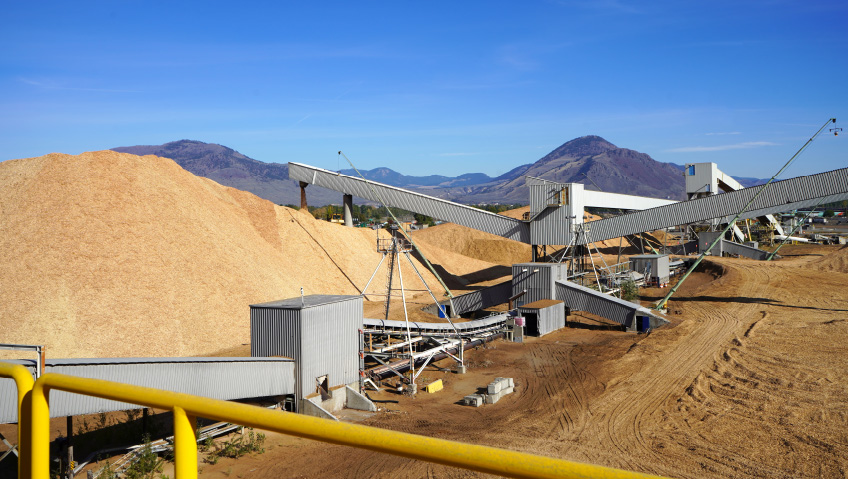
The company’s main markets include mines, oil and gas operations, and forestry/wood handling. Cement and aggregate plants, port infrastructure, and grain handling facilities represent other sectors for which IEM has built products.
Forging a strong team
The business was founded in 1953 under the name Industrial Equipment Company (IECO). Half a century after the launch, John Hards and Joe Wurz purchased the machinery design and manufacturing division of IECO. The new owners changed the name of their acquisition to Industrial Equipment Manufacturing Ltd. and introduced an employee-ownership plan. At present, “maybe 95 percent,” of IEM staff own shares, Walls explains, with ownership of shares limited to employees only.
IEM has roughly 55 employees at present, up from around 50 at this time last year, and about half of these workers belong to the United Steelworkers (USW) union. The company typically hires newly graduated or junior engineers who can be trained in the company’s practices, such as its hands-on approach. “Our engineers can walk into the shop, see what they’ve designed, see how it’s being built,” says Walls. Here, shop floor staff can directly approach the engineers to refine designs or suggest ideas, a collaborative setup that gives IEM a competitive advantage over companies that perform engineering work in one country and manufacturing in another, notes Walls.
IEM is Engineering and Manufacturing ISO 9001:2015 certified and the company’s welding services are certified by the Canadian Welding Bureau (CWB) to CSA W47.1 and CSA W47.2 standards, for steel and aluminum respectively. The IEM Vice President of Manufacturing is tasked with ensuring that quality benchmarks are met, while the company’s welding supervisor, who is certified in non-destructive testing procedures, conducts extensive weld-related tests.
Safety-wise, IEM employs toolbox talks and strict hazard-avoidance procedures, says Walls. Employees also rely on the company’s close-knit spirit to keep them safe. This is “not a big operation,” so everyone knows everyone else, as well as their spouses and children, says Walls. “We believe that the most important aspect of safety in any operation is—and it sounds corny—how much you care about the people you’re working beside. We find that our senior folks are always looking out for our junior people, making sure they’re doing things right, not taking shortcuts,” he continues.
Competing on quality
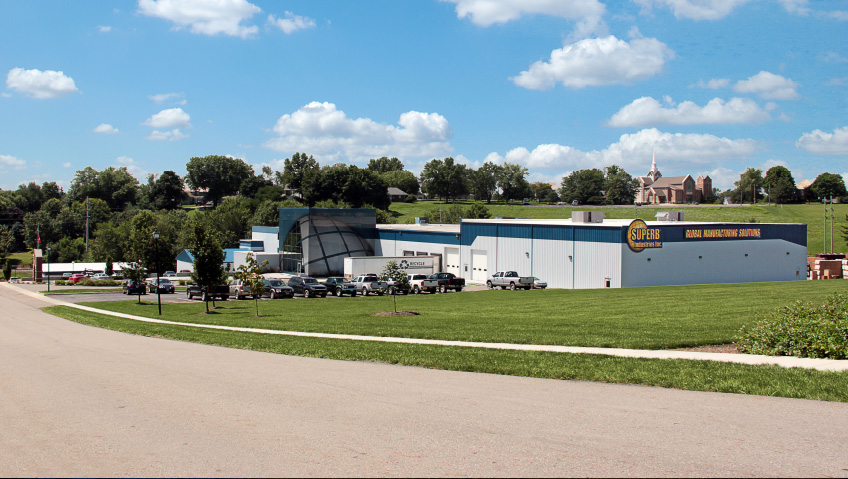
The company is based out of a 50,000-square-foot facility conveniently located near both Vancouver International Airport and major ports. While many of its clients are Canadian, IEM has sold equipment to companies with operations in Mongolia, Indonesia, and South America as well. It has also done “a little bit in Europe, and the U.S. of course,” adds Walls. “We specialize in mechanical design, while anything structural or electrical, we would subcontract out.”
IEM also stocks a huge number of spare parts, primarily to provide replacements for its own equipment. For example, it designs and manufactures specialized equipment for surface mining operators in Fort McMurray, Alberta, the epicenter of that province’s oilsands industry. Among other items, IEM supplies specialty equipment including plows, belt cleaners, and pulley cleaners. IEM uses a welding robot built to create wear parts that address the challenges of working with bitumen. Spare parts for such gear might be hard to find outside of IEM.
Walls acknowledges that competition within the bulk equipment handling space can be brutal. “We compete against some very, very large companies [including some] that manufacture all over the world, where the wages are much lower and it’s much cheaper to produce equipment… We can compete with them because of the custom engineering facet of our business,” he shares.
For example, “If you want an overland conveyor, to go from A to B, you go to [the competition]. But if you want three or four kilometers of underground conveyor that’s going to be attached to the ceiling of your mineshaft, you will come to us.”
IEM’s longevity also stems from its reputation for making quality products. “We can’t afford to produce sub-par equipment,” says Walls. “Our quality standards are very high, and we provide excellent after-sales service. What we find is, once we get a customer, they keep coming back. We’re not generally the cheapest when it comes to sticker price, but we compete very well on total cost ownership.”
Wins and challenges
Clearly, clients like what IEM has to offer, as the team has taken on a number of major projects over the decades. The company was hired to build conveyors and galleries—the enclosed structures that go around conveying systems to provide protection from the elements—for a company operating in Nunavut, Canada. Construction was done in sections, which were fitted together in IEM’s shop then painstakingly shipped to the client via barge and ice highway, among other methods. “That was a pretty cool project and quite challenging,” recalls Walls.
IEM has also built cable reel structures for storing ship cables for a major maritime company in British Columbia building supply ships for the Canadian navy. IEM has also designed and manufactured massive de-barkers for a forestry business in Michigan and a pulp and paper companies in Alberta and B.C. Company engineers frequently attend mining and other industry trade shows to meet existing and potential customers face-to-face.
Given the nature of IEM’s work, it is no surprise that Walls cites “the cyclical nature of the natural resources business,” as the company’s biggest challenge while, interestingly, tariffs imposed by the White House have benefitted IEM in some ways. The company has taken on some non-American customers that are eager to find suppliers elsewhere. “We just signed a contract with a small company that builds water treatment systems. They were looking for an alternative tank supplier [to their normal U.S. supplier], because they sell both into the U.S. and Canada, and it’s much simpler for them to have [their systems for Canadian customers] built in Canada,” says Walls.
Embracing the future
Going forward, the company is looking into using artificial intelligence (AI) in its operations. Design work is currently performed with 3D design software, and IEM is open to new technology. “We’ve contracted an AI expert to come in this summer and train some of our people,” Walls shares. “They will look at some of our manufacturing processes and our drafting to see if there are some opportunities to improve quality and efficiency.”
As for the business itself, he personally would like to see the company grow over the next five years, perhaps through acquisitions. One plan would be to buy a fabrication firm, then incorporate IEM’s engineering methodologies into the work practises of the new purchase. Vertical integration is another possibility under consideration. “We spend a lot of money on painting, for instance. As the company starts to build some capital, I wouldn’t mind seeing us invest in a paint company or another kind of supplier to us, and running the companies separately, but owned by IEM.”
Given the company ownership model, any decisions regarding the future must be endorsed by an employee-run board. Naturally, the board is averse to risky ventures that might jeopardize the future of the business if things do not go as planned, notes Walls—and he is fine with this, viewing employee-ownership as a strength.
“It’s nice to work for a company where, when we succeed, all the employees succeed with us—not on a figurative level, but on a very real financial level.”