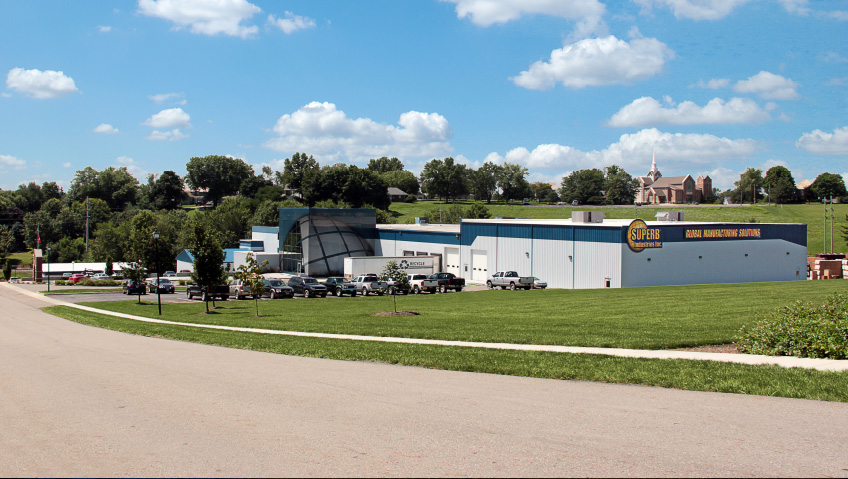
Thinking back on the past 40 years, John Miller remains proud of his legacy. In his youth, Miller worked alongside his father at the family-owned business, Crawford Manufacturing, based in the Amish stronghold of Sugarcreek, Ohio. He reflects on the irony of making parts for products they weren’t allowed to use, like cord reels for Hoover sweepers; not being able to use electricity, he says, fueled his father’s imagination, with him using automated air relay logic instead.
At age 24, Miller left the community because of convictions regarding the seventh-day Sabbath. “I’m just an Amish guy who lost his hat,” he says. With years of experience and ingenuity under his belt, he started his own business in a two-car garage, and had the audacity, as he calls it, to name the company SUPERB Industries Inc., aligning with his vision of superb-quality people and products.
Created with his brother Daniel, SUPERB is another link in the family’s legacy. “Dating back to the late 1700s, Miller family craftsmen, beginning with Christian ‘Schmidt’ Miller, have been making the world a better place,” states the company. “At SUPERB Industries, this remains the mission for every engineered component manufactured.”
Smarter thinking
Founded in 1986, SUPERB Industries has emerged as one of America’s leading-edge hybrid high-speed manufacturers. Based in a 70,000-square-foot facility in Sugarcreek since 2000, the company has grown from a team of six to almost 100. The company’s many in-house capabilities include development, product and process design, engineering, assembly, die stalking, welding and more, making SUPERB a one-stop shop. Always aiming to add value, the company’s experienced engineers seek to make products faster and more affordably for customers.
A solutions-based business, the SUPERB team doesn’t see problems; they create opportunities. The company’s decades-long legacy has resulted in countless products being designed—and sometimes, re-designed—to be lighter, more durable, and more efficient. In one case, a die-cast locking system for a truck cap handle was “costly and cumbersome,” heavy, and prone to rust. Faced with this challenge, SUPERB’s engineers re-designed the lock system. Instead of heavy die-cast components, parts were manufactured using high-strength engineered polymers. Instead of the old system, the truck cap handle was remade “to include a field activate-able integrated e-lock system,” Miller explains. The result: a durable, lightweight, patented integrated e-lock system that was now more cost-effective to mass-produce.
Hybrid high-speed manufacturing
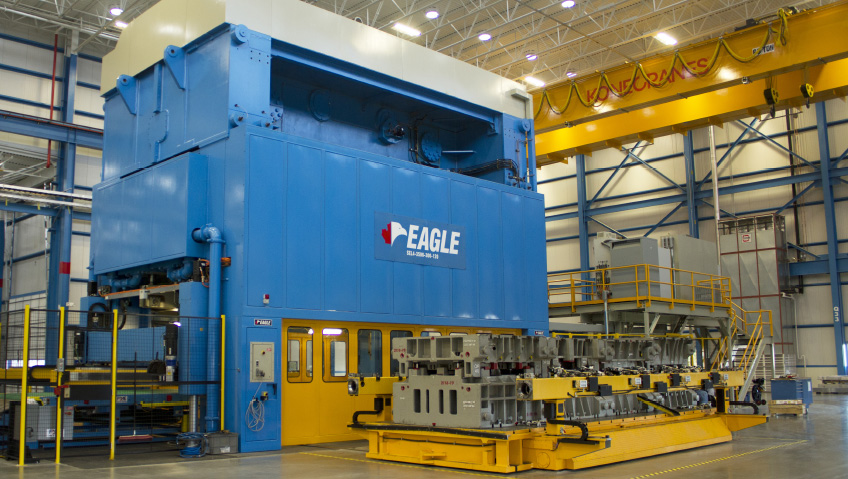
One of the many ways SUPERB has stayed ahead of the competition is by continually investing in technology, growing from a handful of production lines to over 20 today. The company’s home of Sugarcreek is renowned as “The Little Switzerland of Ohio” owing to the many Swiss immigrants who settled in the area 200 years ago. Familiar with European quality, the company utilizes the high-performance stamping presses of Switzerland’s Bruderer with the exceptional stamping, assembly, and welding systems technologies of Germany’s Bihler.
“We married those two systems together, and that’s what we call hybrid high-speed,” says Miller, who knew of the two companies because of his time in Germany and working with some Germany-based businesses. “We acquired the technologies over time and integrated them into our platform. We also have direct personal relationships with the ownership.”
Thanks to combining Bruderer and Bihler’s superior-quality equipment with SUPERB’s expertise and automating processes, the company produces quality components in great volumes more efficiently. “We do over a billion parts a year out of our facility in Sugarcreek, and we make just over five million parts a day,” says Miller.
“I call it leveraging time and space,” he adds. “Speed is a component. We have one particular automotive contact component where we make 24,000 parts a minute. So that’s speed, but another component is space.”
Made-in-America quality
At SUPERB, the company’s state-of-the-art technology and in-depth manufacturing knowledge often lead to 20 to 30 percent less material being used, which saves clients money in turn. “That’s how we’ve been able to compete with offshoring; when that was in vogue, that’s how we survived that,” Miller shares. “And now, tariffs and policies of the Trump Administration have made it a bit easier to compete in the United States, so we’re well-positioned going forward and pretty optimistic about the future as manufacturing comes back to this country.”
In SUPERB Inside 3.0, Miller wrote about how American manufacturing has been at a crossroads for years, “torn between rising costs and fierce global competition. SUPERB Inside is the story of a small-town company that bet on itself and beat the odds.”
Unlike some other American companies who farmed-out cheaper—and often substandard—overseas manufacturing, SUPERB invested in domestic capabilities, “proving that efficiency and scale don’t have to come at the cost of quality.” This commitment sees SUPERB ship more than 1.4 billion components annually with an on-time delivery rate of over 99 percent and under 0.01 percent of parts falling short of customer standards. “What’s even more remarkable?” adds Miller. “More than half of what we make is exported to low-cost countries like Mexico and China, places many domestic manufacturers left for.”
SUPERB’s at-home manufacturing and dedication to American values keeps earning the company recognition, including regularly earning a spot on Inc. Magazine’s list of the 100 fastest-growing, privately held U.S. manufacturers.
Of course, “Reshoring is great, but you need qualified people, and there’s a shortage of them,” says Miller, adding that the current immigration system needs work, as SUPERB needs legal immigrants. “We’re having a really hard time finding enough qualified people because there’s just no unemployment in our area.” The company currently has several legal immigrants on its team; part of the challenge, Miller says, is that the H-1B Specialty Occupations visa is connected to a costly $100,000 fee. “That’s something that has to get fixed.”
Making the world a better place
While SUPERB Industries serves customers worldwide, the company has always been there for its local community. Post-pandemic, the company responded to a request from the Amish Mennonite community for home canning lids, since there was a shortage. SUPERB ended up engineering a lid that was superior to existing products, holding its seal for 36 months instead of 18. Independent labs evaluated meat pressure-canned almost six years ago, and it was still fresh and edible. This not only got the attention of the leading brand of canning lids but also saw the creation of Superb Canning and the company’s entering the retail market.
“It’s like inventing another soft drink and competing against Coke,” says Miller of the lid, which has earned over 60 per cent confidence from the Amish Mennonite community and captured 2.5 percent of the market. From the time of the first call the week of Thanksgiving 2020, SUPERB designed, validated, and shipped a million lids by canning season 2021.
An IATF 16949 certified company (the international standard for Automotive Quality Management Systems), SUPERB is audited annually for automotive standards, and Miller says he was surprised by the lack of standards for canning lids. The company applied its own rigorous engineering standards and disciplines in doing the lid validation, benchmarking the competition and far exceeding existing standards. At present, the company is now validating an even better lid.
“I like to tell my employees that our mission is to make the world a better place,” says Miller of the company’s many products. “By noon on Monday, they will have made enough components to control 3,000 hot water heaters, which is enough to put a new one in every residence in our immediate area. So that’s what I want them to envision—they are not just making parts and putting them in a box, but rather making the world a better place, because thousands of people are going to get hot showers instead of cold ones.”
Turning 65 this year, Miller is working on a succession plan which will see his son, a trained electrical engineer, assume control of SUPERB, “and take the company where I couldn’t.” In the years to come, Miller sees the company growing, largely because of the SUPERB Technical Institute, a joint training initiative between SUPERB, the Buckeye Career Center, and L.I.G.H.T. Founded in 2012, the Institute offers a range of apprenticeship training programs to the technicians of tomorrow. “Employment opportunities in this area are phenomenal,” Miller tells us.
Planning to be operationally out of the business by 70, John Miller looks forward to traveling. Publishing one book this past year, he is working on three others, “and then I’ll have to figure out something to do to not go stir-crazy,” he laughs.
As for SUPERB, which represents 10 generations of craftsman going back to Colonial times, Miller confidently says, “We’re not going anywhere.”