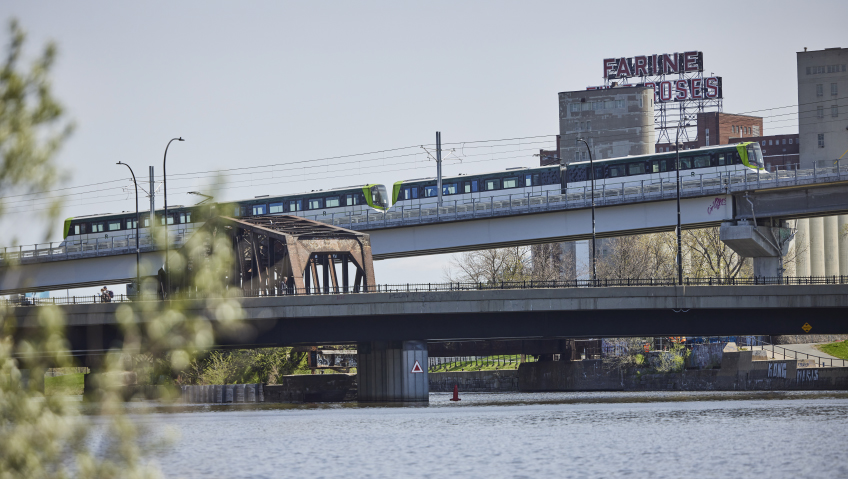
In today’s workplace, many younger employees want more than a job; they want a position that reflects their personal beliefs and values in important areas like visionary green initiatives. These considerations, and many others, make Alstom an employer of choice.
Headquartered in Saint-Bruno-de-Montarville, Québec, Alstom is Canada’s only domestic train manufacturer. A global leader in smart, sustainable mobility solutions, Alstom has about 87,000 employees worldwide, including nearly 5,200 in Canada, and is helping shape the future of transportation while creating opportunities for the next generation of talent.
Many new graduates in fields such as engineering have a say in which sectors they wish to work, and companies like Alstom, with a strong emphasis on creating a greener, cleaner world, often come out on top.
“We are transforming cities for tomorrow and creating economic opportunities by addressing congestion issues in urban centres like Toronto and Montréal,” says Olivier Marcil, Vice President of Public Affairs and Communications at Alstom Canada. “Our passenger rail solutions are modern, automated and very sophisticated. Our employees are contributing to tackling climate change, because they are working at a company that offers clean mobility solutions. Our trains are green,” he explains.
Being part of a business that focuses on sustainability and produces trains powered by electricity, hydrogen, and batteries, is an extremely attractive value proposition.
“It is really appealing for the next generation, and our main challenge is to make it known specifically in North America, where there is a strong car culture and less focus on transit than in Europe or Asia,” adds Marcil. “Our goal is really to make this company, and this sector, familiar to the next generation.”
A leader in sustainable mobility solutions, Alstom remains focused on the future of transportation across North America and worldwide. In 2021, Bombardier Transportation (a division of Bombardier Inc.) was acquired by French multinational Alstom, further strengthening its decades-long presence in North America and accelerating its growth ambitions. The acquisition was followed by the creation of a brand-new Innovation Centre in 2022.
At Alstom’s Americas headquarters on the outskirts of Montreal, the Innovation Centre leads the development of “future platforms for green hybrid, battery, or hydrogen propulsion technologies specifically tailored to the North American rail freight and passenger market, and in doing so meet the sector’s decarbonization needs,” according to the company. This includes dedicated prototyping, augmented reality equipment, and collaborations with key industry players and universities across the country.
In 2023, Alstom conducted a demonstration of the first hydrogen-propulsed train in North America intended for commercial service, a demo driven by the Innovation Centre. To date, the Centre continues to work in areas such as batteries, manufacturing processes, robotics, braking, propulsion, and artificial intelligence.
Decades of experience
French multinational rail systems manufacturer Alstom SA, originally known as Alsthom, was created in 1928 through the merger of Société Alsacienne de Constructions Mécaniques’ (Als) electrical engineering division, and Compagnie Française Thomson-Houston (thom). The following years were marked by acquisitions and international expansion, including the establishment of a longstanding presence in Canada. This expansion sped up following the 2021 Bombardier acquisition, which positioned Alstom as the country’s sole rolling stock manufacturer.
Bombardier Inc. was well established as its own respected global powerhouse. Largely known today for aerospace and manufacturing business jets like the Challenger 650 and Global 8000, the company also built its reputation as a maker of snowmobiles and railway trains. By 2021, the rail industry was increasingly moving toward consolidation.
“There was a lot of discussion across the industry regarding the need for a global player with the size, scope, and capabilities to compete on every continent, and equipped to face competition coming from China,” Marcil explains.
Although there had been previous attempts to consolidate the market, none succeeded until the combination of Alstom and Bombardier in 2021, which created the largest pure rail player in the Western world. The two merging companies were of roughly equal size, employing approximately 35,000 people each worldwide, but differed in their product portfolio and market presence.
The strength of the transaction lay in the complementary nature of the two businesses. Because the companies had established leadership positions in different markets, they were not direct competitors. Bombardier was well-known in North America, the United Kingdom, and Germany, while Alstom had a strong position in France, India, and Brazil. Merging the two companies saw expanded access to different markets.
Similarly, Bombardier was notably known in commuter rail and operation and maintenance, while Alstom was recognized for its strength in high-speed rail. “Merging the two created a very large portfolio of products, services, and technologies, and access to the market, which has allowed us to better serve our clients with a 360° portfolio offer and a multi-local manufacturing strategy,” says Marcil. “That’s been a literal game changer for the industry, and for Alstom employees of course.”
Positioned for growth
Many associate Alstom with rolling stock, but the company also has a strong offering in operations and maintenance and signaling. Depending on the project, maintenance contracts can extend for 25 to 30 years, allowing Alstom to support customers throughout the lifecycle of their transportation systems.
Across Canada and the U.S., Alstom has been integral to many new transit systems. In Toronto, for example, Alstom employees maintain and operate the GO Transit network. They also deliver these services in Los Angeles, Edmonton, and Montreal. The company also handles the operation of Automated People Movers (APMs), automated trains at airports moving millions of passengers between terminals every year.
“We provide, maintain, and operate those trains for nine out of the 10 largest U.S. airports. On top of that, we handle everything that is digital, like AI and cybersecurity,” says Marcil. “It depends on the customer and their specific needs.” Some contracts see Alstom solely providing rolling stock, while others include operation and maintenance, signaling, or systems.
“Our ambition is to grow in every market where we operate, and Canada and the United States are very strategic to us. We see tremendous opportunities, both because of the evolution of the cities and the breadth of our offerings.”
Compared to Europe, Canada and the United States continue to evolve rapidly, with significant growth taking place across many mid-sized urban centres. This is resulting in many cities moving from 100 percent bus systems to rail systems.
Last January, Alstom was awarded a $2.3 billion contract with the Toronto Transit Commission (TTC) to manufacture a 70-car New Subway Train (NST) fleet for Toronto’s subway. The six-car Metropolis metro trains will replace the TTC’s aging Line 2 vehicles and serve on subway extension projects.
“This new fleet of metro trains will be designed and engineered here in Canada, assembled in our Thunder Bay site, supported by an expanded network of local suppliers, and tested in our Kingston site,” said Michael Keroullé, President of Alstom Americas, in a media release. The contract will generate up to 945 direct, well-paying jobs in Canada, and over 1,700 indirect jobs.
“We are pursuing every opportunity that we have in Canada,” says Marcil. “It’s important for us to be there, to be present. We have a bright future in front of us.”
With transit expansion at every turn, Alstom is part of numerous multi-billion-dollar projects to replace and modernize mass transit. These include manufacturing Toronto’s distinctive new red streetcars and being a part of the Eglinton LRT line and the upcoming 18-kilometre Hazel McCallion Line (Hurontario LRT). These projects draw on its expertise in electrification, systems integration, engineering, manufacturing, signaling, operations, and maintenance.
“We keep growing in Toronto, and it’s one of our largest markets,” says Marcil. “Metrolinx and the TTC are among the most important clients we have in the world.” Projects of this scale require close collaboration among multiple partners, with Alstom working alongside companies specializing in civil engineering and other disciplines.
The Alstom Foundation
A strong believer in giving back, Alstom supports communities around the world through the Alstom Foundation, which operates worldwide, supporting several causes and charities.
“For us, it is the idea that we should give back to our community and contribute to a better world,” states Marcil. “It is part of our corporate citizenship commitment.” Since 2007, the Foundation has focused on four key areas: economic and social development, environmental protection, access to mobility, and access to energy and water.
“Our core business is to facilitate the movement of people and goods. There are cities and ecosystems less equipped to do that, so we support access to mobility and projects related to poverty, energy, or water access.”
The Foundation’s success is driven by the engagement of Alstom employees. Every project must be sponsored by an employee, who essentially carries the project to the Foundation. Once a year, project proposals are reviewed by a committee and funding is allocated. To date, the Alstom Foundation has supported over 330 projects worldwide. “Alstom is in over 60 countries around the world, and we are proud to support projects that make a tangible difference in those communities,” says Marcil. “Providing opportunities like these is an important part of our commitment to corporate responsibility and creating lasting positive impact worldwide.”
On track for a bright future
With a shift toward rail in many cities, the future of Alstom Canada is bright. At its Americas headquarters, the company announced plans to fill between 160 and 200 positions, reflecting both the company’s growth ambitions and the increasing demand for sustainable transportation solutions. This growth will enable Alstom to continue playing a pivotal role in helping urban centres expand and accelerate the transition to greener mobility. “It’s a great industry to work in, and trending north,” adds Marcil. “When you look at mega-trends—pollution, urbanization, demographics—all this in the future will favour cities to adopt more passenger rail projects, so we will be very well-positioned in Canada, the United States, and across the Americas to capture that.”
Alstom is the national player in passenger rail manufacturing in Canada, the only with manufacturing capabilities and facilities in the country. With four manufacturing sites, an engineering centre, and a privately owned 2.1-kilometer test track in Kingston, Ontario, Alstom is active across the entire rail value chain—from design and manufacturing to systems, signaling, operations, and maintenance.
“All this positions us as Canada’s number one provider of passenger rail solutions, as demonstrated by our strong presence in Montréal, Toronto, Vancouver, Edmonton, Ottawa, Waterloo, and soon in Quebec City. Looking ahead, the opportunities are significant. High-speed rail is coming to Canada, VIA Rail will renew its long distance fleet, and cities across the country continue to modernize and expand transit. With our footprint, expertise, and capabilities, Alstom is uniquely positioned to help deliver the next generation of transportation projects.”