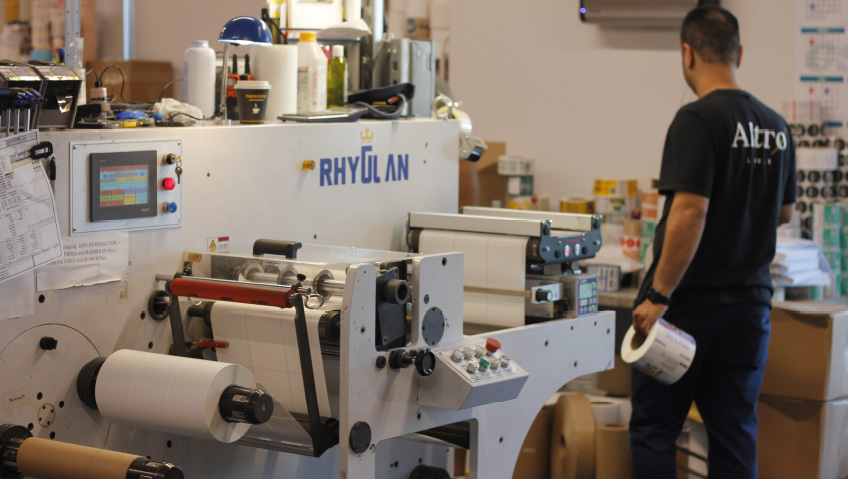
For Altro Industries Inc., building a legacy resides in being an industry leader with heart and strategy. Growing into one of Western Canada’s fastest-growing fabricators and processors in the paper packaging industry in just a few short years, the group evolved from its original footprint in North Vancouver in 2018 into a roaring success in 2026. As an integrated Canadian packaging manufacturer of corrugated sheets, corrugated converting, labels, shrink sleeves, and folding cartons, the company employed only 10 staff in 10,000 square feet in its early days. Since then, its uphill climb has led it to employing a team of 150 and impacting the future of paper packaging in Canada.
As a modern, future-focused operation, Altro comprises three packaging-related companies as part of a single group of family businesses: Altro Labels, CanCorr, and Norlands Box Company. While the company is still relatively young, this works in its advantage as it embraces cutting-edge technologies, making this team faster and more nimble than many of its competitors.
Taking change in its stride, the global economic fluctuations of the past decade have served the group well. As the sudden rise in demand for paper packaging during the e-commerce boom in the pandemic years fueled tremendous growth, it became the company’s most lucrative period to date—one that contributed to long-term fiscal stability.
The team at Altro has always kept a close eye on its market, and with its early years providing sufficient opportunity to thoroughly study the pre-pandemic market, it quickly became clear that what was needed in the local area was corrugated paper packaging products and reliable supply chain processes. Requiring a significant investment, Altro Industries Inc. responded to the market gap with state-of-the-art corrugator equipment, establishing a sheet feeder facility that became CanCorr. CanCorr’s 100,000-square-foot facility was completed in 2022.
The new company went into operation with full velocity, bringing novel offerings to market, which garnered it the loyal following of many smaller companies needing smaller packaging batches. “In six months, we filled up one capacity. Now, we’re sitting at about 80 percent capacity at CanCorr, running in three shifts,” says Baha Naemi, Co-founder and Managing Partner.
But this was just the beginning. Based in Surrey, British Columbia, the Naemi family’s next outfit, Norlands Box Company, followed in quick succession. Complete with an in- and outbound sales team, this company turns CanCorr’s corrugated paper into boxes. It helped the group go from humble beginnings to employing more than 150 team members in a total of 300,000 square feet. In the process, the company’s team has truly become a family.
As a result, Naemi is open about the realities of needing trustworthy people. “The only reason we were able to grow was because of our employees and being able to identify similar-minded people who are looking at growth, especially in a country and in an industry that’s not known to be very aggressively growth-minded,” he says.
Thanks to this future-forward approach, Altro’s integrated team and strategic investments enabled the company to meet the paper packaging market at the right angle at the right time—when many large corporations in the industry lacked service delivery and diversity. In meeting this need, the group also changed the overall landscape of corrugated paper packaging in Canada for the better.
As the country is considered a comparatively small market on a global scale, super-sized North American paper mills traditionally divided the local geography. In the process, their Canadian clientele was roughly divided into East and West North America, requiring large orders to be considered for product and service partnerships with them.
Altro changed all that when it started serving regional box converters and independent Canadian businesses with paper packaging products in smaller quantities to suit their business demands, serving everyone from manufacturers to supermarkets. The success of the approach is evident in its output.
As an operator that runs only full trucks from its facilities, Altro dispatches around 50 containers of paper packaging in a given 24-hour cycle, supporting Canadian businesses all the way. “We utilize local distribution, and we try to use as many Canadian trades and Canadian partners as possible as well as a Canadian supply chain,” Naemi tells us.
While lucrative, this trade is not without its challenges. Paper mills are one of them. As a result of having no paper mill in Western Canada, Altro is pursuing the possibility of investing in such infrastructure once its operations are ready to handle the addition of another facility, either fully or partially.
Beyond the paper mill challenge, however, future markets look promising. With as many as 70 percent of the brands it supplies demanding fully recycled paper packaging, the industry is alive and well—a trend set to continue. Based on the well-managed balance Canada strikes between deforestation and reforestation, Naemi’s forecast is positive.
“Quite honestly, environmentally, [recycled paper packaging] makes more sense than plastics or anything else that they’re coming up with as alternatives to plastics, because wood is not going anywhere,” he confirms. It is this dynamic that made the industry a worthy investment opportunity for the Naemi family in the first place.
Looking at how the industry is unfolding and evolving today, this visionary leader sees artificial intelligence (AI) as a game changer for the corrugated paper packaging industry. His take on the fear of workforce replacement is perhaps best described as pragmatic. “If you’re worried about AI replacing you, then you have to be the one who is a proponent of AI in your own department, no matter what you do,” he says. “What that does is it gives you the knowledge base of what you can do to improve your own scope of activities,” he highlights, advising staff members to turn AI into a tool to enhance their performance rather than replace them. This strategy, he advises, creates an environment wherein a company’s leadership is unable to replace proactive individuals with technology.
As a result, such technologies are employed to improve overall efficiency by streamlining logistics, scheduling, machine learning, and other functions. To fine-tune its approach, the company is partnering with university departments to develop custom algorithms to refine its processes.
Naemi is a big proponent of family businesses—especially around midlife when maturity makes it easier to put things into perspective while improving people’s natural ability to lead. This appears to be a strategy leveraged by many successful businesses. “Not many people know that more than 50 percent of Fortune 500 companies are still family-controlled. And that means there’s huge potential in running a family business,” he says.
Naemi ascribes the success of family businesses to common goals, shared visions, and highly functional leadership processes that stand in stark contrast to those often found in standard corporate environments, where it is not uncommon for members to lose sight of their common goals. For him, running a firm alongside siblings means streamlined, integrated decision-making and better-controlled bottom lines. Both are considered imperative aspects of any successful manufacturing operation.
While the group continues exporting 50 percent of its products to the United States, recent geopolitical shifts have turned local market psychology toward renewed economic expansion. As a result, the corrugated paper industry has also shifted. Altro is proof that recently implemented tariffs have strengthened how Canadians view locally manufactured goods and services, and Naemi reports that this dynamic has brought entrepreneurs together in new ways to develop improved economic outcomes with a long-term vision.
Considering British Columbia and Alberta’s comparatively small economies, these leaders know that simply placing value on numbers is no good if their businesses are to remain in stride with the market. Therefore, the company considers the greater economic climate of its own ecosystem of companies in relation to their abilities and resources. The approach has allowed Altro to develop uncanny agility within its market, adapting at impressive speed to its customers’ needs and demands.
At Altro, the renewed growth mindset of the nation is further reflected and supported by its staff, many of whom are immigrants like its owners, who moved to Canada from Iran nearly three decades ago. Canada’s potential has always been a motivating force behind the family’s and the team’s aspirations to create a better future for all, and this sense of altruism appears to naturally attract employees who share a similar mindset. For that reason, the company supports its people in finding and securing good housing and schools, ensuring that the families connected to it are well established and cared for.
Moreover, team members receive generous incentives for pursuing personal growth and furthering their education. By ensuring that its employees, systems, and facilities perform at optimal efficiency and by removing the complexities and cost of American imports, Altro provides its Canadian partners with stability and predictability alongside top-quality corrugated paper packaging they can count on.
For the same reason, the group considers itself a respectful competitor to legitimate Canadian businesses in the same market. “We are very respectful of genuine businesses that are not owned by private equity firms in the market just making some quick money and passing it on to the next private equity,” Naemi points out. “Any business that is looking at building an actual long-term business in British Columbia, we are very cordial with,” he continues. The reason is simple: many of Altro’s competitors are also its customers, making for a genuinely amicable business environment where healthy competition and mutual support help create a vibrant trade environment.
Proud of what the company has achieved in a market where prices of everything from commodities to real estate are currently inflated, competition is rife, and human resources are sparse, Altro Industries Inc. is a shining example of what is possible when a company commits to long-term success with resilience and watertight economic contingency plans. Now, its strategy for continued success includes further growing its presence in the Western Canadian paper packaging sector to secure its future plans over the next two to three decades.
Maintaining its loyalty to local communities, the company aims to expand its presence, particularly in British Columbia and Alberta, while cultivating its market share in the United States. In the process, it is exploring possibilities in procuring the services of a local paper mill, either as part of its own portfolio or through partnership, as most of the paper pulp produced in Western Canada is still exported. In establishing its own operations, Altro’s goal would be to keep pulp in the country for its own use. As Naemi says, “That will give us assurance that the business can stay for a long time to come.”