Since 1892, Elliott Tool Technologies has built its reputation on a simple premise: giving manufacturers the specialty tools they need, exactly when they need them.
What began with the invention of the tube expander, a tool that helped make the boiler and locomotive industries safer, has grown into a full-scale American manufacturing operation with two facilities, an in-house engineering team, and a product line that now stretches well beyond its original tube tool roots.
That growth has taken Elliott from a single-product tube tool company into a manufacturer with a full catalog of tube installation, cleaning, testing, plug, and removal products, alongside a growing metal finishing division. Its team, based primarily in Dayton, Ohio, still designs and assembles its products in-house, a structure the company credits for its ability to keep pace with a manufacturing market that increasingly wants shorter lead times and more customized solutions.
Vice President of Sales and Marketing, Thomas Wagner, traces the company’s history back to its founding, when the tube expander “revolutionized the boiler and locomotive industry to make it much safer at the time.” That single invention set the tone for a business that, more than a century later, still designs and builds its tools under one roof in Dayton, Ohio.
Elliott’s independence is a relatively recent chapter in its long history. The company was originally owned by Elliott Turbo Machinery in Pennsylvania before a group of local employees purchased the Dayton operation and turned it into its own entity.
Supply Chain Manager, Dawn Luker, says the company became privately owned on December 18, 1996. “That was a game changer because it really allowed us to focus on what we wanted to do,” she says. “We were no longer under that corporate umbrella.” According to Luker, the three original owners used that independence to put new KPIs in place and invest in machines, people, and training, changes that have shaped Elliott’s operations for the better part of three decades.
Today, Elliott employs approximately 100 people across its two locations. The main manufacturing facility in Dayton houses design, manufacturing, supply chain, human resources, and finance functions, while a second facility in Texas City, Texas, supports the Gulf Coast market as a stocking and service location.
Elliott markets itself around the tagline, “Quality specialty tools for an ‘I need it yesterday’ world,” and Wagner says the company’s operations are built to back that up. Elliott runs a full ERP system to help it keep pace with customer demand, and it keeps as much of its supply chain local as possible.
“We are able to keep that local so we can still control 100 percent of our process through the design, build, manufacture, quality checks, and assembly,” Wagner says. “We do all of that right here under one roof here in Dayton. So, response time is typically what we pride ourselves on, being able to be very responsive to the customer as well as meet their challenging delivery demands.”
While Elliott’s tube tool line remains its foundation, its Precision Metal Finishing division represents a newer and fast-growing part of the business. Business Development Manager, Michael Bitsko, explains that Elliott relaunched the division as a wholly owned part of the company in 2024, after previously relying on an outside source to manage that product line.
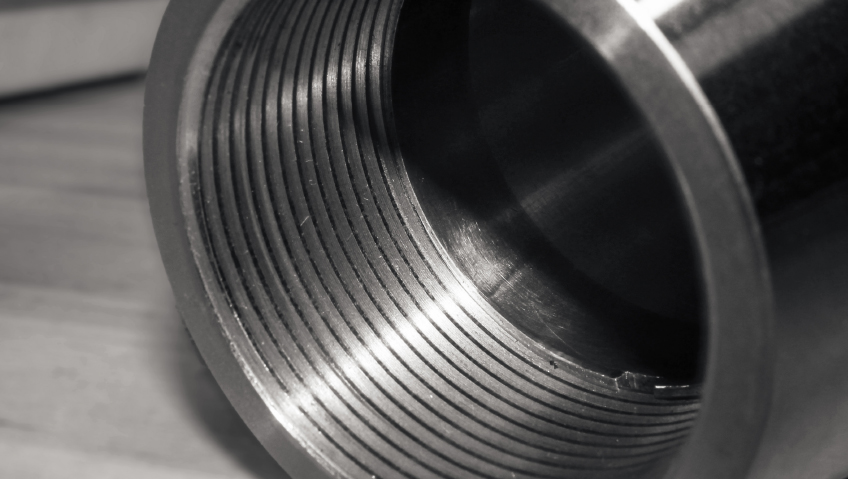
The Precision Metal Finishing line is built around three core product groups: mechanical joining tools for swaging applications; internal recessing unit (IRU) cutters; and burnishing tools. The IRU line is designed to cut down machining time on parts like hydraulic valves.
“There are specific machining requirements for those valves that take a lot of time with conventional tooling,” Bitsko explains. “What this tool does is it creates an application where somebody may spend minutes in doing the machining, where this tool will do it in three to five seconds.” He adds that unlike conventional tooling, which is often discarded after use, Elliott’s cutting tools can be reground and reused multiple times, an efficiency that Bitsko says resonates with higher-volume customers.
Burnishing, meanwhile, gives manufacturers a way to achieve tight surface finishes without slowing down production. Elliott’s burnishing tools are adjustable in tenths of an inch and cover a wide range of hole sizes, from an eighth of an inch up to 18 to 20 inches in diameter. Where conventional cutting tools often force a shop to slow its process down to hit a single-digit surface finish, burnishing turns that multi-minute step into a matter of seconds without sacrificing consistency across a production run.
The IRU line has been part of Elliott’s lineup for some time, but the company has recently put a heavier focus on getting the word out to a market still catching up on what this tool can do. “We’re trying to spread the word in the market that we are innovating against the challenges folks are bringing to us,” says Bitsko.
Wagner describes the internal recessing unit as consolidating what might otherwise be a multi-step process. Where a shop using interpolated milling might need to run the same operation six separate times, Wagner says Elliott’s tooling can complete it in one pass and in a matter of seconds, a distinction the team plans to emphasize heavily on the show floor at IMTS.
The mechanical joining line rounds out the division, using expansion to create secure mechanical joints across a range of applications.
Elliott has historically shown its tube tool products at trade shows, but its upcoming appearance at IMTS marks a shift toward showcasing the Precision Metal Finishing line to a broader manufacturing audience. This event gives the team a chance to build awareness with customers who may not be familiar with Elliott’s specialty tooling.
“The great thing is, you get these face-to-face conversations,” Bitsko says. “You don’t have that ability when you’re talking to somebody on the phone. You’re going to have that time to be able to discuss particular applications, things they maybe haven’t even thought of, in understanding what their processes are and what their applications are.”
That kind of in-person conversation also helps Elliott get past the surface-level questions that tend to dominate phone calls. In the company’s experience, what a customer initially describes as the problem is not always the true source of the issue, and face-to-face time gives the team room to dig deeper. Those extended conversations at trade shows allow Elliott to more accurately match customers, both current and new, with the right tooling for their actual pain points.
Wagner sees the show as an opportunity to grow a division that still operates in the shadow of Elliott’s larger, more established tube tool business. He says Elliott has already delivered measurable savings for customers in industries such as aerospace, defense, hydraulics, and data centers, and that IMTS offers the chance to extend that reach.
“As shops really start to automate, the premium is really shifting to consistency and doing more with less skilled labor,” Wagner says. “That plays directly into a lot of the precision finishing.” He adds that the shift extends to complex valve bodies and precision mechanical joints alike, describing Elliott’s approach as a process rather than a single tool.
Beyond its product lines, the company is also focused on the workforce challenges facing manufacturers more broadly. Manufacturing Manager, Christopher Woosley, says the company has run an internship program for the past three years in partnership with a local career center and has hired two of its interns full-time.
“I would say an apprenticeship or an internship of some sort is key, because if we’re preparing the road for the next generation and there’s nobody behind us to take the torch, well, then we’ve practically wasted our time,” Woosley says. He encourages other manufacturers to build relationships with local trade schools and community colleges, noting that career changers—not just recent graduates—are increasingly drawn to manufacturing as a stable career path.
Elliott’s internship program runs in partnership with the Greene County Career Center, along with connections to at least one local community college. Woosley says the program has given the company a reliable pipeline of new talent while providing students with hands-on exposure to a manufacturing career path many may not have otherwise considered. For a company built on precision and process, that early investment in people is treated as its own form of quality control, ensuring the next generation of machinists and engineers understands Elliott’s standards from the start.
Wagner says Elliott is taking a measured approach to artificial intelligence internally, describing the company’s strategy as “deploying responsible AI.” Rather than adopting new technology for its own sake, the company is evaluating where AI tools could improve response times or quoting accuracy as part of a broader implementation roadmap.
At the same time, Bitsko points to AI as a force reshaping demand for Elliott’s tools from the outside in. The buildout of AI server farms and data center infrastructure is driving new demand for metal finishing and increased surface density on the components that go into them, and Elliott has seen a rise in applications tied specifically to that infrastructure boom.
Bitsko also points to a shift underway in defense manufacturing, where government contracts are pushing companies to automate munitions production that has traditionally relied on manual labor. He says Elliott’s role has expanded from simply supplying a tool to supplying a piece of the automated manufacturing cells used to scale up that production.
Between the AI infrastructure buildout and the push to automate munitions production, Bitsko says Elliott’s Precision Metal Finishing division is being pulled into two of the fastest-moving corners of American manufacturing at once. Both trends, he says, point toward the same underlying shift: customers need tooling that can hold up to higher volumes and tighter tolerances, without adding more manual labor to the process.
For all its growth, Elliott’s leadership team is mindful to frame the company as a problem-solving partner rather than a supplier moving tools off a shelf. Wagner says Elliott wants customers to see it as a manufacturing expert with a dedicated team behind it, one that helps customers dial in their processes for long-term savings and efficiency gains.
Bitsko echoes that sentiment, noting that Elliott’s internal database of specialty, one-off tools built for individual customer applications is larger than its published catalog. He says that gap reflects the core of Elliott’s business model: rather than asking customers to adapt to an off-the-shelf product, Elliott’s engineering team designs a tool around the application a customer brings in. Luker sums up the philosophy simply: Elliott is in the business of solving customers’ problems.
With more than 130 years behind it, a newly relaunched Precision Metal Finishing division, and an upcoming appearance at IMTS, Elliott Tool Technologies is positioning itself for its next chapter of growth while staying true to the responsiveness that has defined it since 1892.