For more than four decades, Codonics has built its reputation on a simple but disciplined principle: technology should solve real-world problems in healthcare.
Founded in 1982 by Owner, President and CEO Peter Botten, the Ohio-based company began with a focus on medical imaging. Over time, however, its trajectory shifted toward an area of care that remains one of the most complex and high-risk environments in modern medicine: the operating room.
Today, Codonics is recognized globally for its leadership in perioperative medication safety. Its systems are used in more than 16,400 operating rooms across over 1,100 hospitals worldwide, supporting hundreds of millions of medication preparations and administrations. This level of adoption reflects not only the scale of the company’s reach, but also the practical relevance of the problems it addresses.
From the outset, Codonics was built on engineering rigor and a commitment to usability. Botten established the company with the belief that healthcare technology must reduce complexity rather than add to it, and that philosophy continues to guide product development today.
“What started in medical imaging evolved as we identified a growing need in patient safety,” the company explains. “That shift comes from listening to anesthesia providers, understanding where medication errors occur, and applying engineering to reduce risk in high-pressure environments.”
This transition into perioperative medication safety marked one of the most significant turning points in the company’s history. While its early work in imaging established a strong technical foundation, the move into medication safety redefined its long-term focus. By concentrating on perioperative workflows, Codonics has positioned itself at the intersection of clinical practice and technology, where small improvements can have meaningful impacts on patient outcomes.
In healthcare, reliability is not negotiable. Hospitals depend on consistent performance in environments where delays or errors can have serious consequences. By keeping production and development aligned, Codonics ensures that its systems meet the expectations of the clinicians who rely on them daily.
Operating from Ohio, Codonics maintains its identity as a U.S. manufacturer with design, engineering, and production closely integrated. This allows for tighter quality control and faster iteration, both of which are essential in the medical technology sector. “Being U.S.-based allows us to maintain control over manufacturing processes, respond quickly to customer needs, and ensure consistency across our systems,” the company says.
This approach also reinforces accountability. When design and manufacturing operate within the same ecosystem, feedback loops are shorter and issues can be addressed more efficiently, and that level of oversight has become increasingly important as the company has expanded.
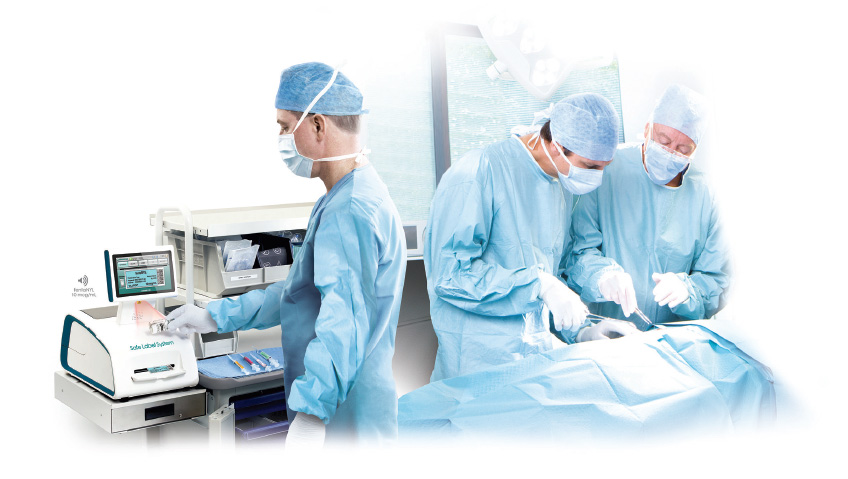
As the team began to work more closely with hospitals, they identified a persistent challenge: medication errors remained common, especially during preparation and labeling. These errors often stemmed from vial swaps or mislabeling, issues that were exacerbated by the fast-paced and variable nature of surgical environments. In response, Codonics developed the Safe Label System, a first-of-its-kind FDA Class II medication safety device designed specifically for anesthesia providers working in the operating room. This system introduced verification, standardization, and traceability into a process that has traditionally relied on manual steps, redefining how medication labeling is performed in the operating room, and became a cornerstone of Codonics’ offering because it addressed medication safety as part of a broader workflow rather than as a standalone task.
During medication preparation with the Safe Label System, providers scan a barcode on the parenteral drug vial or ampoule. The system verifies the medication and concentration against a pharmacy-defined formulary, providing both visual and audible verification, a safety check that acts as a second set of eyes. It then generates a full-color syringe label that complies with Joint Commission standards and includes a machine-readable barcode. That label serves as a critical link throughout the workflow, but the value lies in the verification and workflow support behind it—not the label itself. At the point of administration, the labeled syringe can be scanned again to support documentation within Electronic Health Record (EHR) systems and Anesthesia Information Management Systems (AIMS), including platforms such as Epic and Cerner. This integration improves documentation accuracy while adding another layer of verification during patient care.
“Safe Label System is designed to transform what was once a manual process into a standardized workflow,” Codonics explains. “It helps reduce variability and supports clinicians without disrupting how they work.”
This distinction is central to the company’s philosophy. Rather than replacing clinical judgment, the system provided structured support within existing practices. As a result, it became embedded in daily operations.
Codonics’ growth has largely been driven by this kind of adoption at the clinical level. Instead of relying heavily on traditional marketing, the company has expanded organically as anesthesia providers and health systems recognize the value of integrating safety into their workflows. “Adoption is driven by clinicians looking for a practical way to reduce medication errors without adding complexity,” the company notes. “Once implemented, the system becomes part of the standard workflow.”
This approach has contributed to Codonics’ growth both domestically and internationally. While healthcare systems differ across regions, the underlying challenges of medication safety and workflow efficiency remain consistent, and Codonics aligns its solutions with local standards while maintaining a unified foundation of usability and safety. Its systems are designed in accordance with guidance from organizations such as The Joint Commission (TJC), the Institute for Safe Medication Practices (ISMP), the Anesthesia Patient Safety Foundation (APSF), the American Society of Anesthesiologists (ASA), and the American Society of Health-System Pharmacists (ASHP). This alignment ensures that the technology not only meets regulatory expectations but also reflects best practices in patient care.
And as healthcare technology evolves, so too does Codonics’ engineering approach. Early systems may have been designed as standalone solutions, but modern healthcare environments demand interoperability and integration. “Healthcare technology needs to work within a broader ecosystem,” the company says. “Our focus is on designing systems that support clinicians without adding complexity.”
Of course, feedback from clinicians plays a critical role in this process. The operating room is a dynamic setting where theoretical solutions must perform under real-world conditions, so Codonics works closely with anesthesiologists, pharmacists, and perioperative teams to refine its systems based on direct experience. This ongoing collaboration ensures that its technology remains aligned with clinical needs and reinforces the company’s emphasis on usability, an essential factor in environments where time and clarity are critical.
Over the years, Codonics has received recognition across multiple areas, including patient safety, healthcare innovation, and technology leadership. Most recently, it was named Medication Safety Technology Company of the Year – Perioperative for 2025, a distinction that reflects its continuing focus on improving safety in surgical environments.
“Recognition is meaningful because it reflects the impact of the work being done,” the company says. “But what matters most is that the technology is trusted and used consistently in clinical environments.” Awards bring visibility to the challenges associated with medication safety, but adoption serves as a more meaningful measure of success. When systems become integrated into everyday workflows, they demonstrate their value in a tangible way.
Unfortunately, despite advancements in preparation and administration, medication safety in the operating room remains a complex challenge. Many processes are still manual, and there is often a lack of standardization across different stages of care. One of the most significant gaps exists at the end of the workflow: medication waste and reconciliation. This process is frequently handled separately from preparation and administration, creating gaps that must be reconciled after the fact rather than as part of the workflow, making it difficult to track and verify.
“Waste and reconciliation have historically been inconsistent and difficult to manage, often requiring manual follow-up, delayed documentation, and additional effort from both anesthesia providers and pharmacy teams,” Codonics explains. “This is where we see a major opportunity to improve visibility and accountability.”
To address this challenge, the company developed the Safe Waste System, an FDA-listed, Class I Exempt device designed to operate in conjunction with the Safe Label System. The Safe Waste System’s expected availability is Q4 2026. Using spectrophotometric analysis, the system identifies and measures liquid-controlled substance waste at the point of care. This process allows anesthesia providers to document waste in real time, creating a record that supports reconciliation and compliance. By connecting waste handling with earlier stages of the workflow, the system introduced a level of continuity that had previously been difficult to achieve.
With the addition of the Safe Waste System, Codonics expanded its capabilities into a more comprehensive perioperative medication safety platform. What began as a solution for labeling has evolved into a connected medication safety system that spans preparation, administration, and waste. And while each stage of this process presents potential risks, it also offers opportunities for standardization. By linking these steps together, Codonics has created a more cohesive workflow that supports both safety and efficiency. “This is about connecting steps that were previously disconnected,” the company explains. “It allows healthcare providers to introduce consistency and visibility across the entire process.”
The ability to integrate these stages within a single framework represents a significant advancement in perioperative care, reducing fragmentation while supporting more accurate documentation and improved accountability.
Understandably, collaboration plays a key role in Codonics’ approach. The foundational concept behind the Safe Label System originated from work conducted at Massachusetts General Hospital, where efforts to improve syringe labeling safety began. Codonics built upon this foundation, engineering a scalable system that can be deployed globally.
The company has also partnered with technology providers such as BD (Becton, Dickinson and Company), integrating its systems with platforms like the BD Pyxis Anesthesia Station and Intelliguard’s Mira Care Station (RFID). These integrations streamline workflows and reduce manual steps for clinicians, further embedding Codonics’ solutions within the healthcare environment.
Looking ahead, Codonics sees continued advancements in areas such as radio-frequency identification (RFID), interoperability with EMR systems, and real-time data integration. These technologies have the potential to further enhance visibility and coordination within perioperative workflows. At the same time, the company emphasizes the importance of standardization. While automation can improve efficiency, it must be implemented in a way that supports clinical decision-making rather than replacing it.
“Standardization remains one of the most effective ways to reduce variability and support safety,” Codonics says. “Technology should act as an aid within the workflow.”
As regulatory expectations evolve, the need for accurate documentation and accountability is likely to increase. Codonics continues to align its systems with these developments while maintaining a focus on practicality and usability. At its core, the company is driven by a commitment to improving patient outcomes, and this mission influences not only its product development but also its organizational culture. “There is a strong sense of responsibility across the organization,” the company says. “The systems we develop are used in critical moments of care.”
This perspective reinforces a focus on reliability and continuous improvement. By maintaining a close connection between engineering and clinical practice, Codonics ensures that its solutions remain relevant and effective.
For Codonics, the future of perioperative care lies in viewing medication safety as a connected process rather than a series of isolated tasks. Preparation, administration, and waste and reconciliation are all part of the same continuum, and each stage must be addressed to reduce risk effectively. “Medication safety is not a single step; it is a connected process. Our platform brings those steps together to support clinicians, improve outcomes, and introduce a more consistent and accountable approach to perioperative medication workflows.”
As healthcare systems continue to seek ways to enhance safety and efficiency, this integrated approach offers a clear path forward, one that Codonics is actively helping to define. By combining engineering discipline with clinical insight, Codonics remains focused on delivering solutions that align with the realities of patient care, both today and in the years ahead.