Like white lightning—that is how quickly and efficiently Southland Trailers is changing the world of industrial trailer engineering and construction in North America.
The company’s products are popular for good reason. Inspired by Toyota’s lean manufacturing principles, which eliminate waste to optimize end-user benefit, Southland Trailers’ heavy industrial and livestock trailers run as far afield as Russia, Hawaii, and Australia, with dealers across Canada and the United States.
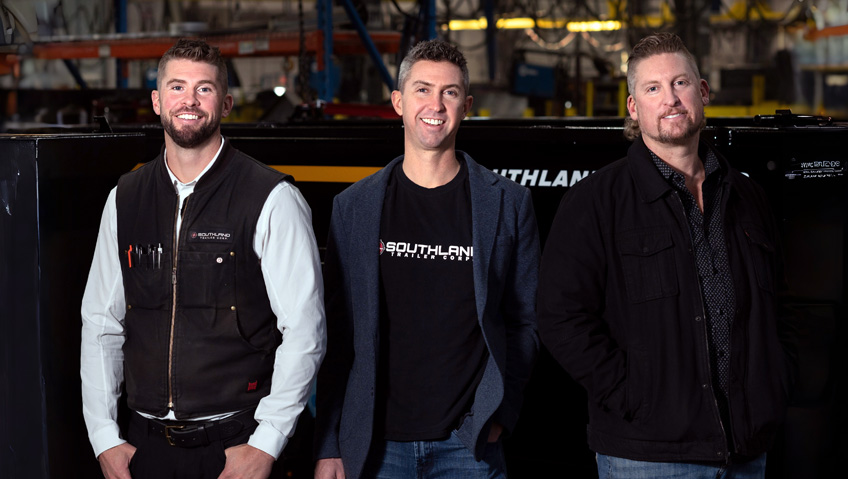
In an industry that is not necessarily known for being on the cutting edge, Southland Trailers is a thought leader known for pushing the limits of trailer engineering. Owners Jason, Ryan, and Scott Sailer are passionate about driving evolution and always being available to their team and customers. Scott Sailer is open about the company’s position on industry evolution. “The understanding of what a trailer is needs to change. We’re trying to change the perception of what a trailer should do,” he says.
What makes Southland’s products so special? The secret to its next-generation trailers is deceptively simple. By recognizing the waste of fuel and steel in outdated traditional trailers on the end-user’s side, the company’s engineering team has modernized its durable, high-performance trailer units in ways that competitors have been unable to match. Southland is therefore actively revolutionizing how people perceive trailers by building products that are significantly lighter than traditional trailers, yet every bit as strong and durable.
If it is not yet clear, Southland Trailers is by no means just another industrial fabricator. The company fulfils its mission with a refreshingly advanced approach to creative freedom, focus, and fun—a rare combination in a tough industry. While minimizing waste and the use of materials in its products, its design ethos relies on built-in strength and durability by maintaining high-level efficiency and non-negotiable quality.
One case in point is its engineered sill design, Southland’s most game-changing feature to date. “We’ve built, I believe, the best dump trailer in the market. We’ve had every competitor basically try to copy it. Most have failed because they didn’t copy it properly and didn’t do things properly,” says Scott Sailer, Director of Operations. And as expected, this next-generation innovation has been selling itself.
“The key is that this one can haul more, and you’re going to make more money with our [trailers]. You’re going to put more money in your pocket because you’re going to be pulling a lighter trailer, which is more fuel-efficient for you,” Sailer says of the efficiencies these trailers provide. And the benefits do not end there. “You’re going to be able to put more product into that trailer because it’s lighter, so you can put more onto the axles,” he adds.
The weight allowance on axles after the trailer weight is subtracted can limit transportation volumes when employing old-fashioned, heavy trailers. That means that Southland allows for larger haulage volumes and better earnings and returns on investment.
The company even takes its paint finishes seriously. In using liquid paint instead of powder coating, as it is easier to maintain and repair, electrostatic paint booths prevent waste by drawing paint directly onto the metal, without the tremendous waste typical of old-fashioned methods. These are just a few of the ways in which Southland Trailers is committed to delivering better quality and value in every way possible.
As the largest employer in Lethbridge, Alberta, Southland’s outstanding professionals have more to do with its success than most may realize. Growing from a team of 70 a decade ago to a team of 600 today is no small feat, and the company is continuing to hire. And, if it is no ordinary fabricator, it is certainly no ordinary workplace, either.
With an ownership team whose acute understanding of creativity allows for all employees to contribute, the company’s approach continues to reap astounding results that have secured its reputation for excellence for the long haul. As such, the team is proud of the millions of dollars it has invested in its local Alberta communities thanks to its success.
It also does its best to be environmentally responsible wherever possible, with sustainability efforts including recycling materials like plastic, cardboard, aluminum, and steel. “I do wish there were better programs within Canada to help recycle cardboard and plastics and better facilities to take it away,” Sailer shares. “There are definitely some roadblocks getting that material taken out of our facility once it’s all banded up, but we’re trying to do our part, that’s for sure.”
The company was founded by Sailer’s parents, Shelly and Monty, in 1980. Their three sons worked their way up from the bottom, changing brakes, working on axles, driving forklifts, and selling trailers. When the time eventually came for the next generation to take the business over, around 2008, the pair were initially concerned about the large changes the siblings started implementing. From improving production flows to changing the building’s layout, it took some serious courage on their part to give the youngsters the space they needed to take the company to the next level. Their patience and trust paid off in a big way.
As business goes, taking the company their parents built over many years to the next level was not without its challenges. But Jason, Ryan, and Scott persevered, growing their leadership skills alongside the company. Today, Southland Trailers has a work environment that is every bit as lively and positive as the Sailer brothers themselves.
They have created a high-energy spirit in their facility, complete with large sound systems and the team’s favourite music setting the pace. Always forward-thinking, the company has proven that a four-day work week can be every bit as beneficial to its bottom line as a five-day work week—if not more so—so its weekly fabrication schedule runs from Monday to Thursday from 6 a.m. to 4:30 p.m., with an occasional Friday as needed to wrap up large projects.
Other incentives abound, including on-site cafeterias and top-end health and wellness benefits. Social gatherings are also common, with people having the option to join the social club. Sometimes families are included, and other times it is just the Southlanders bowling, eating pizza, and having a few beers and laughs together.
This strong sense of camaraderie is what gives the team its strength to build BHAGs (big, hairy, audacious goals, in case you were wondering). Around 2014, the group committed to start working toward expanding its output from 800 to 1000 trailers annually to 25,000 units per year. Now that goal is in sight, with the company rolling out around 15,000 trailers last year.
To ensure that it secures the workforce needed to continue scaling, the company goes out of its way to show youngsters that fabrication is not the dingy, sweaty nightmare it was in the previous century. Beyond working in considerably improved facilities, earnings are high and people are empowered to share their points of view and ideas. The company has seen a tremendously positive response to its efforts. “We just built a weld shop for the high school here in town, and they had over 100 students already sign up to come into the welding program to learn how to weld,” Sailer tells us.
Such students are typically also free to weld at Southland’s facility to get a feel for the job. Because, while technology has allowed the company to scale, it has by no means taken jobs from people. On the contrary. As Sailer puts it, “the robots need to be fed.”
The outcome of this is that Southland employs four new people for every robot it installs—a far cry from the general perception of what happens following the arrival of high-tech resources in fabrication facilities. A decade ago, when its first robots arrived, there was nobody available locally to program them. Creative as ever, its leadership invited all lovers of video games in its ranks to join the programming training. And they did.
Since then, the company has not looked back. Today, it employs around a dozen top-notch robotics technicians as a result of that first initiative. These machines run on Intuitive software, while Aratum is harnessed for enterprise resource planning. And as the team investigates how best to integrate AI, Sailer is clear on the fact that it, too, will not be replacing people. “Is it going to replace everybody and eliminate all these jobs? No, I think it’s going to buckle up right beside them and help them,” he confirms, highlighting that the added support can only further improve efficiency and, ultimately, customer satisfaction.
What is also clear is that this leader adores his team. “Without them, we wouldn’t be able to do anything,” he says, highlighting the sincerity with which each team member is welcomed into the family.
Looking at its immediate future, Sailer is clear on the company’s commitment to maintaining a genuine relationship with every customer. There are certainly no plans of selling out, either. Instead, maintaining vertical integration and steady growth toward its 25,000-unit goal is where its motivation remains for now. In the meantime, its team of around 15 creative engineers continues coming up with product improvements while driving innovation. They lead with autonomy, lateral thinking, and a quintessentially free approach to hatching Southland Trailers’ next great industry disruptor.