Simple observations often inspire the greatest inventions. While breaking off a segment from a Hershey chocolate bar, Yoshio Okada thought of glass breaking and revealing a sharp piece, which immediately led to a revolutionary idea: what if you could snap a steel blade so that when you break off a used segment, you reveal a fresh new edge? Thus was the inspiration that led Okada to create the legendary OLFA knife.
This year, OLFA North America Inc. proudly celebrates “70 Years of SNAP.” Since introducing the world’s first snap-off blade knife in 1956, OLFA has changed the way people cut, create, and work. “This year marks seven decades of innovation, precision, and creativity,” says Carl R. Cottrell II, Vice President of Sales and Marketing. “It was a game-changer then, and it’s still the foundation of OLFA’s innovation today.”
Today, OLFA North America continues founder Okada’s legacy of innovation. At trade events, the company is swapping traditional swag for custom sweets and cookies featuring a light-hearted ‘70 Years of SNAP’ logo. “You’ll see the anniversary highlighted across digital campaigns, printed materials, and updated in-store merchandising,” says Cottrell. “It’s a celebration of the people who use OLFA tools every day and a reminder that great ideas, even simple ones, can have a lasting impact.”
Knives for every need
In the years since Okada’s original snap-off blade knife, OLFA has continually refined this original design and introduced unique new items. This company doesn’t think in terms of just “one product, one SKU,” says Cottrell. “We think of how customers buy and use our products.”
The 18mm snap-off blade, for example, is the same core product but is offered in 5, 10, 50, and 100-pack sizes to meet different needs, from DIY to industrial use. “When you count every unique UPC—the way our customers actually purchase—OLFA easily has over 350 products in the market.” The company’s extensive catalogue includes blades, utility knives, cutting mats, scissors, rotary cutters, rulers, art knives, semi-automatic and fully automatic knives, and more.
OLFA’s legacy product is its 18mm Ratchet Lock Utility Knife (L-1). One of the company’s classics, it has been a trusted staple on job sites and in toolboxes for decades. Built with a durable ratchet-lock mechanism and heavy-duty snap-off blade, the L-1 delivers consistent performance day after day. With an ergonomic design and reliable construction, it remains a favorite of professionals and DIYers alike and is the foundation of OLFA’s reputation for quality cutting tools. “What started as a workhorse utility knife became the go to example of Japanese engineering meeting everyday utility needs,” says Cottrell.
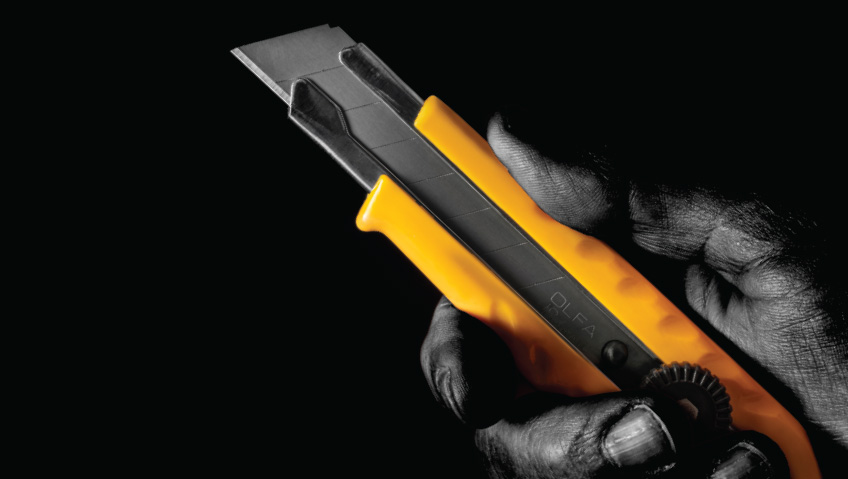
The OLFA 18mm Fiberglass Utility Knife (LA-X) represents the company’s ongoing evolution in performance and ergonomics. With its fiberglass-reinforced body, anti-slip wraparound grip, and auto-lock blade slider, the LA-X knife brings precision, comfort, and durability together in one tool, making it ideal for heavy-duty applications. The multi-pick feature also adds versatility for scraping, prying, and other job site tasks. “This knife is emerging as a core growth driver because it blends classic reliability with modern enhancements that resonate across construction, industrial, and retail usage,” says Cottrell.
Innovation at OLFA isn’t just about performance; it’s also about safety and efficiency, exemplified by the OLFA Quick Change Concealed-Blade Safety Knife (SK-16). Designed with a concealed, quick change blade system, the SK-16 protects users while reducing waste. With a wider cutting channel and a premium stainless-steel blade, it can handle thicker materials such as double-wall cartons, carpet, and strapping with minimal resistance while reducing the risk of accidental contact. With proven cutting longevity (making up to seven times the cuts as many competitors), this model showcases OLFA’s leadership in safety tool design and professional oriented innovation.
Growing the brand
Despite the challenges of the COVID-19 pandemic, OLFA globally strengthened its brand by launching two new North American subsidiaries in 2020. This was when no one could travel because of lockdowns. “We couldn’t go anywhere,” comments Cottrell, “and we were working via video conference as this small team that we built here in North America. It was about 18 months before we could all sit down together.”
Coming out of the pandemic, OLFA Corporation’s President and CEO, Shinichi Okada, flew the entire North American team to Japan for four days. “It was absolutely amazing,” adds Cottrell. “Bringing the entire OLFA North American team together with the OLFA Corporation team in Japan was a meaningful milestone—one I believe everyone involved will remember.”
At the time, Okada said, “OLFA has established the two new companies to better grasp the needs of the ever-changing market in North America and to develop additional new products. These companies will strengthen the sales and marketing reach of the OLFA brand in North America.” The move makes OLFA more locally responsive while staying true to its core of innovation and precision.
Responding to the market
Much more than just a maker of snap-off blade knives, OLFA realizes cutting needs aren’t the same everywhere. Applications common in one region may be rare in another, and requirements like workplace safety and accident prevention can vary widely across markets.
“By investing in a dedicated North American presence, OLFA has been able to better understand these regional differences and respond with more targeted solutions,” says Cottrell. “This closer connection to the market has accelerated product development, allowing OLFA to design tools that meet specific customer needs—whether that’s enhanced safety features for industrial environments or precision-driven solutions for specialized applications,” he explains.
“At the same time, it has strengthened collaboration between North America and global headquarters, creating a more agile and informed innovation pipeline. The result is a stronger, more unified global brand, one that combines Japanese engineering heritage with localized evolution.”
Today, OLFA makes products for professionals and crafters alike which are safe, effective, and durable.
A world first
In 1979, OLFA introduced the world’s first rotary cutter. For years, seamstresses, tailors, and hobbyists alike complained that when they cut delicate fabrics with scissors, the material would typically fray. To address this issue, OLFA created a revolutionary rolling razor blade, much like an extremely sharp pizza cutter. To go with the rotary cutter, the company developed mats to make the cutting easier and safer.
“Originally designed to make sewing easier, these products actually changed the entire world of quilt making,” Cottrell shares. Thanks to OLFA, quilts that previously took tediously long to cut out could now be created quickly and simply with a rotary knife. “And so, we have this entire section of our business that stems from the innovation of the rotary cutter, which OLFA invented. If all we did was snap blades, we would be essentially half the company we are today.”
Almost 30 years ago, the company was focused far more on its construction customers than on quilters. But soon after starting at OLFA, Cottrell was given free rein to explore the market. A single man in his twenties at the time, he signed up for a senior citizens’ quilting class for beginners. All these years later, he remembers cutting multiple layers with an old ‘stack and whack’ method, and others in the class making T-shirt quilts and quilts for babies. He learned the importance of safety and of putting the protective cover back on knife blades. Fellow students were concerned that their cats would jump on tables and cut themselves, or about holding the knives with arthritis-challenged fingers.
Back then, rotary cutters weren’t ergonomically designed—there were no safety features, and many older users struggled to change sharp blades. Cottrell’s older fellow students frequently asked him to swap out blades for them, an occurrence that resonated with him.
Sharing this information with OLFA’s new product development team led to the development of a deluxe curved rotary cutter with a squeeze handle that required little pressure to open and close the blade—essentially a safety feature for fingers. The company also added a safety lock, so users had no worries about the blade opening in their purse or bag.
“That product is the number one selling rotary cutter today,” he says. “It does the same thing as the original, but the handle is equipped to address the needs of the person who’s quilting today.”
To this day, new product development is integral to OLFA’s success.
Safety becomes official
What was learned from the rotary cutter episode also generated an entire category of self-retracting safety knives wherein, once a cut is made, a spring returns the blade to the safety housing on its own. This has also influenced standards for knives—and the creation of standards for cutting mats—set by the International Safety Equipment Association (ISEA) and North American Services Inc. (NASI).
“In 1997, the term ‘safety knife’ didn’t exist,” Cottrell explains. “Now, we have products that we’re selling into an entire industry so people can cut things in production lines, factories, and distribution centres with products designed to mitigate accidents.”
For OLFA, the safety knife industry is entering an exciting new era. For the first time, the ISEA is developing an official standard for safety knives, a project bringing competitors together to set clear guidelines for the entire industry. Once approved by ANSI, this standard will help safety managers evaluate and select tools that truly protect workers while maintaining productivity.
The initiative, says Cottrell, reflects a growing recognition that different jobs—from breaking down heavy corrugate to slicing film or plastics—require the right tool for the task. “As chair of the committee guiding this effort, I’ve seen firsthand how collaboration across the industry is creating a more consistent, safer approach to cutting tools,” he says. “This standard promises to give companies the guidance they need to equip their teams safely and effectively, marking a big step forward for U.S. workplace safety.”
In the 29 years he’s been with OLFA, Cottrell has seen firsthand what sets the company apart from the competition. In a world of mergers, acquisitions, and shifting directions driven by private equity, OLFA remains a family-owned Japanese company grounded in the same principles that inspired its founding.
“Under the leadership of Shinichi Okada, the founder’s son, OLFA continues to honor its legacy of precision, innovation, safety, and consistency while embracing the opportunities of a global, modern marketplace,” says Cottrell. “Our message is clear: OLFA is ready for tomorrow. We’re investing in innovation, safety, and solutions-driven products that meet the needs of today’s customers, while never losing sight of the quality and reliability that have defined the brand for over 70 years.”