As artificial intelligence reshapes the global economy, the race to build the infrastructure that supports it has brought about one of the construction industry’s most urgent challenges. Data centers capable of supporting high-density AI workloads are in extraordinary demand—but building them quickly enough has proven difficult.
For LIVIO Building Systems, the answer lies in rethinking how these facilities are delivered. Through its LIVIO AI Data Center Factory (LAIF) platform, the company has positioned itself at the vanguard of rapid AI infrastructure deployment, enabling developers to transform land and power into operational AI compute capacity in a fraction of the time traditionally required.
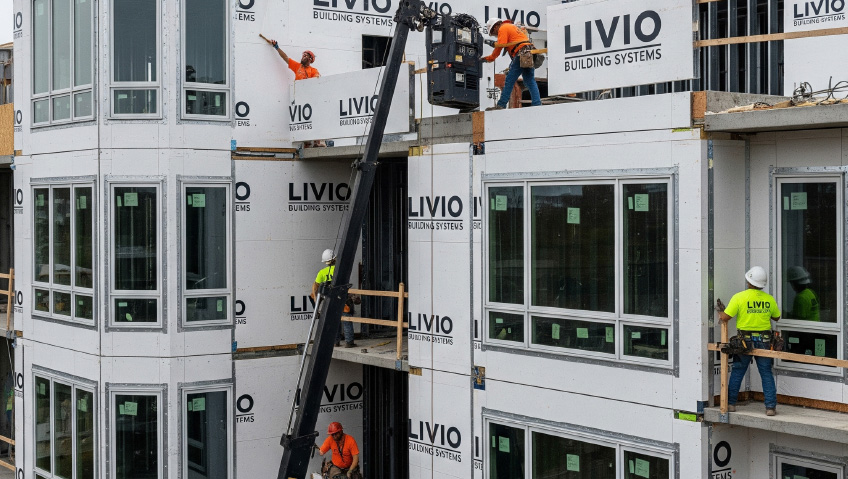
At its core, LAIF is a pre-engineered, multi-trade panelized building system designed specifically for AI data centers. The approach combines LIVIO’s modular wall and roof panels with integrated electrical and plumbing infrastructure, allowing structures to be assembled on site with remarkable speed. The system is designed to support scalable modules ranging from 20 megawatts to more than a gigawatt of capacity, accommodating the massive computing loads required by modern AI systems.
In practical terms, the LAIF approach condenses what would typically be a multi-year development cycle into mere months. Using standardized components shipped directly to the project site and assembled in a LEGO® brick-like manner, the building shell can be delivered in roughly 45 days, with hardware and rack installation following shortly thereafter. A complete AI data center can be converted from “land to compute” in as little as 99 days.
Engineering the next generation of AI infrastructure
The concept builds on LIVIO’s established panelized construction system, which has been evolving rapidly in recent years. In fact, since the company was last featured in Construction in Focus in 2024, two new generations of its building system have been introduced.
Generation 2.0 enhanced LIVIO’s original panelized platform by integrating structural sheathing into wall assemblies and incorporating plumbing and electrical infrastructure directly into the panels themselves. Founder and CEO Navneet Aron says the upgrade dramatically increased the completeness of the company’s off-site manufactured components.
Shortly afterward, Generation 3.0 launched as a fully closed-wall system designed to arrive on site essentially ready for finishing. With the interior surfaces prepared for painting and exterior surfaces ready to accept dry cladding systems, customers can move almost immediately from installation into the finishing phase.
These improvements laid the groundwork for LAIF, which adapts the same manufacturing philosophy specifically for high-performance AI data center environments.
“AI infrastructure is one of the fastest-growing construction segments in the world,” Aron explains. “The challenge is that traditional construction timelines simply cannot keep up with the demand for compute capacity.”
Solving the bottleneck
The surge in generative AI and large-scale machine learning has triggered unprecedented investment in digital infrastructure. Hyperscale technology companies and specialized developers are pouring hundreds of billions of dollars into new facilities, yet the pace of construction remains a major constraint. For many developers, the building itself—not the chips or cooling systems—has become the biggest bottleneck.
This is precisely where LAIF can make an impact. By fabricating building components off-site and assembling them quickly on location, LIVIO’s system dramatically reduces the labor requirements and construction time typically associated with large-scale data centers.
In one recent project in Ohio, LIVIO and its partners demonstrated the potential of this approach, delivering a fully operational AI data center facility within weeks of the project’s initiation. The speed and efficiency of that deployment led the developer to commit to using LIVIO systems across its broader project portfolio.
The LAIF platform also incorporates design features tailored to AI workloads, including compatibility with high-density racks, advanced cooling systems, and integrated infrastructure for power distribution and monitoring.
A platform built for global scale
While AI infrastructure has become the company’s most prominent offering, LIVIO’s building systems continue to serve a diverse range of applications, from residential and commercial developments to specialized structures with enhanced security features. Still, the explosive growth of AI computing is shaping the company’s global strategy. In recent months, LIVIO has seen strong demand not only across the United States but also from developers in the Middle East and other emerging markets eager to build new infrastructure quickly. Saudi Arabia has been one of the first regions where the company has engaged with major development groups, while opportunities are also emerging in parts of Africa and Asia.
As word spreads about the efficiency of its systems, Aron says developers are increasingly drawn to the company’s combination of precision, speed, and cost control.
“A developer anywhere in the world wants the same thing,” he says. “They want to build accurately, quickly, and predictably. Our system makes that possible.”
Reimagining how the world builds
Beyond speed, the company’s technology addresses several structural challenges facing the construction sector. Labor shortages continue to affect markets worldwide, while traditional building methods often struggle with delays, cost overruns, and inconsistent quality. LIVIO’s panelized system reduces on-site labor requirements by as much as 80 to 90 percent while delivering construction accuracy within one-eighth of an inch, Aron says.
“Our mission has been to reduce reliance on a highly skilled labor force on the job site,” he explains. “If we can simplify the process and make it more predictable, we can fundamentally improve how buildings are delivered.”
To help achieve that goal, LIVIO systems are designed to be intuitive to assemble, with clearly labeled components and step-by-step installation guidance.
The road ahead
As the global AI infrastructure boom accelerates, LIVIO expects its LAIF platform to become an increasingly central part of its business. The company is already preparing future generations of its building system, which will introduce additional pre-installed elements such as roofing assemblies, interior doors, and expanded finishing options.
The ultimate goal is to push the boundaries of how quickly complete structures—particularly complex facilities like AI data centers—can be delivered.
“We will continue to deliver to our current customers and expand our markets here nationally and globally,” Aron says. “AI infrastructure is only going to grow, and we believe our technology will play a major role in enabling that growth.”