
Sunnen Products Company, a leading manufacturer of honing equipment and associated products, passed the century mark last year. It was an extraordinary achievement for a business with very humble origins that today boasts an international presence, top-of-the-line honing machinery, and a commitment to comprehensive customer support.
“Sunnen has been in business for 100 years, and I think the reason for that is our consistent quality,” states Business Development Manager, Dan Conner. “A lot of it is also the technical support we provide with our products; I think that really makes a difference as far as buying from us. We are always trying to improve our products to ensure the quality is there,” he continues. “Our products will last. We have a lot of customers that have been using their particular machines for 30 to 40 years, and they’re still using those machines today.”
Based in St. Louis, Missouri, the company (pronounced “Son-in”) makes honing, lapping, deep hole drilling, skiving, and roller burnishing machines. Honing is an ultra-precision bore machining process prized by quality-minded manufacturers and job shoppers when making high-end components. Used to finish and polish bores, tighten tolerances, and remove stock, honing is central to Sunnen’s mission. “We have always just tried to focus on the honing market. I think a lot of other companies try to diversify and go into other products,” Conner notes.
By emphasizing honing above all, Sunnen has been able to perfect its craft and “meet tolerances on specifications that were once very unrealistic as far as machining went,” he adds.
The company offers a full lineup of horizontal, vertical, single-stroke, and tube-honing machines, plus machine automation solutions. Training, tooling, repairs, abrasives, gages, oils, and coolant are also available. Sunnen’s main sectors served include automotive, medical, firearms and defense, aerospace, energy, general machining/job shops, and diesel engines.
Sunnen maintains an advanced technology center which houses current and legacy machines as well as other equipment, while technicians in the center perform in-house testing and application work for customers who send in parts. Staff can also offer demonstrations and provide in-house training for clients or take calls from concerned customers to walk them through various issues.
“Maybe you’re trying a different material, and you need a recommendation for different abrasives—you can call in,” says Conner. “We have someone on that line every day, five days a week, and they can help you with your application.”
Alternately, Sunnen technicians can travel to a customer’s worksite to assist with machine installations, provide training, or sort out application woes. Such thorough client support is vital, as “honing is a little more specific, a bit more of a unique process,” compared with other types of machining, he adds.
While manufacturing operations are centered in St. Louis and Mexico, the company is able to tap into a global talent pool for technical and engineering support on complex projects, he adds.
Having an international subsidiary network was not likely on Joe Sunnen’s mind back in 1924 when he founded the company that bears his name. In his early 20s at the time, Joe had invented and patented a valve lifter tool but lacked the funds to set up a brick-and-mortar site to make and sell the product. So, he drove around the St. Louis area and sold the product directly at job shops and garages. Clients were impressed, and eventually, a permanent location was established. Joe developed other products, including a manual cylinder hone in 1928, as growth continued apace. The company started exporting products to Canada in the 1930s, then into Scandinavia. Sunnen switched to wartime production during World War II and later returned to making civilian goods in peacetime.
The company has continued to broaden its horizons, establishing branches in China and the UK in 1994, then Switzerland, Poland, and Italy shortly thereafter. Other new branches included Brazil in 2013 and India in 2014. As Sunnen expanded its reach, it also explored new, honing-adjacent markets, and began selling machines for deep hole drilling and skiving/roller burnishing in 2016. Growth in recent years has been driven in large part by the company’s commitment to “get into more difficult applications… including tight tolerances down to a millionth of an inch.”
Today, the company has branches in 15 countries throughout Asia, North and South America, and Europe, with 316 employees in the United States and 670 in total around the world.
When it comes to new hires, Sunnen looks for “a committed, dedicated employee, first and foremost—an employee who is willing to learn, willing to grow. Sunnen, like a lot of other companies, provides in-house training because it’s hard to find people with a machining background who have the specific technical background needed,” Conner explains. “We try to bring in the right employees with the right attitude and the right work ethic and then teach them the machining part of what we need.”
After almost a century as a family-run business, Sunnen was sold to private equity firm, P4G Capital Management, on December 1, 2023. Conner says that the company remains committed to quality and innovation, and to this end, there has been a big push to increase throughput and productivity. Sunnen is also striving to achieve AS9100 certification. Achieving the aerospace standard is a grueling process involving performance benchmarks, audits, and a constant focus on quality. The company currently does a brisk business with aircraft OEM suppliers, and this segment will likely expand further upon certification.
As for its own supply chain, Sunnen aims to use companies located near its home base in Missouri. Tariffs have caused some headaches with pricing and sourcing, leading the team to investigate alternative vendors in some cases, Conner explains.
Over the decades, the company has received industry kudos for its work, earning multiple Army-Navy Production Awards during World War II in recognition of the quality and quantity of its output. When it was revived by President Kennedy in the early 1960s to salute exporters, this honor was rebranded as the E Award, as in E for excellence. Sunnen received an E Award in 1964, and then an E Star Award 22 years later, a category that honors E Award winners who increase their exports. On May 17, 2024, Sunnen garnered a second E Star Award at a Washington D.C. ceremony hosted by the United States Department of Commerce. It was among only 13 companies to receive this honor at the event.
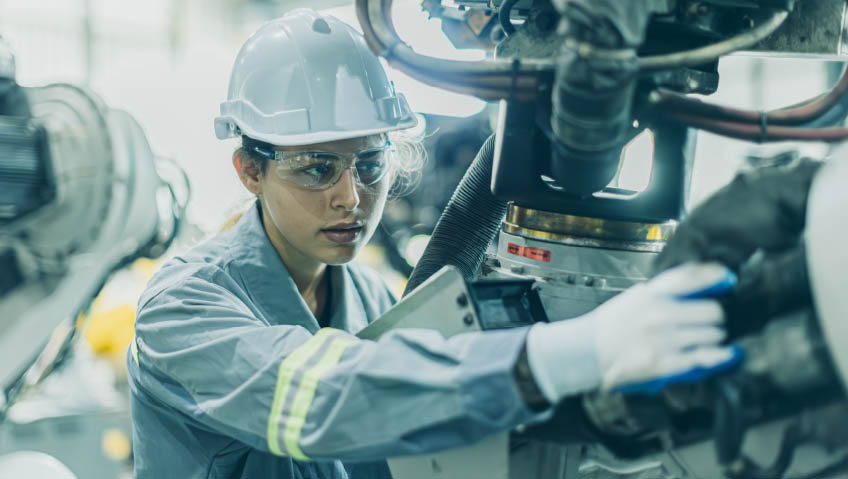
While delighted by these awards, Sunnen staff members remain grounded and alert to day-to-day concerns about workplace safety. A safety manager ensures that machines and processes in the manufacturing facilities are hazard-free and that shop employees wear appropriate personal protection equipment including steel-toed boots, safety glasses, and hearing protection when required. The human resources department works alongside the safety manager, assisting with documentation and liaising with employees who want to report safety issues. “There are a lot of checks and balances to make sure everything is not only compliant, but that people who are advocating for safety around here are heard and that any changes get made,” says Conner.
In terms of promotion, the company has a social media presence and participates in several trade shows each year, demonstrating its machinery and machining processes. That said, “Sunnen has been around for 100 years,” and “doesn’t need a lot of brand recognition help,” notes Conner. The company does face its share of challenges, such as the struggle to recruit new talent and retain existing staff. Across the manufacturing sector, many veteran employees are approaching retirement age, and insufficient numbers of young people are stepping up to replace them. The human resources department is “working on the culture here to attract younger people and attract people who want to stay in manufacturing for the long haul.” Among other things, Sunnen is aiming to improve communication between departments to ensure that no employee feels left out.
While it might be a centenarian, Sunnen remains a forward-thinking company. The team is investigating the opportunities presented by artificial intelligence (AI), for example, which might be helpful in simplifying business practices or augmenting engineering services. That said, “We don’t want to just throw in AI for no reason. It has to be something that our customers really want, something that makes their life easier or makes the machining process easier for them.”
As for the future, Conner says, “I think we’re at the place where we’re assessing opportunities. That will guide us over the next five years.”