When Joe Bliss left his job at heavy-duty truck brake manufacturer Bendix in 1988, he had two things: an engineering degree and an entrepreneurial streak that would not let him work for anyone else.
He started an O-ring distribution business with his brother, and when a customer asked about gaskets, he did what engineers do: he figured it out. He bought die-cutting equipment and began making them. The manufacturing business took hold, Joe bought out his brother, and the distribution side faded away. What remained was the foundation for what is now JBC Technologies: a precision die-cutting and flexible materials converting company headquartered in North Ridgeville, Ohio.
More than three decades later, JBC Technologies has grown into a multi-facility operation with 185 employees, 16 degreed engineers on staff, and a client base spanning medical, aerospace and defense, battery energy storage, automotive, HVAC, and appliance markets.
Todd Wright, the company’s Chief Executive Officer, joined JBC after the founder partnered with a private equity firm in 2020. Joe Bliss remains an investor and sits on the board, but Wright now leads the business, and he leads it with the same problem-solving ethos that built it.
“Joe is very passionate about solving problems and overcoming challenges,” Wright says. “He really sought out customers and companies that had a need for something to be solved and then went to work to solve that. If that involved additional equipment, Joe went out and bought that equipment. If it involved different types of materials, he went out and learned about the materials.”
That founding mindset, what Wright calls an “engineered solutions” philosophy, has shaped everything about JBC Technologies, from its staffing model to its market strategy. 16 degreed engineers is a remarkable figure for a company of its size, and Wright is candid about its significance: competitors, even larger ones, rarely carry that kind of engineering depth in-house. But for JBC, it is not a point of pride so much as a competitive prerequisite.
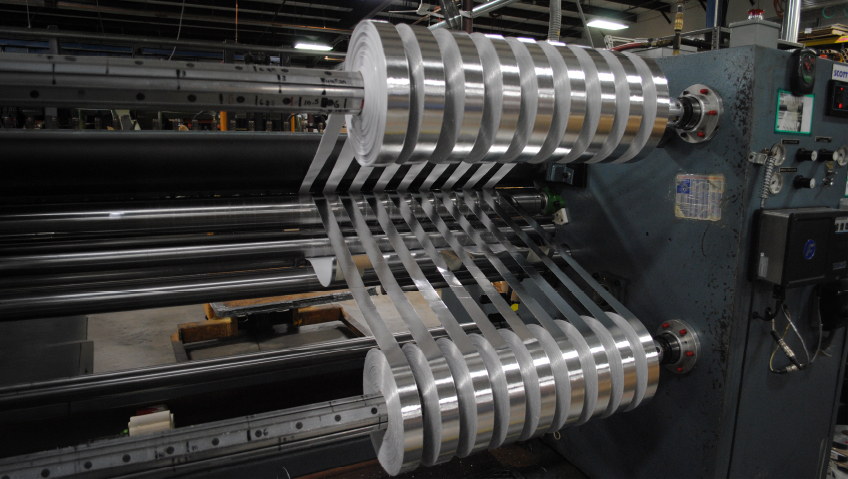
To understand what JBC Technologies does, it helps to understand what flexible material converting involves. At its most basic, converting means taking raw flexible materials, foams, films, adhesives, and non-wovens and cutting them into precise shapes for use in manufactured products. A simple product might involve laminating an adhesive to a foam to create an adhesive-backed gasket. Most converters can handle that.
Where JBC Technologies distinguishes itself is in complexity. When customers need multiple substrates brought together in intricate geometries, or when they need parts delivered in a format compatible with automated assembly on their own production line, the technical bar rises sharply and that is where JBC’s engineering staff excels.
Wright points to a standing program for a major medical customer as a clear illustration of the company’s capabilities. The customer required fetal heart monitoring pads built from a five-layer stack-up of materials in complex geometries. Previously, five separate parts were assembled manually, a slow, labor-intensive process with inherent quality variability. The customer came to JBC to see whether the entire assembly could be accomplished in a single press pass. Other converters had attempted it, but none had succeeded.
“We went through our normal engineering design process and were able to solve the issue and get them a completely fully automated solution,” Wright says. “We supply, and have for the last several years, about 50,000 of those parts a week. We visually inspect those parts, which is rather unique in our industry. We are able to provide them with a complex part for their automation with 100 percent inspected parts so that they have zero defects and have for the last three years.”
That combination of engineering-led problem-solving, high-volume production, and 100 percent visual inspection is the kind of outcome that builds long-term partnerships. Wright frames the company’s ideal customer relationship not as a supplier arrangement but as an extension of the customer’s own design team—involved early, contributing to design for manufacturability, and managing inventory solutions in tandem.
JBC Technologies operates across three facilities. Its headquarters sits just west of Cleveland in North Ridgeville, Ohio. A second facility in Denver, Colorado came through an acquisition in December 2021. A third location in Madison, Wisconsin serves the upper Midwest customer base. All three facilities carry ISO 9001 certification, providing customers with a consistent quality baseline across the network regardless of which location is producing their parts. The company previously maintained a smaller site in Elk Grove, Illinois, but rapid growth in its medical business caused it to outgrow that footprint, and it was consolidated into the Ohio and Denver facilities, with the Ohio site gaining expanded clean room space in the process.
That clean room expansion reflects a deliberate strategic shift. Over the last three to four years, JBC Technologies has moved away from the industry-agnostic, broadly diversified model of its founding era toward what Wright describes as a focus on three “premium markets”: medical, aerospace and defense, and battery energy storage. Legacy business in HVAC, automotive, and appliance continues to grow, but the company’s front-end commercial energy is concentrated on those three segments.
The reasoning is straightforward; in each of the three premium markets, engineered solutions carry genuine value, agile product development is expected, and the competitive field of converters capable of meeting those demands is thin.
Medical is the most heavily regulated of the three, and JBC Technologies holds ISO 13485 certification, is FDA registered, and operates multiple ISO Class 8 clean rooms across its facilities. The combination allows the company to supply fully certified medical components to customers across the sector, from wearable diagnostic devices to wound care and IV dressings.
Within the aerospace and defense category, it is the emerging commercial space market, satellites and rockets specifically, where Wright sees the most compelling growth trajectory. JBC Technologies has built a significant position in this segment over the last three to four years, and Wright says the company is now the market leader in flexible materials and converted products for satellite components.
What makes the new space market distinctive is not just the technical complexity of the materials involved, but the pace at which customers need to move. Satellite and rocket programs run on launch schedules, and those schedules do not flex for supply chain delays.
“Lead times really are measured in days instead of weeks or months,” Wright says. “We will get a request for a new part today, and the customer very likely will need us to deliver that in the next week or two to be able to meet their launch schedule. That is something that not everyone is equipped to handle.”
Meeting this challenge requires an inventory strategy built for speed, a broad equipment base with available capacity, and an organizational culture wired for rapid response. JBC Technologies has spent the last two to three years restructuring its operations with that responsiveness as the design brief. Wright is clear that technical knowledge of the exotic materials used in space applications, while important and growing, is secondary to that capability: without the agility, the expertise alone would not be enough to win or retain business in this segment.
Organizations that thrive in high-pressure, high-complexity environments tend to share certain cultural traits. At JBC Technologies, two of the company’s core values, “don’t ever quit” and “multifaceted” reflect exactly the demands its premium markets place on the business and the people who run it. “Around here, people understand that they are going to be asked to do many different things throughout the day and throughout the week, some that are directly related to their job description and probably many that are not, in order to meet the customer’s needs and timing,” Wright shares.
That culture flows directly from JBC’s founder. Joe Bliss built the business by refusing to treat a challenge as a reason to walk away, and that disposition has been institutionalized across 185 employees in three states. Wright sees it as inseparable from the company’s commercial success: in the medical and new space segments, a supplier that hesitates or hits its limits is quickly replaced by one that does not.
JBC Technologies is also investing in capabilities that extend its value further into the customer’s own production process. The company uses robotics to automate assembly steps, applying plastic components to die-cut adhesive parts, for example, on behalf of customers, handling work that would otherwise occur on the customer’s own floor. Engineers visit customer facilities, observe how parts are used in the assembly process, and return with proposals for how JBC can absorb additional steps and deliver a more complete, ready-to-assemble component.
“When we really can bring value and where our customers really can see the worth in what we’re doing, is when we have those deep partnerships, where we are working together to ensure that both sides are more efficient,” Wright explains.
Today, JBC Technologies occupies a specific and defensible position in the flexible materials converting market. The company is large enough to sustain significant engineering depth, run high-volume automated programs, and operate across multiple certified facilities. It is focused enough on three premium markets with outsized needs for engineered solutions to develop genuine expertise rather than spread capabilities too thin. Indeed, the company Joe Bliss started with a set of O-rings and a desire to work for himself has become a specialist manufacturer at the leading edge of medical device components, satellite supply chains, and emerging energy storage technology.
Wright and his team are betting that the characteristics that made JBC attractive to its earliest customers—engineering rigor and a willingness to take on problems others have given up on—are precisely what its next chapter of growth demands.