
There was a time when sustainability in manufacturing was considered on the leading edge of trends, but no longer. Now sustainability has become table stakes when people think of the products they ultimately buy and the brands they put their trust in. According to Forrester, a leading global researcher, 38 percent of U.S. adults say buying from brands that embrace sustainable products and practices has become more important to them than ever before.
Indeed, eco-conscious consumers are a growing segment that manufacturers ignore at their peril. But there is a lot of good news in this realm as myriad sustainability options have become available for manufacturers to incorporate.
One of the key principles in sustainable manufacturing is the circular economy; once a product reaches the end of its life, it is either harvested for all its reusable materials or refurbished to provide it with a new product lifecycle. In industry, this can be supported through systems such as tagging products like batteries and electronics and thus tracking a product’s origin and level of recyclability.
For example, Assembly Magazine recently looked at how the automotive industry is finding new ways to take a circular approach through the supply chain of a car. This is especially important when you consider that the average car has about 40,000 parts. That equates to a lot of OEMs contributing to the manufacturing process. To better manage these parts, European automotive manufacturers created Catena-X, which is a data ecosystem for the automotive industry, connecting companies along the supply chain including names like BMW, Denso, Ford, Renault, Volkswagen, and Volvo.
“Catena-X is not just a technology—it’s a paradigm shift for our industry,” Kevin Piotrowski, Chief Transformational Officer of the Automotive Industry Action Group (AIAG), told Assembly. “We’re enabling OEMs and suppliers of all sizes to achieve unprecedented transparency and visibility—while retaining full control over their data.”
This approach is creating a measurable business impact through enhanced supply chain visibility, accelerated compliance, and improved quality management, all without requiring companies to overhaul their existing systems or partnerships.
Through Catena-X, the industry can address challenges like a product’s carbon footprint, tracking CO₂ across suppliers and products while letting companies retain full control over their data. This all leads to faster root-cause analysis, responsive supply chain management, and the ability to anticipate and prevent problems.
Approaches to how things are ultimately put together is also changing with the greener push toward modular production. That means less glue and more compatible parts that make it easier to swap them out and ultimately recover materials once a product reaches its end of life.
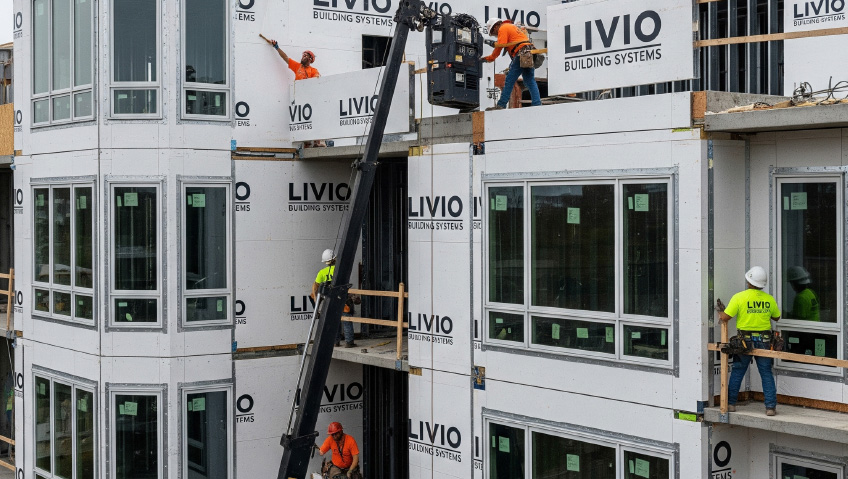
Modular production is gaining quick traction in home construction to meet the rising demand for affordable housing, and that is because the process is often faster, relatively inexpensive, and sustainable. The components of a house are built ahead in a factory to better control the output. And because the pieces are pre-assembled, the process minimizes material waste and delays caused by weather. In the factories, automation like robotic arms can be used for framing, welding, insulation, and panel assembly.
Another interesting move toward sustainability among manufacturers is the shift to leasing products as opposed to simply selling them. The journal, Environmental Science & Technology, discusses the potential benefits that come with manufacturing companies leasing rather than selling their products outright. Where disposal costs are high or production costs are low, volumes under leasing are lower than with selling, reducing the industry’s relative environmental impacts.
“If the focus is shifted from products sold to services rendered, it becomes advantageous to have reliable and long-lasting equipment, especially where research and development costs are high,” the researchers note. “With a service-focused business model, the manufacturer has more to gain from improving product performance and reducing the number of units delivered. In-use factors can be minimized with maintenance, whereas efficiency improvements and manufacturing burdens can be improved with product take-back and remanufacturing.”
Furthermore, with leasing, regular maintenance can increase a product’s functioning lifetime, reducing the overall amount of these products that end up in landfill. And the lessor is generally obliged to perform maintenance on leased items, an advantage as the company in question will retain proprietary knowledge of its products and is in the best position to make repairs and upgrade components, potentially even leading to improved technologies in the industry over time.
Like many other sectors, manufacturing is incorporating AI to help improve sustainability. In fact, AI in manufacturing now extends well beyond supporting automation to support real-time decision-making. This leap forward is described in terms like “smart factories” or “smart manufacturing,” which are part of a larger change known as Industry 4.0. IBM has noted how this advanced approach to production uses a combination of connected technologies, real-time data analytics, and AI to create flexible, efficient, and highly automated manufacturing systems.
As IBM explains, “AI monitors ongoing production processes and adjusts without prompting, which maximizes productivity and reduces waste. These systems revolutionize the way companies manufacture, improve and distribute their products.”
The company points out that AI is also at the heart of the growing trend of human-robot collaboration. Traditional industrial robots often require close supervision and controlled environments, but the new generation of AI-powered collaborative robots, or cobots, can work safely alongside humans. Cobots take on repetitive or strenuous tasks while employees focus on more complex and creative work.
Together, these AI applications propel manufacturing toward smarter, more adaptive, and more sustainable practices.
A key component of making manufacturing more sustainable also means taking a close look at supply chains. An MIT report, Sustainability Still Matters, surveyed responses from 1,203 professionals in 97 countries and found that 85 percent of companies say they are continuing supply chain sustainability practices at the same level as in recent years or are increasing those efforts.
Broadly, the survey found that for European-based firms, the principal driver of action in this is government mandates such as the Corporate Sustainability Reporting Directive, which requires companies to publish regular reports on their environmental impact and the risks to society involved. In North America, company leadership and investor priorities are the factors driving an organization’s efforts.
When it comes to business and sustainability, greenhouse gas emissions are either produced directly or come from the energy used to produce an item. And then there are the emissions that are produced across a firm’s supply chain, including activities involved in producing, transporting, using, and disposing of its products. The report reveals that about 40 percent of firms keep close track of the emissions they directly produce, but far fewer track the emissions of the supply chain. Yet the supply chain may account for roughly 75 percent of emissions overall.
Clearly, trying to calculate the total emissions along a supply chain is no easy task. However, there are opportunities to acquire analytics in this area. One option is called life cycle assessment software, which provides estimates of a product’s emissions, from the extraction of its materials to its disposal.
And finally, one of the ways to make a sustainability impact is with the actual materials that go into the product. Take green steel for example. Traditionally, extracting that all-important iron from ores requires blast furnaces that run on fossil fuels, and on a large scale. The iron and steel industry is responsible for 11 percent of global emissions—that’s the equivalent to all the world’s private cars and vans.
Steelmaking in the U.S. is already greener than in many countries, thanks to the popularity of electric arc furnaces that use electricity, not heat from burning fossil fuels, to melt scrap steel and recycle it. On this front, there are emerging startups such as Boston Metal that say they can use electricity for the iron-making process, a crucial step in making brand new, or virgin, steel, the BBC reports.
Switching from traditional blast furnaces to electric arc furnaces can lower carbon emissions per ton of steel produced from 2.32 tons of CO2 to 0.67 tons of CO2, says the BBC. “For ironmaking, some plants could use green hydrogen, made using electricity from 100 percent renewable sources,” says Simon Nicholas, lead steel analyst at the Institute for Energy Economics and Financial Analysis.
There are paths forward, with North America taking a leadership position. As sustainability continues to become a greater consideration in purchasing decisions, it is worth looking at how to incorporate the latest advances or find ways to become more sustainable in the existing processes of manufacturing to stay relevant. Consumer preferences will influence the market and help drive change.