That package you ordered lands on your porch—great! Everything inside the box is in one piece—even better! You go on about your day.
But for that box to land on your porch (especially in one piece), a lot of steps needed to come together. And one step that probably never gets the attention it fully deserves is the conveyance system. When it comes down to production and packaging, it is conveyors that are crucial to keeping our supply chains moving.
Conveyors are much more than just a belt that products and packages ride along on; they are data-driven systems that monitor, label, and track inventory in real time. They also can weigh, divert, and inspect products as they ultimately get the package ready to go out for shipping.
It is also these systems that keep many businesses working, by reducing production bottlenecks and increasing the capacity of what a given business can produce. And conveyors work across diverse sectors, from food and beverage to healthcare to paper products.
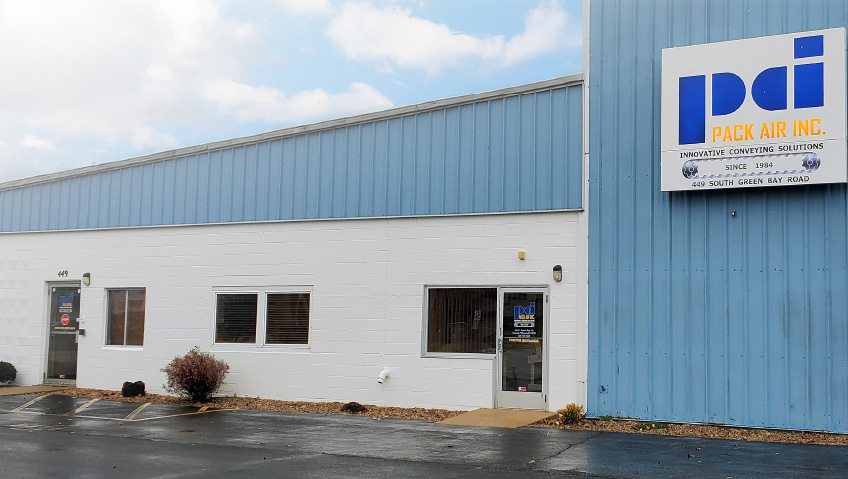
These systems have grown in leaps and bounds over the past 40 years. One industry leader, Pack Air Inc., has been at the forefront of these changes and growth. “It’s very rare now for a customer to have a truly dedicated production line where there are no adjustments needed, just running one product all day long,” says Michael Sohn, General Manager for Pack Air Inc. “They need a conveyance system that can adapt from running individual wrapped products in the morning to a 12 pack in the afternoon and be capable of multiple other product configurations on the same line.”
To get a sense of how much this company has had to adapt to the innovations that have taken place in conveyance, we need to travel back to when Pack Air got its start: 1984. Back then, Van Halen and Prince were at the top of the charts and conveyor belts were pretty much just that—loops of rubber and fabric. They required a lot of maintenance and did little more than move an object from point A to point B.
Headquartered in Neenah, Wisconsin, Pack Air was innovative from the jump, starting with a focus on using air conveyors as a primary means for moving materials. While many companies at the time were fixed on the conventional rubber and fabric conveyors, Pack Air got its name from focusing on air conveyors. Air conveyors move objects along on a cushion of air, avoiding contact with a surface, something particularly important for delicate products. But these conveyors also had a good amount of power to move objects that can be very difficult to convey. For example, a single operator can easily maneuver a window or door assembly weighing 1,000 pounds on one of the company’s Air Tables.
The other major advantage of this kind of conveyance is that there are only two moving parts, the motor and fan, which means few things that can break down. In fact, many of these systems can last for over 30 years with very little maintenance.
“We still do use air,” Sohn explains. “We are unique in the conveying industry when it comes to all the different types of conveyance that we use—fabric belts, plastic chains, and metal chains—and we are one of the few that still uses air.”
But it was soon apparent to the company there was a need to branch out to meet manufacturing demand. That’s because conveyors were changing. From being long loops of belt that moved things along, they became integral pieces of the production line, tied directly to other manufacturing and production equipment. Then technological advances started to introduce smart capabilities like self-monitoring, high-speed cameras to identify damaged goods, and more autonomy through integrated robotics. Indeed, there’s a level of sophistication in this field that many consumers simply wouldn’t know about.
Conveyors have also played a significant part in Industry 4.0 developments, which have seen the rise of automation and smart machines. These developments came about alongside the advent of COVID and the subsequent “Great Resignation” or “Great Retirement,” which saw up to 50 million people leave their jobs between 2021 and 2022, making businesses look at new ways to automate.
“Prior to COVID, roughly 50 percent of our mechanical projects had some electrical scope to them. Today it’s probably closer to 80 percent that have electrical components,” says Sohn. That is to say, customers are automating to make up for the reduced number of workers available.
Since its early days, Pack Air focused on engineering and the technical aspects of customers’ facilities. But since 2019, the company has seen a notable uptick in technical support much earlier in the process, and in some cases, Pack Air provides technical expertise for customers that used to be available to them in-house.
An example of this is EVO, one of Pack Air’s solutions that can be adapted to almost all conveyance applications through an adjustable guide rail that allows for very quick changeovers from a single point with either a hand wheel or an automated motor. So, customers making a changeover from one product to another can do it in a matter of minutes instead of what used to take up to a full day.
But it’s not just selling conveyors that sets Pack Air apart from others in the industry; it is how the team arrives at a solution for each customer they work with. Pack Air’s customers are not experts in conveying, packaging, and material handling; they are experts in producing paper, food, beverages, and all other kinds of consumer and industrial goods. But without that critical step of conveying their products, the whole process would break down. That’s where Pack Air comes in. The company focuses on the root problem the customer is trying to solve, and this may not always be what they wrote in their spec.
As Sohn points out, “If you walk in some place and you say, I have these conveyors for sale and we’ll try to fix your problem by using one of our existing solutions, well, that’s not what we do.” Instead, his veteran engineers and technicians listen at length to the customer’s challenges and develop a unique system in response. “I want the customer to tell me their problems—what works with their existing system and more importantly, what doesn’t work, and how we can change that.”
A recent project for Pack Air was for a cheese manufacturer handling one-pound and three-pound bags of cheese. “They originally came to us looking for a one to three diverter. The cheese is already in the bags, and they were heading toward a strapper,” Sohn explains. “So, they take the individual bags and strap them together as value packs in either two or three packs.”
Pack Air was not making the drop filler or the strapper. Those pieces of equipment were provided by others. “But we were responsible to connect them and do our diverting operation. That requires us to be very familiar with how other manufacturers design their equipment as well,” Sohn notes.
At first, this may sound straightforward, but, like many projects Pack Air gets involved in, there are hurdles to get over. That included redesigning equipment into a very specialized piece of machinery, because the floor space needed a specific path to handle the packaging in a very confined space. “We essentially combined two machines, a one to three servo diverter and a right angle transfer, into a single machine that fit their layout, fit their rate, and did the job.”
And that is a big part of what makes Pack Air special. It is almost like engineering improv; the team is able to create custom solutions by taking standard product lines and fusing them together in a way that meets its customers’ exact needs.
Reaching a creative solution like this doesn’t just happen. It’s a process that starts early on, by understanding the customer’s process and listening to what they need to do. In the above case, “we actually said, ‘wait a minute, I don’t think this works,’ and we started asking more questions.” The questions led to the successful outcome. “The client needs to understand how important those questions are upfront,” says Sohn.
Looking ahead, he foresees an increasing need for specialized advice and a growing demand for more automation. “We always had to consider how a mechanical device was going to be controlled, but we weren’t always responsible for designing a control system,” he shares. Ten years ago, many customers would do that themselves, but that expertise is not available at a customer level like it once was. “What’s different today is that those experts are gone in the larger corporations, and they are looking to us for that responsibility.”
It is a challenge that Pack Air is only too eager to meet.