Major developments have been taking place at Lapeer Plating + Plastics, Inc., (LP+P) since Manufacturing in Focus last checked in with the Class A auto parts manufacturer in April 2025. The company has made a huge capital investment in its plating line, purchased new electric injection molding machines, and is enhancing its reclamation and waste treatment services.
The centerpiece of these recent upgrades is a $3.8 million investment in a trivalent chrome plating system. Trivalent plating entails the use of trivalent chromium and is becoming a popular alternative to traditional hexavalent plating, which relies on hexavalent chromium. The trivalent process produces less hazardous waste and other pollutants than hexavalent plating, while still offering excellent corrosion protection.
“Trivalent is your last step in the plating process,” explains Plating Manager Steve Sedely. “It’s a different type of chrome compared to the standard hexavalent chrome. It’s more environmentally friendly.”
In addition to providing ecological benefits, going green was a smart business move, given Lapeer’s clientele. “Our largest customer, which is General Motors, made the decision that future chrome components used on its vehicles will require trivalent. So, for us to stay aligned with our largest customer and obtain work with the new vehicle programs, we had to make this investment,” explains CEO Doug Goad.
Premium plating and much more
Based in Lapeer, Michigan, LP+P offers chrome plating, injection molding, and assembly services. Of these competencies, “plating is the heart of the company,” says Goad.
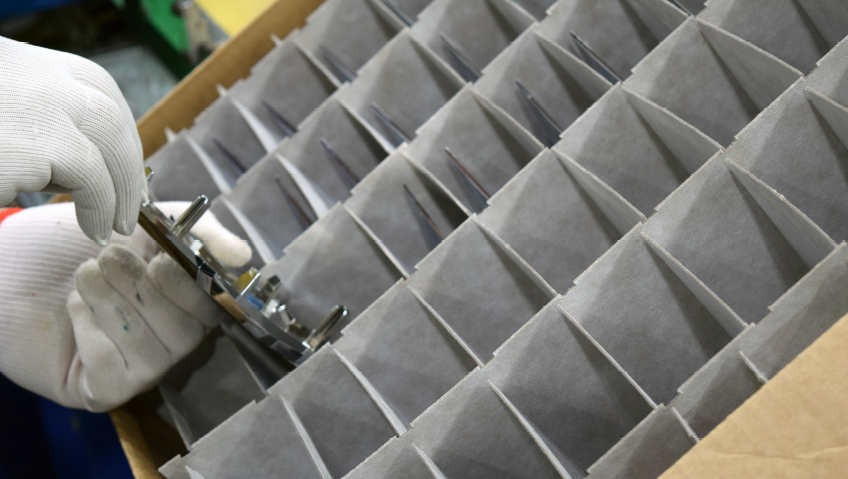
To this end, Lapeer uses high-end electroplating processes to apply chrome, matte, and other finishes to parts and products, with ancillary services including post-plating, a category that covers mask-painting, vacuum metalizing, and hot stamping. LP+P’s main products include grilles and moldings, decorative trims, ornamentation, and emblems, items primarily made for the automotive sector.
Lapeer didn’t expand its 135,000-square-foot plant or add a new line to accommodate the equipment required for trivalent plating; instead, the company spent part of this summer reconfiguring its existing plating line. This was accomplished on time and on budget, and the line was back in operation by early September.
“The line is constrained by the size of the building. Steve and his team put a plan together to extricate some of the tanks, install some new trivalent tanks, stretch the line out a little bit, remove and move different plating equipment, and pack it all back in the same footprint. We’re not looking at expanding the building itself, but you never know what the future might bring,” Goad shares.
The introduction of trivalent plating will not be accompanied by a sudden spike in production, he adds. “Our capacity for the number of pieces we can actually produce has not necessarily increased; what the upgrade has done is give us a dual capability with the probability that things are going to shift over the long haul from hexavalent to trivalent… We’ll go into production on the trivalent line in October 2026, on the new GM trucks.”
While the introduction of trivalent plating was a response to GM, there is “a big push for all the OEMs” to adopt the trivalent process, notes Sedely. Toyota, for example, has expressed interest in finishing more parts with this process. As such, Lapeer stands to pick up new work from a variety of sources.
“We fully expect this will open the door for us for a number of customers that we are going after… Over the next decade, requirements will continue to get more and more environmentally friendly. We positioned ourselves to be part of that shift,” states Goad.
Making changes
If the introduction of trivalent plating has been a major cause for celebration, the company hasn’t neglected other aspects of its operation. Lapeer recently acquired three new electric injection molding machines and may replace other machines with electric models in the near future. The new electric molding systems “are more accurate and more efficient” than the injection molding machines they replaced, which were between 20 to 30 years old, explains Goad. LP+P is also re-evaluating its painting capacity and investing in its nickel and metals reclamation systems. Enhancing its efforts to reclaim nickel and other production materials is a good way to reduce costs and benefit the environment at the same time.
In the same spirit, “we’re looking at a new waste treatment system as well… having the cleanest and most up-to-date waste treatment system possible,” says Sedely. LP+P would like to reduce the amount of PFOS (Perfluorooctanesulfonic acid), a synthetic chemical and dangerous pollutant, in its operations. Commonly used in metal plating processes, the presence of PFOS is “a growing concern,” he says.
In addition to gaining new prospects with GM, recent changes at LP+P have been driven by broader economic trends. “We’re actively looking at where we can make ourselves much more efficient to compete in this industry. There are a lot of new opportunities coming due to some of the reshoring taking place. The challenge, with some of this reshoring, is that people have gotten used to some very, very competitive prices [from overseas]. In order to compete, we have to make ourselves much more efficient,” says Goad.
He is referring to domestic manufacturers who have considered moving their offshore operations back to North America. Lapeer is proud of its multi-faceted capabilities and made-in-the-USA approach, so this could be a winning combination if the reshoring movement gains momentum.
It also helps that LP+P has a reputation for doing excellent work; the company has International Automotive Task Force (IATF) 16949:2016 certification for the production and decorative plating of plastic wares. And as part of its overall focus on quality, Lapeer also strives to reduce waste and scrap, maximize machine productivity and efficiency, and follow a continuous improvement ethos.
Building the workforce
In support of its growth, Lapeer continues to practice progressive recruitment methods. As noted previously, the firm has formed partnerships with groups such as the Lapeer County Community Mental Health Agency, Job Corps (a U.S. government career-training program), Goodwill, and Michigan Rehabilitation Services (MRS) to source workers. Some of the potential recruits from these agencies have mental disabilities and other challenges that make it difficult for them to find employment. By bringing such individuals on board, Lapeer can bolster the ranks of its workers while assisting a disadvantaged demographic at the same time.
“We’re continuing to maintain a diverse work environment with individuals facing barriers, and we’ve gotten a lot of support from community partners,” says Human Resources Administrator, Joe Du Breuil.
LP+P employs approximately 270 people at present. Complicating matters is the fact that, industry-wide, skilled workers in the manufacturing sector are edging toward retirement and young people don’t seem eager to replace them. The situation at Lapeer is particularly critical as the company’s operations are still relatively labor-intensive, Goad tells us. “If you look at our plating system, bars are moved in and out of that system manually,” he notes.
To address the labor issue, Lapeer has brought in some new hires who have demonstrated an aptitude for mechanical work, then trained them so they can maintain existing plant equipment.
“Maintenance is an activity that nobody pays much attention to; everyone looks at the new equipment, the robotics. The fact is, there are still lots of companies that have lots of older equipment that needs to be maintained, and those skill sets are disappearing, so we’re developing our own people to be able to keep the machines up and running,” says Goad.
The company has also introduced a Department of Labor-approved apprenticeship program. “It’s a four-year program where individuals have their schooling either partly or completely covered through scholarships and grants, through the state of Michigan,” explains Du Breuil. The program blends in-house training with classroom learning. Participants will receive lessons on subjects such as hydraulics, mechatronics, and electrical work, with the aim of expanding Lapeer’s pool of skilled young workers.
Planning for growth
Going forward, Lapeer remains very much in growth mode. “We’ve got a business plan right now to increase our overall revenue… I’d like to see Lapeer at $60 to 100 million a year, which would be growth of three or four times,” says Goad.
LP+P stands to achieve this goal by not only embracing new services and methods, but also by maintaining its status as a comprehensive, one-stop shop.
“There are a lot of injection molders out there and lots of people doing assembly,” notes Goad. “Lapeer is unique in that it does everything underneath one roof. As a result, we’ve gained efficiencies that have made us competitive, and the new requirements and upgrading of our current chrome capability is key to the long-term viability of the company.”
With these strategic investments, strengthened capabilities, and forward-thinking workforce initiatives, Lapeer Plating + Plastics is positioning itself for a future defined by both competitiveness and responsibility. By modernizing its chrome processes, retooling key equipment, and doubling down on efficiency and environmental stewardship, the company is not only aligning with the needs of major OEMs but also creating opportunities for new business in a rapidly shifting manufacturing landscape. Committed to cultivating skilled talent and operating as a true one-stop shop, LP+P is charting a path toward sustainable growth—one that reinforces its reputation for quality while ensuring it remains a trusted partner to customers for years to come.