Last year, Flex Technologies of Midvale, Ohio reached the half-century mark as a thermoplastics powerhouse. This one-stop shop handles all aspects of production, from compounding to manufacturing finished plastic products. It has an enviable reputation for quality work, as evidenced by the slew of industry awards it has earned over the years.
For all of its manufacturing prowess, the company’s success can be largely attributed to its client-centered approach. “We put the customer first,” says Sales Manager, Francie Williams. “That’s why we have the customer retention we do, and why we’ve been in business so long.”
Being relatively small, the company is nimble and highly responsive to client needs. Flex Technologies also has a loyal, dedicated workforce and invests in the communities in which it has a presence.
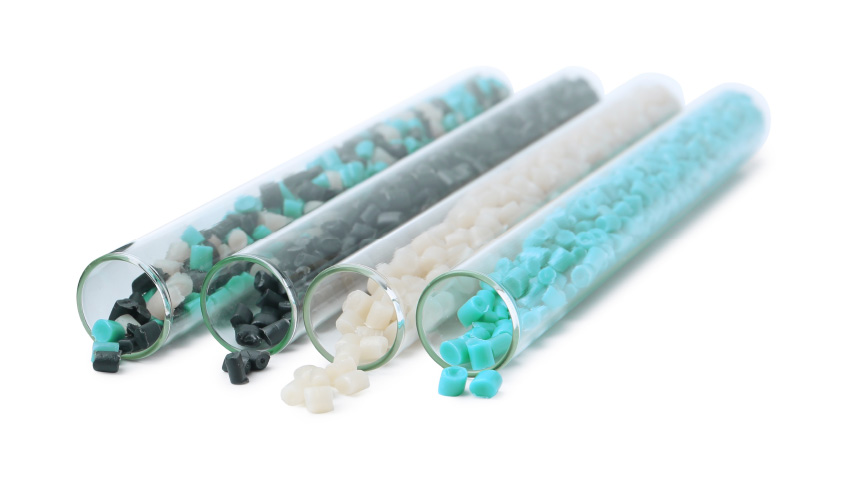
In addition to the company headquarters, it operates an extrusion plant in Midvale. Injection molding and assembly work is done at sites in Mount Eaton, Ohio and Lafayette, Tennessee while a division called Polyflex, based in Baltic, Ohio, specializes in polyvinyl chloride (PVC). This process entails blending PVC resin with various additives to create custom plastic material.
All work is self-performed, a major point of pride for the company. Being vertically integrated makes things more convenient for customers and is “pretty much our main selling point for the bigger assemblies with large customers,” notes Williams.
Flex Technologies’ products can be grouped into three main categories: assembled products, injection molded components, and custom extruded products. The assembled products category includes sunroof drain tubes, fuel line assemblies, vacuum, and PVC assemblies, as well as vapor emission assemblies and carbon canisters. These are produced through automated processes and then assembled by skilled manual workers.
Products in the injection molded components category include fuel vent valves, fuel line valves, fuel caps, specialized fuel delivery connectors, and specialized couplings. The company uses presses ranging from 85 to 440 tons and excels at shuttle molding—a technique to mold multiple components in a single cycle.
Tough and durable aeration tubing to inject oxygen into soil or water is a flagship product in custom extrusion. This category also covers protective boat moldings to prevent rub and clear PVC tubing, among other goods.
Flex Technologies’ capabilities range from on-site compounding and material customization to custom extrusion and injection molding, design and engineering, rapid prototyping and validation, assembly, testing, and quality assurance. The company also performs laser etching, 3D printing, in-house tooling, and welding, and markets served include marine, consumer, automotive, lawn and garden, and industrial.
“We ship worldwide,” Williams explains. “We have quite a few customers outside of the United States, but our main focus is the U.S. just because shipping costs are so high.”
Flex Technologies boasts both ISO 9001 and IATF 16949:2016 certification, the latter being a global automotive standard—in this case, for thermoplastic assemblies, spin welding, and manufacture of injection molded components. Dedicated quality assurance teams conduct inspections, tests, and quality checks, and the company’s guiding principle is “quality products, the first time, on time, every time,” she says.
To maintain quality, productivity, and efficiency, Flex Technologies works hard to stay on top of the latest technological developments. Besides 3D printers, it uses computer-aided design software and just purchased new CNC machines for mold-making. “We’ve been hiring mechanical engineers to help with making our processes better and improving the way we make, produce, and assemble, making it all more cohesive and faster,” adds Williams. “We’re always continuously working on improving the products.”
The company was founded in 1975 by Glenn Burket, and at first featured a tiny staff of roughly a dozen employees working from an extrusion plant in Midvale. It initially focused on making specialized tubing for the automotive sector. Three years later, the Polyflex division was established, and the business was able to achieve vertical integration. PVC compounds created by Polyflex are used for everything from toys and shoes to wires, cables, hoses, and molding, in the agricultural, automotive, fencing, and extrusion markets.
At present, Flex Technologies/Polyflex operates six compounding lines with an annual capacity of over 150 million pounds. The Polyflex division can perform color matching for customers who send in material samples and offers goods in a variety of colors, formulations, and formats, from highly flexible to semi-rigid. Polyflex complies with relevant U.S. guidelines as well as Registration, Evaluation, Authorisation, and Restriction of Chemicals (REACH) and Restriction of Hazardous Substances Directive (RoHS) regulations, two European Union standards.
Founder Burket served Flex Technologies for decades. He passed away in early November 2024, but many aspects of his original vision remain in place. For a start, all the company’s sites are still located in small towns, a reflection of Burket’s community-minded spirit. “Our founder [thought it was] very important to keep it local and to support local,” says Williams.
The company has been a long-time sponsor and supporter of community groups, local sports teams, and 4-H agricultural events. Burket was well-known for purchasing meat at local county fairs and then distributing it to his personnel.
In the same spirit, Flex Technologies proudly manufactures its products in America, and when possible, uses recycled materials, be it cardboard or reprocessed plastic (used thermoplastic material that has been cleaned, then melted down and extruded into pellet form to be re-used). Keeping production within the United States gives the company more control over quality and ensures shorter lead times, and the company extends this viewpoint to its supply chain, aiming to obtain its raw materials from within the U.S. This makes good business sense, given the chaos that engulfed global supply chains during the recent COVID crisis.
At present, the company has approximately 135 employees across all divisions. The workforce is highly diverse, represents a wide range of ages and backgrounds, and is proud to have a female leader in Chief Operating Officer, Rachel Tetreault. Anyone looking for a job here needs to demonstrate self-motivation and a positive mindset, says Williams, and once brought on board, the company offers staff an array of opportunities. While outsiders are more than welcome to apply for positions, Flex Technologies likes to promote from within. The company encourages camaraderie through special events such as the recent Easter Egg hunt at the Lafayette site in addition to celebrating personal milestones. An employee in the prototype shop, for example, was recently honored on her fortieth anniversary of working there.
Over the decades, Flex Technologies has received numerous industry kudos, the most recent being a General Motors ‘Customer Care & Aftersales Excellence in Supplier Performance Award’ for 2025. This honor was the latest in a series of awards bestowed by GM and other sources for work well done.
“We’re very, very proud every time we get any of these awards,” Williams says. “It is one of the biggest highlights for our teams to see these awards and they are very proud to receive them. It gives our employees a great boost to morale.”
The company does face its share of challenges, including supply chain woes despite domestic sourcing. “Right now, raw material prices are skyrocketing,” explains Williams. “We’re looking at increases that nobody has seen before, other than during COVID, for plastics and resins.”
Inflation has pushed up the cost of machinery, equipment, and software as well. Outside of purchasing, it also causes headaches on other fronts; when customers insist on sticking to quotes made a year or two ago that are now outdated thanks to inflation, profit margins suffer. All of this is compounded by upheavals within the automotive sector as the Big Three American OEMs cope with overseas competition and unpredictable markets.
For all that, Flex Technologies continues to innovate and is eager to create new offerings. “We have new products in the pipeline,” Williams shares.
She has a very positive outlook on the company. Within five years, she hopes to see the company “increase our portfolio, increase our sales, and absolutely keep our customers happy… We’ve been in business for 50 years. We’re looking forward to the next 50. To [reach our centennial] we are upgrading and improving and working to keep our quality high, keep our employee retention high, and to have a work environment that stays positive.”