In Drummondville, Quebec, a manufacturing operation is quietly reshaping what accessibility means for people who are blind or visually impaired—from braille devices and tactile displays to wearable smart technologies and magnification solutions.
By any measure, HumanWare is a company built not just on technology, but on empathy. Founded in 1988 as a small startup in Quebec, HumanWare began with a bold and deeply human mission: to create independence and accessibility for people who are blind or have low vision. Nearly four decades later, that mission continues to guide every product decision and manufacturing process, now on a global scale.
From its headquarters and production facility in Drummondville, Quebec, to research and development teams in the Montreal area, sales teams across the United States, offices in the United Kingdom, and partnerships spanning Europe, Australia, and beyond, HumanWare has grown into a global leader in assistive technology. Yet, despite its expansion and its integration into the EssilorLuxottica group, the company remains deeply rooted in the same values that shaped its earliest days: innovation, agility, quality, and above all, human impact.
Addressing real-world needs
“Everything we do is centered around independence and accessibility,” says Marc Jiona, Senior Director of Operations at HumanWare. “Our products are not conveniences; they are lifelines. People rely on them every day to work, study, navigate their environment, and live independently. That responsibility shapes everything we do.”
From its inception, HumanWare has focused on addressing the real-world challenges faced by individuals with visual impairments and sight loss. In its early years, this mission required developing solutions from the ground up, often before the necessary technology even existed. Nearly every component of a HumanWare product—tools, platforms, hardware, and software—had to be created in-house, demanding exceptional creativity and resourcefulness from the team to design, prototype, and deliver functional, reliable solutions.
That pioneering spirit remains central to the company’s DNA. While HumanWare now benefits from the resources and global reach of EssilorLuxottica, its leadership team works deliberately to preserve the agility and innovation of its startup roots.
“Our challenge today is to maintain that speed and flexibility,” says Jiona. “We want to keep moving fast, responding quickly to needs, and staying deeply connected to our users.”
This connection is more than philosophical. Roughly nine to ten percent of HumanWare’s global workforce lives with a visual impairment, including product testers and customer service representatives. Their lived experience ensures that products are not merely functional, but intuitive and practical. “They help us build better,” says Myriam Champagne, Director of Marketing. “They understand firsthand what works, what doesn’t, and what could make daily life easier.”
A different way of doing business
HumanWare’s Drummondville facility is where ideas become reality. Home to approximately 40 employees, the site houses production, quality control, technical support, and repair operations. Additional R&D teams in the Montreal area expand the company’s engineering capacity, bringing the total Quebec workforce to nearly 75. Globally, HumanWare employs approximately 150 people, supported by regional teams in the United States, United Kingdom, Australia, and Europe.
What sets the manufacturing operation apart is not just technical excellence, but emotional investment. “Every single device that leaves this building will change someone’s life,” says Jiona. “That creates pride. People here know they’re doing something meaningful,” and this sense of purpose drives exceptional attention to detail. The company’s products undergo extensive durability testing, including extreme temperature exposure and drop tests designed to reflect real-world conditions.
Even the materials are thoughtfully chosen, combining durability with easy cleanability to ensure both hygiene and lasting performance. Designs are optimized for everyday use across a wide range of environments and conditions around the world, ensuring reliability wherever the device is used. Some video magnifier models experience return rates as low as two percent, an extraordinary figure in consumer electronics, particularly in a category where products endure heavy daily use.
Emerging innovation
Among HumanWare’s most revolutionary products is the tactile and multi-line braille tablet, Monarch, a device that has fundamentally transformed access to education, information, and professional opportunity for blind individuals.
Named one of TIME Magazine’s Best Inventions of 2025, the Monarch is the world’s first multi-line tactile display capable of rendering both text and graphics in real time. “It’s like an iPad for someone who is blind—but with the ability to dynamically render tactile text and graphics in real time,” says Jiona. For blind students, this represents a monumental leap forward.
In traditional learning environments, braille textbooks can be on average ten times thicker than standard books. Locating chapters and navigating complex subjects becomes an enormous logistical burden. “The Monarch removes that barrier,” says Champagne. “Now students can scroll through digital textbooks, read equations, feel graphs, and explore maps, all in one device.”
The implications are enormous. Mathematics, geography, physics, and data-driven disciplines suddenly become far more accessible, and students no longer face delays waiting for specialized embossed materials. Learning becomes immediate and interactive.
The Monarch’s impact has been especially profound in educational settings, supported by HumanWare’s partnership with the American Printing House for the Blind (APH). Through government funding programs in the United States, eligible students can receive advanced assistive technology, ensuring that financial limitations do not restrict access.
One such student, Emma Olech, who is homeschooled, describes the impact: “I think the most beneficial part of using the Monarch is being able to easily access the tactile graphics… it is much easier than flipping through unwieldy hardcopy books.” These experiences reaffirm why HumanWare continues to invest heavily in innovation, even when product development timelines stretch over years.
Support at every step
The company’s value proposition extends well beyond hardware development, encompassing a fully integrated support ecosystem designed to optimize user performance and long-term reliability. Each product launch is supported by comprehensive technical documentation engineered for compatibility with screen-reader technologies, detailed audio-based instruction systems, and structured video-based tutorials, including guided installation and setup protocols.
These resources are reinforced by direct access to trained customer service specialists who provide real-time troubleshooting and product guidance. In parallel, HumanWare deploys dedicated field trainers to educational institutions and partner organizations to deliver hands-on demonstrations, structured onboarding, and in-situ technical support, ensuring effective deployment across diverse user environments.
“We want people to feel supported at every step,” says Champagne. “From the moment they open the box, they should feel confident.”
Of course, customer service is another pillar of the company’s philosophy. Unlike some technology companies that rely heavily on automated systems, HumanWare ensures that customers speak directly to trained professionals, many of whom are visually impaired themselves. “When someone calls, they talk to a real person,” says Jiona. “And often that person understands their challenges personally.” This approach fosters trust and a deep sense of partnership between HumanWare and its users.
A commitment to quality
Underlying every HumanWare product is a rigorously structured and continuously audited quality management system designed to meet the highest international standards. The company operates under ISO 9001:2015 certification and complies fully with the stringent requirements of the European Medical Device Regulations (MDR), ensuring consistent product quality and regulatory compliance across global markets. And in parallel, HumanWare’s designation as a Certified B Corporation reflects its commitment to responsible business practices, encompassing environmental stewardship, ethical governance, workforce wellbeing, and social impact. This commitment has also been recognized externally, most notably through its inclusion in the Forbes Accessibility 100 in Spring 2025, highlighting the company’s leadership in advancing inclusive innovation.
Collectively, these certifications and recognitions underscore not only HumanWare’s engineering and manufacturing excellence, but also its broader responsibility to operate with integrity across its entire value chain. The company’s B Corp certification underscores its commitment to balancing profit with purpose, ensuring positive outcomes for employees, customers, communities, and the planet.
In addition to its collaboration with the American Printing House for the Blind (APH), the company works closely with organizations such as the Canadian National Institute for the Blind (CNIB), the Royal National Institute of Blind People (RNIB) in the United Kingdom, Vision Australia, ONCE in Spain, and multiple United Nations–supported accessibility initiatives. These partnerships serve as continuous feedback channels, enabling HumanWare to refine product functionality, anticipate emerging user requirements, and validate new technological concepts through real-world application. “These organizations give us invaluable feedback,” says Champagne. “They help us refine products and validate new ideas.”
This structured global feedback loop ensures that HumanWare’s solutions are informed by educational and operational environments, resulting in technologies that are both globally scalable and locally relevant.
For HumanWare, three principles guide manufacturing and operations: quality, availability, and cost. Quality remains paramount, as any failure could disrupt a person’s independence, safety, or livelihood. Availability ensures that devices reach users when they need them, even during unexpected demand surges. Cost, meanwhile, remains an ongoing challenge in a niche market. With relatively low production volumes compared to consumer electronics, maintaining affordability requires continuous optimization without sacrificing quality. “We work extremely hard to keep costs as low as possible,” says Jiona. “Accessibility must include affordability.”
As wearable technology and artificial intelligence continue to advance, HumanWare is positioning itself at the forefront of the next generation of accessibility solutions. Through its integration with EssilorLuxottica, the company collaborates closely with teams developing smart eyewear, including Ray-Ban Meta glasses, to explore new ways to combine hardware, AI, audio, and spatial awareness into seamless assistive tools.
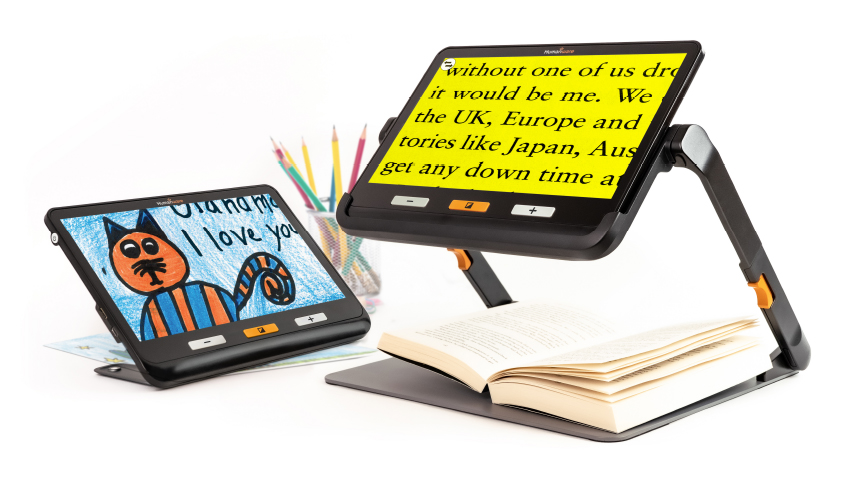
And beyond education and employment, HumanWare devices also dramatically improve daily living for individuals with age-related vision loss. One veteran in the United Kingdom, living with wet age-related macular degeneration (AMD) while awaiting cataract surgery, described his experience using HumanWare’s Explore 12 video magnifier:
“As a wet AMD patient awaiting cataract surgery, optical magnifiers were of little use to me. However, after trying the Explore 12, I was amazed at what I could read compared to prescription glasses alone. The white-on-black feature is my favourite because it soothes the effects of my photophobia, and I love the device’s ease of use and portability. It makes my life 1000 times better.”
For many users, HumanWare technology restores confidence and independence, allowing them to continue living at home, working, and engaging socially. Rather than offering a single solution, HumanWare envisions a modular ecosystem: portable magnifiers, tactile displays, wearable navigation aids, AI-powered reading tools, and smart glasses that work together. “There is no one-size-fits-all,” explains Champagne. “People want options. They want technology that adapts to their lifestyle.”
Powered by purpose
Ask HumanWare employees what motivates them, and a common theme emerges: purpose. “The mission is powerful,” says Jiona. “It gives meaning to everything we do.” From engineers and assemblers to marketers and service technicians, the team understands that their work has real-world consequences, and this shared sense of impact creates deep loyalty and pride.
“It’s not just manufacturing,” Champagne adds. “It’s about leveling the playing field, from early childhood education to career development and aging with independence.”
In an evolving technological landscape, HumanWare remains firmly focused on human-centered innovation. Artificial intelligence, smart wearables, real-time tactile displays, and multi-sensory interfaces will increasingly converge, opening new possibilities for accessibility. Yet, amid this rapid change, HumanWare remains grounded in a simple philosophy: “Technology should serve humanity,” says Champagne. “Not the other way around.”
From a small Quebec startup to a global leader in accessibility innovation, HumanWare continues to redefine what inclusive manufacturing can achieve, proving that when engineering meets empathy, extraordinary things happen.