While many look forward to the start of a new year, some years are more tumultuous than others. In 1962, growing tensions between the United States and Cuba escalated rapidly following the Cuban Revolution of 1959. Trade between the two countries was cut off, and Cuba’s President Fidel Castro established closer ties with the Communist government of the Union of Soviet Socialist Republics (USSR) when America and the USSR were still engaged in the Cold War.
Except for food and medicine, then-President John. F. Kennedy banned trade with Cuba in February 1962. By March, the U.S. was preparing “a new intervention against Cuba,” with additional bans put in place on all Cuban-made goods. Tensions increased, ultimately culminating in October’s Cuban Missile Crisis.
It was against this backdrop of global uncertainty that German businessman and entrepreneur Ortwin Stieber decided to diversify. Founder of the Munich-based transmission company Heynau Antriebtechnik, Stieber began investigating other countries in which to do business, including Canada. Invited by the Kitchener Chamber of Commerce to visit the Ontario city, Stieber soon purchased an industrial property and founded a gear manufacturing business, calling it Ontario Drive & Gear Limited (ODG).
“The reason he called it Ontario Drive & Gear was so that he knew where it was and what they did,” says ODG’s Director of Program Management, Stephen Brown.
ARGO
In 1967, the year of Canada’s centennial, the company moved to New Hamburg, Ontario. ODG was manufacturing steering transmissions for an amphibious all-terrain vehicle company when that business failed. ODG was left with a number of transmissions and no customer. This led to Stieber’s building his own amphibious all-terrain vehicle named ARGO.
Continuously refined over the decades, ARGO remains, according to the company, “the world’s most successful amphibious vehicle” in terms of units produced. Other models were introduced, including Centaur (known as ARGO’s big brother), the three-wheel ATV Taurus, and Artemis, a robotic concept rover for exploring the Moon and Mars.
For a time, Ontario Drive & Gear and ARGO were under one roof. The ARGO business was cyclical, explains Brown—busy in spring and fall with hunting and fishing, but slowing down over the winter months. Not wanting to lose skilled labour, the company began looking for outside customers. “Over the years, the machine shop side of the business started to grow and grow,” says Brown. “In 2000, we built the gear division building, because we grew both the ARGO side and the gear side of the business beyond the walls of the one building. Today, ARGO makes up about 15 percent of our manufacturing capacity; 85 percent of what we do is work other than ARGO.”
In the gear division, the company builds transmissions and some mechanical components for ARGO, while the rest of the vehicle is made and assembled in another building. While some materials, like tires and engines, are purchased, ODG does everything else, including vacuum forming of the upper and lower vehicle bodies, welding the frame, powder coating and painting, final assembly, and shipping directly to dealers from the factory.
A different breed of machinist
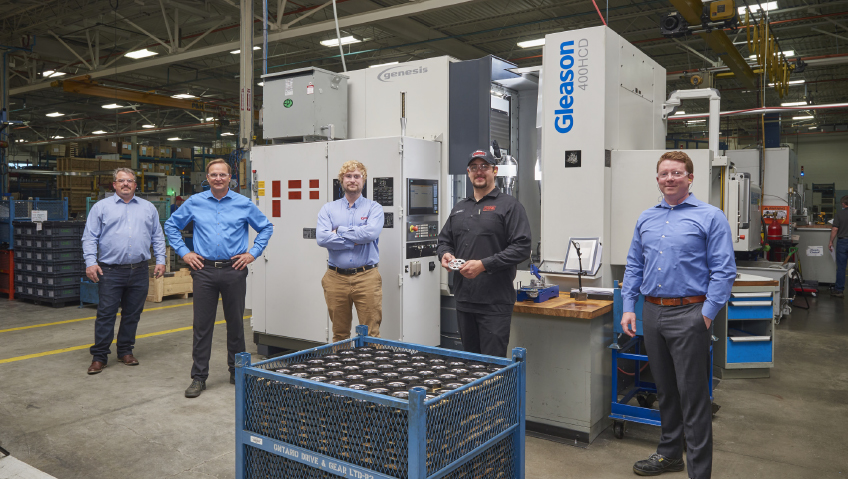
Family-run for many years and under the long-time leadership of Ortwin’s son, Joerg Stieber, ODG is today under its second private equity ownership. With a dedicated team of about 200 staff members between its two facilities, ODG’s work demands a different breed of machinist. “Although it’s manufacturing gears, the type of machining is different,” says Brown. “Knowledge requirements for gear manufacturing is specialized, and the equipment itself is highly specialized as well.”
Like many other companies employing highly skilled professionals, Ontario Drive & Gear is facing challenges arising from retiring workers. To address this, the company is striving “to bring knowledge to the next generation,” says Brown. “It’s not something where you can sit in a boardroom and come out being a gear expert, but developed over a long period. It’s a learning exercise—hands-on, working on machines—and requires a lot of investment in people. Since few educational institutes teach gear manufacturing, a lot of what we do is develop good machinists into good gear manufacturers. There’s a lot of in-house training, and we rely on some of our machine manufacturers to provide some training.”
The recently renamed Motion and Power Manufacturers Alliance (MPMA)—formerly the American Gear Manufacturers Association (AGMA)—provides some training as well. “We have to grow our own talent in many respects,” says Brown.
Local business, worldwide reach
Through its global dealer network, the company ships to customers across North America, South America, and Europe. Customers choose to work with ODG for many reasons, including the company’s outstanding work, customer service, and reduced lead and travel time. “We are a very high-quality, high-skilled manufacturing facility, where the product we put out the door is the best quality,” Brown says. “If there is a problem, we are very responsive. If there is a design change requirement, we are very responsive. And if there is a demand change—whether they need to expedite or draw back—we are very responsive. We can be on site with most of our customers within 24 hours if need be.”
Sometime, customers come to ODG with finished drawings; other times, they arrive with just an idea. In either case, the professionals at ODG can help. “We manufacture to print or help develop a concept,” says Brown of the company and its in-house design capabilities. “It just depends on the scope and size of the project. We like to call it design, manufacture, assemble, and test. We are a custom gear shop, small to medium production volume. We are niche, and we do very high-precision work and lower volume than most gear manufacturers do.”
Decades of gear knowledge, a high level of service, in-house engineering and design, and the ability to pinpoint potential issues puts ODG at an advantage. Sometimes customers come to the company with an existing design that just doesn’t work. Other times, the design works, but not as efficiently or quietly as it could. In those cases, ODG’s talented engineers can take a client’s existing design, perform a gear analysis or assembly analysis, and suggest small changes to the gear geometry could take the decibels down to an acceptable level.
“It really depends on what the customer needs,” Brown explains. “Is it weight savings? Is it cost savings? Is it noise concerns? And that’s where we lean on our design expertise, our capabilities, our talented team members, over 60 years of manufacturing experience, and some of the latest equipment to develop a better product for an existing customer.”
As a production facility, ODG typically pursues production volumes, or projects that will have a future in production. This can range from as few as one or two pieces in the prototyping and pre-production phases up to about 100,000 pieces a year, depending on the product, market, and customer needs. “Much of what we do today is lot sizes from 50 pieces up to 3,500 pieces a lot, and annual volumes ranging up to 35,000 is fairly common,” says Brown.
Gears range in size from 6mm to 500mm in diameter. Although most are made from ferrous or non-ferrous alloys which are case-hardened, ODG will also handle plastics, bronze, and brass. “Gearing is about carrying torque and power, so really soft materials are rare in the gear industry—it would be niche applications for actuators. The vast majority, probably 98 percent of what we do, is ferrous metals that can be case-hardened,” explains Brendan Purcell, Business Development Manager.
The solutions customers are seeking
Ontario Drive & Gear considers itself a ‘Customer first’ business, Brown tells us. “We like to be a solutions provider, and realistically, if it’s outside of our scope of internal expertise, we can help you source whatever you need.”
The gear industry is complex, and investments can be significant for companies seeking to be a jack of all trades of gear manufacturing. In approaching its customers to determine their needs, the ODG team—who refer to themselves as “a bunch of gear geeks”—listens to their customers, their requirements, and any existing or potential design issues.
“We aren’t just a machine shop; we are much more than that,” says Purcell. “We have a design, manufacture, and assemble philosophy here. So we can help with everything from black box design, where the requirements of the mechanical system itself are unknown, all the way through to production, or anything in between. And for the size of our company, we are a large supply chain both domestically and internationally.”
Gearing up for the future
In business for 64 years, Ontario Drive & Gear continues to grow mindfully. Many times, the runway for projects is very long—sometimes six months to a year or longer from the quoting stage to production. And continuing to invest in equipment means the team looks not only for replacements, but for the next advanced technology. “Parts are getting more complex,” says Brown. “That’s the niche environment we live in, and we have to have specialty equipment to do it. It’s about investing in the people as well.”
Owing to the company’s location, ODG is able to draw on the next generation of talent from institutions such as the University of Waterloo and Conestoga College. At any one time, the company has several co-op students from the University in various departments including manufacturing, engineering, and quality engineering. “We are also going further, planting some seeds with the local school board here, to see if we can get some interest at the high school level as well,” says Purcell.
Although the company advertises through its website and LinkedIn page, ODG finds word-of-mouth is still its best promotion. “We attend trade shows, but we don’t necessarily show at them,” says Brown. “Having these connections—and with our sister company in the off-road recreational space—we often say, ‘Come to our factory, see what we do and how we manage our processes.’ We’re not just gear manufacturers; we are also gear users. We put these products into our own vehicles, and we know how they work, and we know the legacy of them in the field,” he says.
“Once we have someone interested in engaging with us on a project, we like to get them into a plant, introduce them to our processes and our people, and I think that’s what really draws people to continue to work with us. Our best marketing tools are our factory and our people.”