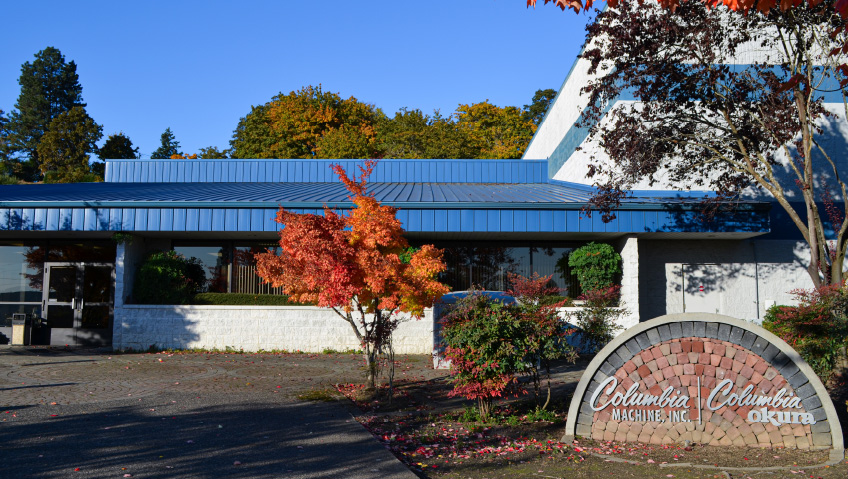
By the time many automation companies reach their third decade, they are defined either by scale or by specialization. Columbia/Okura has managed to hold both in balance. As this joint venture approaches its 30th anniversary in February 2026, the company stands as a clear example of how purpose-built technology, long-term thinking, and disciplined focus can shape not only products, but enduring customer relationships in manufacturing.
Founded in 1996, Columbia/Okura emerged from a deliberate partnership between two fourth-generation, family-owned companies: Columbia Machine of Vancouver, Washington, and Okura Yusoki of Kakogawa, Japan. At the time, robotic palletizing was just beginning to gain traction in North America. Columbia Machine had decades of experience with conventional palletizers, while Okura Yusoki had developed an articulated robotic arm designed specifically for palletizing. The joint venture was created to unite those strengths and bring purpose-built robotic palletizing to a market that was just beginning to understand its potential.
“The joint venture was formed in 1996,” says Michael Stuyvesant, Director of Sales and Marketing at Columbia/Okura. “It was a combining of two now-fourth-generation family-owned companies, and the values and the relationship made for a strong foundation.” That foundation was technical, but also cultural. Okura’s four-axis robotic arm was designed solely for palletizing, a distinction that set it apart from general-purpose industrial robots adapted for end-of-line use.
For Columbia, the partnership provided a path into robotic automation without losing sight of its deep understanding of palletizing applications. For Okura Yusoki, it created an entry point into the North American market through a trusted, established partner.
From the outset, Columbia/Okura was not trying to be everything to everyone. The company’s focus was clear: end-of-line automation, with palletizing at the core. Over time, however, what that focus meant in practice expanded significantly. In its early years, Columbia/Okura systems were typically single-line, stack-on-floor robotic palletizing cells primarily in agriculture. Over the past three decades, those systems have evolved into fully integrated end-of-line solutions that extend well beyond palletizing and into a wider range of industries including industrial products, food and beverage, and pharmaceuticals.
Today, Columbia/Okura designs and delivers systems that integrate conveyors, sortation, product validation, stretch wrapping, bagging equipment, and increasingly, autonomous material movement. “We started with just simple stack-on-floor robotic palletizing systems,” Stuyvesant explains. “Those have evolved into complete, fully integrated systems where we’re tying in with other pieces of automation equipment and automating the process all the way through the end of production.”
That evolution reflects broader changes across manufacturing. As labor availability tightened, product variation increased, and expectations around uptime and safety grew more stringent, customers began looking for solutions that could do more than simply stack product. They needed systems that could adapt, communicate upstream and downstream, and operate reliably over decades rather than years.
Columbia/Okura responded by strengthening its role as a systems integrator while maintaining a disciplined scope; this evolution is most visible in the launch of the dynaPAL® product line, the company’s industrial robotic solutions. Rather than branching into unrelated automation domains, the company focused on complementary technologies that directly support end-of-line performance. A key milestone in that expansion came in 2017, when Columbia/Okura formed a partnership with STATEC BINDER to supply bagging equipment in the United States. For a company whose early growth was rooted in bag palletizing, the ability to integrate bagging upstream created new value for customers seeking a single partner from fill to pallet.
At the same time, advances in robotics were opening new opportunities at the other end of the spectrum. In 2019, Columbia/Okura introduced its miniPAL® system, which uses a collaborative robot rather than a traditional industrial arm. Designed for lighter products, lower production rates, and smaller footprints, miniPAL® allowed the company to bring robotic palletizing into environments that previously could not justify the space, guarding, or cost of conventional systems.
“What collaborative means is it’s a robot that’s designed to work in collaboration with humans,” Stuyvesant explains. “You don’t necessarily have the big physical guards, and operators can interact with the process without stopping everything.”
This approach reflects a broader shift in manufacturing automation, where flexibility and human-machine collaboration are becoming just as important as throughput. Columbia/Okura’s systems now regularly integrate collaborative robots, industrial robots, autonomous mobile robots, and automated guided vehicles into unified end-of-line architectures. In many installations, mobile robots have replaced fixed conveyors, allowing pallet movement between palletizing cells and warehouses to adapt dynamically as production needs change.
As systems have grown more complex, safety has remained a constant priority—not only a regulatory requirement for Columbia/Okura, but one of the company’s core values, alongside flexibility, integrity, reliability, and accountability. That emphasis is reflected in both system design and internal culture.
All Columbia/Okura systems are built to meet or exceed applicable A3, OSHA, and ISO standards, with Category 3 compliance as a baseline. Each system undergoes a formal risk assessment, and customers are encouraged to conduct site-specific assessments to ensure proper integration within their facilities. Physical guarding, Electro-Sensitive Protective Equipment (ESPE), and trap-key systems are designed to prevent access to energized equipment, while newer technologies such as radar-assisted safety monitoring enhance protection in collaborative environments.
On systems like miniPAL®, safety scanners detect intrusion into defined zones while radar technology assesses the surrounding area before allowing the system to return to full operational speed. These layered safeguards are designed not only to meet standards, but to support real-world use cases where operators and automation must coexist efficiently.
Beyond technology, safety is reinforced through organizational structure and accountability. With just over 80 employees in the joint venture, Columbia/Okura operates as a tightly connected organization spanning marketing, sales, applications engineering, mechanical and controls engineering, manufacturing, supply chain, and service. The company’s service team supports a large installed base with 24/7 availability, ensuring that customers are not left to manage issues alone once systems are commissioned.
That long-term commitment is one reason many Columbia/Okura customers return time and time again. Some relationships date back to the company’s earliest installations, including a robotic palletizer sold and installed in 1996 that remained in operation until 2019. When the original system was finally replaced, the customer returned to Columbia/Okura for its next generation of automation.
“Our systems are in place for decades,” Stuyvesant notes. “That doesn’t happen if we’re not partnered with the customer throughout their journey.”
Partnership, in this context, goes beyond equipment delivery. Columbia/Okura offers structured ramp-up programs for new customers, ongoing training, and responsive service to support facilities as their production needs evolve. While repeat customers still account for a significant portion of business, the venture has also expanded into new industries and applications as its technology portfolio has grown.
Internally, Columbia/Okura prioritizes long-term investment in its people, a commitment reflected in an average employee tenure of 10 years and a tuition reimbursement program that facilitates career growth from shop floor roles to engineering and applications positions. This emphasis on stability and professional development is reinforced by a culture of transparency and open communication. By pairing an open-door management approach with these growth opportunities, the company maintains a workplace environment built on mutual trust, accountability, and a clear strategic direction.
Nicholas Shiraishi, Marketing Coordinator at Columbia/Okura, highlights the company’s commitment to workforce development beyond its own walls. “We support FIRST® robotics programs,” he says. “It’s an organization that introduces kids to robotics early, and we sponsor several local teams.”
Through its involvement with FIRST® and participation in industry programs such as The PMMI U Skills Fund, Columbia/Okura contributes to the development of future manufacturing and automation talent. Charitable donations made through these programs are often matched, extending the company’s impact within the broader community.
As manufacturing continues to evolve, Columbia/Okura faces many of the same challenges as its customers. Packaging materials are changing, product variability is increasing, and sustainability expectations are becoming more complex. While the company does not position itself as a sustainability solutions provider, it takes steps to minimize waste in its own operations, returning test product where possible, supporting donations, and avoiding unnecessary landfill disposal.
Ultimately, Columbia/Okura’s value proposition rests on clarity of purpose. Rather than chasing every emerging trend, the company continues to refine what it does best: designing and delivering safe, reliable, future-ready end-of-line automation systems. “We’re more than just an automation provider,” Stuyvesant says. “We’re a trusted partner dedicated to transforming businesses through safe, reliable, and innovative end-of-line solutions.”
As the company approaches its 30th anniversary, that message carries weight. Three decades of operation in industrial automation is not simply a measure of longevity, but of relevance. Columbia/Okura’s history reflects an ability to adapt without losing focus, to integrate new technologies without abandoning core principles, and to build systems and relationships designed to last.
With a growing portfolio of integrated solutions, a strong culture of safety and accountability, and a proven record of customer trust, Columbia/Okura enters its fourth decade positioned not as a legacy brand, but as an active participant in the next phase of manufacturing automation.