If you have never heard of a pipeline pig, you are in good company. These unassuming devices rarely make headlines, yet they are quietly essential to the infrastructure that moves oil, gas, water, and industrial fluids across continents. Quality Polly Pig Ltd. (QPP) has spent nearly three decades manufacturing them and, in the process, has built a polyurethane engineering operation that reaches well beyond the pipeline world.
Based in northeast Edmonton, Alberta, QPP is a 100 percent Canadian-owned manufacturer of polyurethane pipeline pigs and pigging accessories. Its product range spans sizes from compact-diameter water and chemical lines right up to the large-diameter transmission pipelines that cross North America. The company serves customers in oil and gas, mining, water and wastewater, and industrial process sectors. And since 2016, it has operated as a subsidiary of Suncast Polytech Inc., a strategic acquisition that changed the scope of what QPP is capable of, and what it aspires to be.
What’s in a name?
The name raises eyebrows in boardrooms and on job sites alike. Tim Canete, President of Quality Polly Pig Ltd., is used to the question. “A pipeline pig is essentially a device that travels inside a pipeline, pushed along by the flowing product or by water or air, to do a job,” he says. “The main function is cleaning the inside of the pipe during new construction, for ongoing maintenance, and for prepping lines ahead of inspection.”
Beyond cleaning, pigs serve two other primary roles. Batching pigs separate different products travelling through the same pipeline so a transmission operator can move bitumen down the line one day and switch to a different fluid the next, with a pig acting as a physical buffer between the two. Foam swabs, meanwhile, are used to dewater newly constructed lines before they enter service.
QPP manufactures its pigs exclusively in polyurethane (PUR), in both solid-cast and medium-density foam configurations. The choice of material is deliberate—polyurethane is a family of materials whose properties can be tuned by adjusting prepolymers, curatives, and processing conditions.
QPP engineers select and blend formulations to suit specific duties including harder compositions for aggressive mechanical scraping, softer ones for sealing inside slightly out-of-round pipe, more chemically resistant grades for refined product lines, and highly abrasion-resistant versions for slurry applications in mining.
“Polyurethane provides the combination of properties that pigging demands,” Canete says. “It needs to be soft and flexible enough to conform to the pipe yet tough and durable enough to clean the pipe.”
Partners in success
QPP began operations in 1996. For its first two decades it operated as a focused pig manufacturer, building a reputation for quality across the Canadian oil and gas sector. The transformative moment came in 2016, when Suncast Polytech Inc., an Edmonton-based manufacturer of large-scale polyurethane wear parts for mining, oil sands, industrial, construction, and forestry applications, acquired QPP and brought it under its roof.
Suncast itself had been founded in 1998, driven by a technology it developed in-house, ReCast™. The premise of ReCast is straightforward in concept and technically demanding in execution. New polyurethane is bonded directly to worn, cured polyurethane, rebuilding the original part to its design specifications. The result is a restored component that performs like new. Suncast spent years perfecting this process in some of the harshest industrial environments on the planet, including the oil sands operations of northern Alberta.
“Suncast has been doing ReCast since around 2000,” Canete says. “Initially it was focused on pipeline pig components for Suncor, then it expanded into larger wear parts. The 2016 acquisition of QPP was really about spreading that technology into the broader pigging world.”
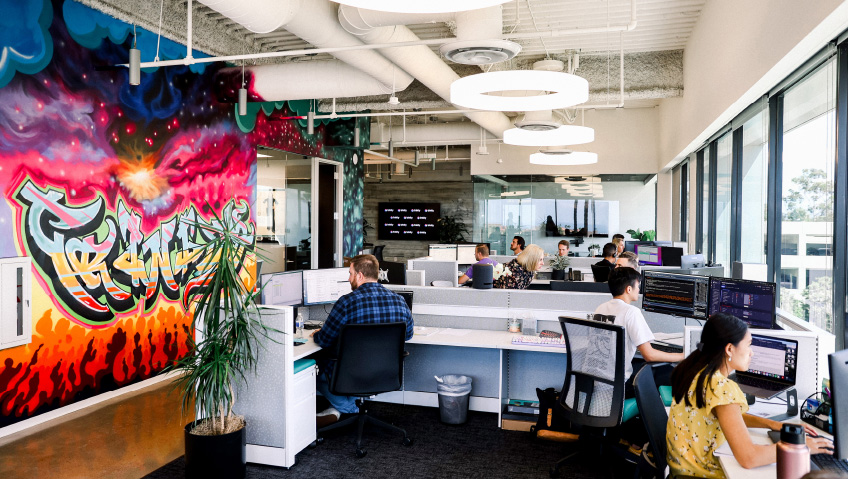
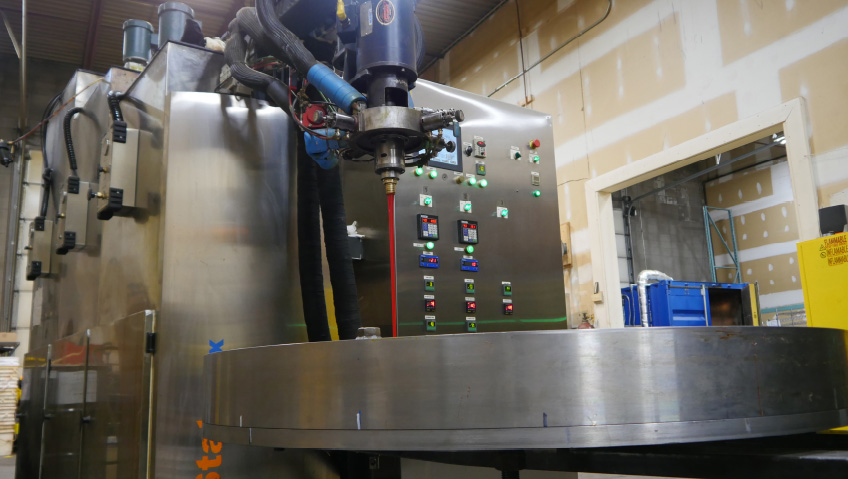
Today, QPP and Suncast share a single 22,000-square-foot facility on 3.3 acres in northeast Edmonton. Under one roof sit five automated pour machines, multiple curing ovens, lathes, a coordinate measuring machine (CMM), and a large-format 3D printer added in recent years for rapid prototyping. The combined team numbers around 15 people, small by industrial standards, but deep in expertise.
What the acquisition gave QPP was access to Suncast’s accumulated materials science. Where QPP once operated with a handful of polyurethane formulations, the combined operation now works with approximately 30 distinct recipes, each developed through years of real-world application.
“We’ve gone from a three-recipe company to 30-plus recipes,” Canete says. “All of that knowledge in materials, processing, and parts design, goes into every QPP product.”
The role of ReCast™
In most industrial contexts, a worn polyurethane part follows a familiar path: removal, disposal, replacement. A pig cup that begins its working life with a sharp, precisely dimensioned sealing edge gradually rounds with use. Traditionally, the logical endpoint is the landfill.
ReCast interrupts that cycle. The worn component becomes a core onto which new PUR is cast, creating a permanent bond between the new and cured material. The rebuilt part is restored to full specification dimensions and, based on more than two decades of oil sands service history, performs equivalently to a new component.
The numbers behind the program are significant. Suncast has processed more than 3.5 million pounds of polyurethane since 2000, with nearly half of that volume accounted for by ReCast rebuilds. The program has, by the company’s calculation, kept over one million pounds of polyurethane out of landfill, and ReCast parts cost approximately 30 percent less than new equivalents.
Until recently, however, ReCast remained largely unknown outside of the oil sands sector. “We have a proven rebuilding technology with decades of empirical evidence behind it in one of the toughest industrial environments in the world,” Canete says. “Sustainability is moving from a talking point to an actual procurement criterion in a lot of sectors. ReCast is well positioned for that shift, and we want to get the message out.”
The timing appears right. Canete observes that pipeline operators are increasingly incorporating lifecycle emissions, recycled content, and end-of-life material handling into supplier evaluations. What was once a value-add is becoming a differentiator that procurement teams actively seek.
Home-grown expertise
One of the less visible dimensions of what QPP and Suncast have built is the depth of manufacturing knowledge held within their team and the degree to which that knowledge had to be developed from scratch.
Polyurethane manufacturing for industrial wear applications is a niche with no formal training pathway. There are no degrees in pipeline pig formulation, no certification programs for oil sands-grade PUR wear parts. Everything QPP and Suncast know about the craft—every formulation, every processing technique—has been developed internally over nearly three decades. “There aren’t schools you can pull from. It’s all on-the-job development, and some of our people have been processing urethane parts for more than 20 years,” Canete says.
That institutional depth has a practical consequence and QPP now operates as a recognized engineering house, not merely a manufacturer. Its team uses advanced 3D modelling software for part and mould design and can either develop custom engineered solutions independently or collaborate directly with customer engineering teams. The large-format 3D printer added in recent years compresses the prototyping cycle significantly; where custom pig development once took months of design iteration, the team can now have prototypes in hand within a day in some cases.
The quality assurance program reflects the same discipline. QPP maintains strict vetting criteria for material suppliers, recognizing that formulation consistency starts at the raw ingredient level. Every finished part is inspected against customer specification before it leaves the facility.
The 3.3-acre Edmonton site sits on the CANAMEX trade corridor, with direct rail access via CN’s intermodal yard to the Port of Vancouver and the Port of Prince Rupert, connecting QPP and Suncast to Asia-Pacific markets. The corridor runs south to the U.S. border, giving the operation efficient access to its largest export market.
Canete frames the location in terms of what it makes possible with raw materials arriving from global suppliers and finished and rebuilt PUR parts moving out to customers across Canada, the United States, and international markets. The facility, which QPP and Suncast moved into in 2023, expanded the combined manufacturing footprint and production capacity at a time of growing demand.
The proximity to the oil sands region of northern Alberta, particularly the Municipality of Wood Buffalo, is equally deliberate. Suncast has supplied Suncor and other oil sands producers as an OEM polyurethane supplier for over two decades, and QPP, for its part, manufactures approximately 12,000 pipeline pigs and components annually, most of which are deployed within Alberta’s pipeline network.
For Canadian operators, the 100 percent Canadian ownership of QPP and Suncast carries supply chain implications that have become more salient in recent years. For U.S. and international customers, it represents a stable, allied-jurisdiction supplier with no cross-border complexity.
An industry in transition
The pipeline industry is in the middle of a period of convergence as aging municipal infrastructure is reaching design-life limits, smart pig technology is generating new demand for clean lines ahead of inline inspection, and emerging applications including hydrogen pipelines and CO₂ transport for carbon capture are creating requirements that no established pig formulation was designed to meet. Canete sees all of these as QPP and Suncast territory. “Companies that own their materials capability will be able to respond quickly. That’s exactly where we sit,” he says.
On the product side, QPP manufactures a complete range of solid-cast pigs including Utradisc, Powerdisc, Ball pig, Bell-cup, Dyna-flex, Multi-cup, and Pig-valve configurations; foam pigs including balls, squeegees, and swabs; component pigs for batching, bidirectional, construction, and brush-cleaning applications; and a full accessories program covering brushes, magnets, pigging poles, and transmitters. The intent is that a pipeline operator can source a complete pigging package from a single supplier.
Longer-term priorities include broadening the ReCast program to cover a wider range of pig components, expanding into water and wastewater applications where aging municipal infrastructure is generating increasing maintenance activity, and continuing to invest in the Edmonton facility as both product demand and technology capabilities evolve.
When Canete is asked what he most wants readers to take away from QPP’s story, he steers away from the product and toward the foundation underneath it. “When you buy a QPP pig, you are tapping into 30 years of urethane materials science, an Edmonton-based engineering team that solves real-world wear problems, and a sustainability story, through ReCast, that costs less and wastes less than the alternative. We are not trying to be the biggest pig company in the world. We are the company you call when the challenge is difficult.”
It is a precise articulation of a deliberately focused position. QPP and Suncast occupy a narrow slice of the industrial world—Canadian-owned, built on materials expertise accumulated over three decades without a textbook in sight. The pipeline operators, mining companies, and municipal water authorities that rely on QPP’s products are betting, ultimately, on the depth of knowledge behind each pig that leaves that 22,000-square-foot facility. By most measures, it is a solid bet.