For more than half a century, the Association for Advancing Automation (A3) has played a central role in guiding the evolution of industrial automation. What began in 1974 as the Robotic Industries Association has since grown into a global organization representing the full spectrum of automation technologies, from robotics and machine vision to motion control and artificial intelligence.
Today, A3 represents more than 1,400 member companies worldwide and serves as a unifying force across an increasingly complex and interconnected automation landscape. Its work spans safety standards, education and certification programs, and industry events, all with a shared objective: to help manufacturers and technology providers realize the full value of automation.
At the center of that mission is Automate 2026, North America’s largest automation and robotics trade show. Set to take place in Chicago, the event reflects not only the rapid advancement of automation technologies but also the growing urgency for manufacturers to adopt them.
A3’s origins trace back to a time when industrial robotics as a field was still emerging. The organization initially focused on supporting the development and adoption of robotic systems in manufacturing. Over time, however, the scope of automation expanded significantly. As technologies such as machine vision, motion control, and artificial intelligence (AI) became more integral to industrial processes, the organization evolved alongside them. This expansion led to it rebranding in the 2010s as the Association for Advancing Automation, reflecting a broader mandate that encompasses the full automation ecosystem.
Today, A3 operates as a cohesive global organization that brings together technology developers and system integrators. Its leadership in areas such as robot safety standards and workforce development has helped establish a foundation for responsible and effective automation adoption across industries. “We’re passionate about advancing automation and helping more people realize the value of using it,” says Alex Shikany, Executive Vice President of A3.
The history of Automate closely mirrors the evolution of A3 itself. First launched in 1976, the event initially focused on robotics before expanding to include additional technologies as the industry matured. Over the years, it has been known as the Robots and Vision Show and the Robots, Vision and Motion Control Show, before officially becoming Automate in 2011.
That rebrand marked a turning point, positioning the event as a comprehensive showcase for all automation technologies rather than a single segment of the industry. Since then, Automate has experienced significant growth, driven by increasing demand for automation solutions across sectors. The 2026 edition is expected to draw more than 50,000 attendees and feature over 1,000 exhibitors, making it the largest event in its history. For manufacturers and technology providers, it offers a rare opportunity to engage with the full breadth of the automation ecosystem in one place.
One of the defining characteristics of Automate is its broad, industry-agnostic appeal. Unlike events that focus on a single sector, Automate brings together stakeholders from across manufacturing, logistics, agriculture, construction, food production, and more. This diversity reflects the reality of modern automation. Technologies such as robotics and AI are no longer confined to specific industries; they are foundational tools with applications across virtually every sector.
As Shikany explains, attendees do not come to Automate in search of a single technology—they come with problems to solve. “Customers come to Automate for solutions to their problems,” he says. “They’re not necessarily looking for one discrete technology. They want to see how everything works together to address their challenges.”
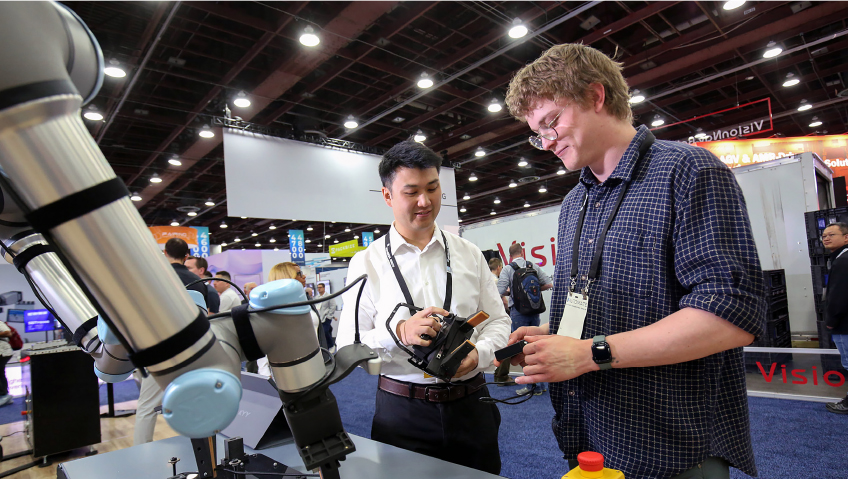
That focus on solutions is evident on the show floor, where technologies are presented not in isolation but as part of integrated systems. Robots are paired with vision systems, powered by AI software, and supported by motion control and sensing technologies. The result is a more complete and practical understanding of how automation can be applied in real-world environments.
Indeed, a key theme shaping Automate 2026 is the convergence of automation technologies. Rather than operating as standalone tools, these technologies work together to create smarter, more adaptive systems. A robot, for example, may rely on vision systems to interpret its environment, while AI algorithms enable it to make decisions in real time. Motion control systems ensure precision and efficiency, while digital tools such as simulation and digital twins enhance planning and optimization.
This convergence is transforming how manufacturers approach automation. It is no longer about implementing a single piece of equipment but rather about designing integrated solutions that address complex operational challenges. At Automate 2026, this shift will be on full display, offering attendees a firsthand look at how these technologies interact and deliver value in practical applications.
Artificial intelligence has become one of the most influential forces in automation, and its role continues to expand. While early discussions around AI were often met with skepticism, the industry has reached a point where adoption is accelerating rapidly, and Shikany notes that this shift is particularly evident in how AI is being deployed. “People are embracing AI in solutions more than ever before,” he says. “When they walk the show floor, they’re going to see real-world applications, not just theoretical possibilities.” Examples such as AI-powered bin picking demonstrate how the technology is being applied to solve specific manufacturing challenges.
This practical focus is critical for manufacturers evaluating automation investments. Seeing technologies in action provides a clearer understanding of their potential impact and helps bridge the gap between concept and implementation.
Among the most anticipated features of Automate 2026 is the continued expansion of humanoid robotics. Once largely confined to research and experimentation, humanoid robots are now gaining attention as potential solutions for real-world industrial applications.
A3 introduced its Humanoid Robot Forum as a standalone event two years ago, and its rapid growth has led to its integration into Automate. The 2026 show will feature both the forum and a dedicated humanoid robotics pavilion on the show floor, sponsored by NVIDIA. The pavilion will bring together leading companies in the field, offering attendees an opportunity to explore the latest developments and engage directly with industry experts.
“It’s one of the hottest topics in our space,” says Shikany. “Our role is to show the technology and its practical use cases so customers can understand where it fits.” While it is still early to define the full scope of humanoid applications in manufacturing, the technology is advancing quickly, and Automate provides a platform for companies to showcase new developments, with several exhibitors expected to make major announcements during the event.
Beyond technological innovation, automation is playing a critical role in addressing one of the manufacturing sector’s most pressing challenges: workforce shortages. Many industries are struggling to fill roles that are physically demanding or hazardous, and automation offers a way to address these gaps while also improving safety and efficiency.
Shikany emphasizes that automation is not about replacing human workers but equipping them with better tools. “These are 21st-century tools for human employees,” he says. “They help companies stay competitive, but they also make those companies more attractive places to work.”
As automation becomes more user-friendly, with advances such as collaborative robots (cobots) and intuitive software interfaces, the barrier to adoption continues to drop. At the same time, companies are investing in upskilling their workforces to support new roles, including robot technicians and system operators. This dual approach, combining technology adoption with workforce development, is helping manufacturers build more resilient and adaptable operations.
Looking ahead, the integration of automation is reshaping how factories are designed and operated. Increasingly, manufacturers are planning facilities with automation in mind from the outset, rather than adding it later, a shift that enables greater flexibility and scalability. Factories are becoming more modular, allowing for easier reconfiguration as production needs change. Intelligent systems provide real-time insights, enabling more informed decision-making and continuous improvement.
Shikany believes this evolution will continue as technologies mature. “You’re going to see factories become more intelligent, more flexible, and designed around automation from the beginning,” he suggests. In such an environment, the role of human workers remains essential. Automation enhances their capabilities, allowing them to focus on higher-value tasks while machines handle repetitive or hazardous work.
For companies considering automation, the decision-making process can be complex; evaluating technologies and identifying the right partners all require significant time and resources. Automate addresses these challenges by bringing the entire automation ecosystem together in one place. Attendees can explore a wide range of solutions and engage directly with technology providers. “There are so many questions that go through the mind of someone looking to deploy these technologies,” says Shikany. “Automate is designed to be the place where they can find those answers.”
Over the course of four days, attendees can gain insights, build connections, and, in many cases, take concrete steps toward implementation. This concentration of knowledge and expertise makes the event a valuable resource for organizations at any stage of their automation journey.
As manufacturing continues to evolve, the importance of automation will only increase. Advances in robotics and integrated systems are creating new opportunities for innovation and growth. At the same time, the challenges facing the industry, from workforce shortages to global competition, underscore the need for forward-thinking strategies. Through its leadership and events, A3 is helping to guide this transformation, providing a platform for collaboration and innovation.
Automate 2026 stands as a reflection of that mission, bringing together the technologies and ideas that are shaping the future of manufacturing. For those seeking to understand where the industry is headed, and how to be part of it, it offers a clear and compelling starting point.