For Fritz Schlabach, founder and owner of Rock Run Industries in Millersburg, Indiana, running a solid business is all in a day’s work. His formula is almost deceptively simple: by ensuring that his employees are happy while keeping an eye on finances, carefully measuring metrics with the help of a good enterprise resource planning system, and maintaining a commonsense approach to management while investing in the best modern equipment money can buy, this matter-of-fact leader has created a business that runs so smoothly, a number of industry leaders have sought advice on replicating its systems.
The owner and his staff make it their personal goal to genuinely enjoy every day at work. By hiring quality people and providing them with quality equipment, this company has reached heights its founder could never have imagined on the day he opened its doors for the first time.
Schlabach dreamed of “working in metal fabrication surrounded by great people,” since childhood. He would never have dreamed what good fortune awaited after a significant drop in hours at his job in the recreational vehicle (RV)/mobile home industry, which took a downturn around 1999. The solution was to offer his services as a volunteer to people with home-based businesses. One man he met used fabricated metal components for equine uses. After a day of painting these, the young entrepreneur offered to make and deliver those parts pre-painted, as he was better equipped at home to do a good job. This was the start of a successful business.
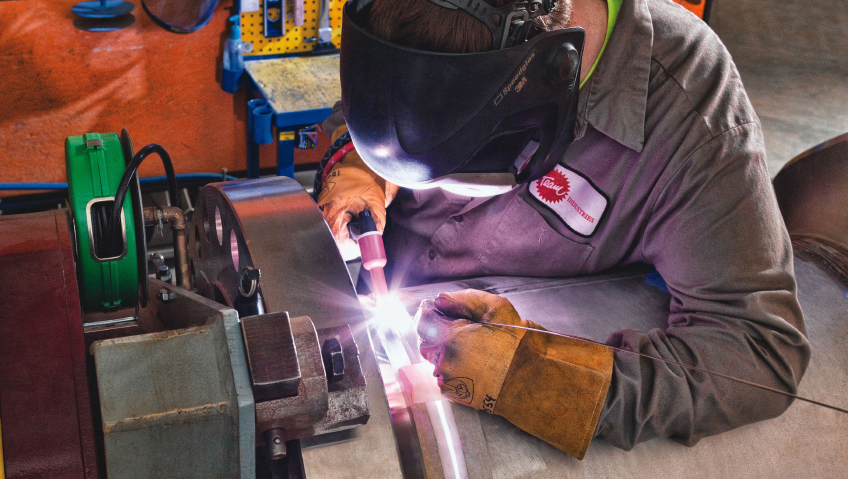
“I went home, and I bought a little bandsaw from Northern Tool out of a catalogue. I had a benchtop drill press, and I bought a welder, and I taught myself to weld. I found enough work to keep me busy,” Schlabach says.
Even though it was a financial struggle, he didn’t mind as he was happy with his new occupation. Prototyping followed, and after a year or two, a larger garage. Schlabach then hired a few assistants—some of whom are still with the firm over 20 years later. He continued working his day job and returned to join his team in the afternoons and evenings. His day job employer later gave him the opportunity to fabricate steel components for RVs.
Business continued increasing, from supplying one RV plant to another, until the recession of 2008 hit. The team was expecting business to grind to a halt again, but the opposite happened. As steel prices doubled, the opportunity to quote for contracts that would normally have been reserved for a select few in previous years suddenly became available as financial strain sent companies in search of significantly lower prices. Suddenly, a large company was willing to give Schlabach an audience, and the team set out to prove itself.
By 2009, when the economy and steel prices started normalizing, the fledgling company had secured itself a place of trust amongst some of the area’s leading component fabricators for the RV industry. Since then, Rock Run Industries saw consistent 35 percent growth for 13 years.
“I kept pouring all the profits back into the business, buying more equipment, which is truly what I like to do,” Schlabach says. “I love going to work. I love working with great equipment. I love working with great people. I got to do exactly what I wanted to do in life.”
He admits that his original lack of knowledge about scaling the business, budgets, goal setting, and other standard business practices—and his subsequent solutions—now defies conventional wisdom. Yet, by staying the course, he came through every challenge with more great equipment and many stories to tell. Once, after hiring a consulting company to analyze the company’s systems with a view to optimize, Schlabach was informed that he had no ordinary company. Asked for clarification, the consultants told him that “normal” businesses have a difficult time receiving products from their vendors; they have a tough time hiring help; and they have an even tougher time showing a profit.
“I said, ‘then why would I want to be normal, if that’s what you’re telling me normal is?’” he says. His response to the value of support could surprise some folks. “I relied on my wife, and I relied on my Savior, my God. The Bible is full of business advice, if a person truly cares to go there for advice and trust in it,” he says.
Schlabach considers his wife Jane to be instrumental in the company’s success. As his confidante, soundboard, and biggest supporter, talking to her gave this natural leader an opportunity to work through challenges and develop solutions. “Thank goodness she was there for me. She’s still there for me. It’s something that most businessmen overlook, the support that they can get from their wife,” he says, praising her poise, intelligence, and beauty.
As for his efficient business systems, paying companies and his people well and on time has proven invaluable and has, surprisingly, become the puzzlement of many, leading a few people, including a chartered accountant from Pennsylvania, to extensively quiz the owner on his secret. “Well, it’s just too darn simple,” the accountant said. “Most people will never believe that.” Schlabach is generous with his formula and describes it as follows:
If a customer buys a part worth $10 in labor value, 75 percent, or $7.50, goes to the employees as a split labor rate. The other $2.50 goes to the company to cover overhead costs. When the company builds over 124,000 parts in a week, the employees earn 75 percent of the labor value of all those parts and the remaining 25 percent goes to the company. Therefore, if one person builds 10 parts per hour at $10 per part in labor value, $75 dollars goes into the labor fund, and $25 goes to the company. Using this system, Rock Run pays employees more than its competitors. The best part is when the employees find efficiencies and ways to produce more than the expected parts per hour. Then their pay goes up per hour but so does the company’s allotment for overhead costs. The company also takes its infrastructure output capacity into account. “In order to cover my overheads and raise the employee’s pay, I might have to buy my people better equipment,” Schlabach says.
In this way, people can then deliver more units in a day. “I do everything I can to make sure that they can make as much money as possible, and if I do that, it takes care of every other problem I have,” he says. The result is happy employees, great cash flow, and better procurement.
With the company’s real profit opportunities residing in the metal it purchases, the more metal that passes through and out of its doors, the more profit it makes. “I make money on every pound of steel that goes through here,” Schlabach says, underscoring the fact that, in this way, a comparatively small outfit moves incredible volumes of metal while retaining staff, covering overheads, and increasing profits. “Everybody wins.”
This approach ensures that staff members are happy, clients are happy, and everybody else in between is happy—all while profits are coming in. For this reason, Schlabach sees no need to implement draconian rules and greedy incentives to squeeze even more out of a system that is very clearly working. Looking back, he shares earlier experiences that shaped the company. Even though the business was making plenty of money, living frugally with nine children meant no splurging on luxuries. There were few vacations, no second homes, and no prestigious vehicles to flaunt their newfound success for the Schlabachs. His advice is clear: to make a company work, ensure that you enjoy the work, because financial gains are hard-earned and slow to materialize. Without enjoying the process, life will lose its luster.
Highlighting that another overlooked business resource is a good banker, Schlabach advises trusting bankers for financing, as they are not at liberty to hand out loans that risk turning bad. “They’ve seen companies that have flourished, and they’ve seen companies that have failed; they know the warning signs. Don’t be afraid to sit down with your banker every three months or six months and hear their side of the story, even if you don’t like what they’re telling you,” he says, pointing out that bankers can be intimidating when one is young, but that they really are valuable allies.
On the topic of financing equipment, this leader advises taking loans during low-interest periods but cautions that paying such loans off early could work against one when cash flow is better directed elsewhere to cover operational costs. Moreover, he believes it is important not to have all equipment financed. By taking what he calls a stress analysis, Schlabach recommends calculating whether the company could survive a black swan event with the amount of debt it holds or not. If the answer is negative, it is time to improve the strategy by turning the situation around. Curb rapid growth and be watchful of finances when clients pay every 60 or 90 days. It is much easier to grow rapidly when customers pay in 30 days or less.
With the majority of RV fabricators being located in Elkhart County, Rock Run has grown tremendously in revenue. While this field remains the company’s main market, it recently signed a contract with Full Swing, a golf simulator outfit. Even more recently, the company started seeing sales representatives arrive at its doors from 250 miles away with fabrication requests. Following COVID-19, when the RV industry skyrocketed and before settling down again, the company decided to start reaching out to contract manufacturing customers to expand its reach. This gave it a head start on establishing trust in new markets at a time when things are looking up for American fabrication.
Always prepared for any eventuality, Rock Run continues to keep costs consistent for customers by maintaining a significant pre-purchased inventory. While this demanded large capital investment, it now means remaining competitive price-wise. To this end, Schlabach counsels vigilance. “There is never a good time to not be paying attention,” he says of the market.
In the last two years, the company nearly doubled its workforce with the appointment of 70 new people, added to its existing team of 100. And as mentioned, paying people more than the standard wage is part of the company’s strategy to maintain an expert workforce. “Our guys make good money. [They earn] very high wages compared to the industry, and they like that. They appreciate that,” Schlabach says. It also means that people are committed to maintaining the happy, respectful equilibrium for which the company is known. Not being driven by money but rather loving to be around the team allows the business to serve as a force for good.
“I never really thought about how much we would grow or what our sales would be or what we would do—I just wanted to work with great people,” Schlabach says. “I’ve been fortunate in that aspect, that it’s happened.”
Today, five of the nine Schlabach siblings have joined the company and will be invited to each purchase 10 percent of the company when they reach the age of 25. “My children are very talented. They have great minds. That’s a blessing, not everybody can say that, but they have great minds. They’ve taken lots of interest, and the current management team acknowledges and appreciates that,” their father says.
As the next generation takes the reins, Fritz Schlabach plans on responding to the call of distressed companies in need of consultation with his expertise as interim CEO to help turn their fortunes around. As a fit 50-year old who gets “a little depressed when there is nothing to solve,” there are clearly many years of great service ahead for this man with his singular vision for achieving good in this world.