For 40 years, Canway Equipment Mfg. Inc. has quietly built a reputation as one of Canada’s most trusted manufacturers of rolling steel ladders and material handling solutions. From humble beginnings focused on hand trucks and ladders to a sophisticated operation producing highly engineered equipment focused on the end user, the company’s journey mirrors the evolution of Canadian manufacturing itself, shaped by resilience and a relentless focus on improvement.
As Canway Equipment marks its 40th anniversary, the milestone offers a moment to reflect not only on where the company has been, but on how it continues to adapt and innovate in an increasingly complex manufacturing landscape.
“The company was started in 1986 by two gentlemen, Paul De Vries and Adrian Hoverstad, and when they started, they were primarily involved in hand trucks and ladders; that was their main focus,” says Roland Verhey, Director of Sales and Operations at Canway Equipment.
What began in a small facility has since grown into a modern manufacturing operation powered by advanced automation, precision engineering, and a deeply embedded culture of safety, quality, and customer responsiveness.
In its earliest years, the company operated from a modest location, producing equipment in small batches, often building “ones and twos” to meet immediate customer needs. By the 1990s, increasing demand and expanding product lines prompted a move to the company’s current facility, a shift that laid the groundwork for decades of sustained growth.
A significant turning point came in 2001, when the business was acquired by its current owners. The transition brought new strategic direction and operational focus, enabling the company to scale its capabilities while preserving its core values of craftsmanship and reliability.
Verhey, who joined the company five years ago, has had a front-row seat to Canway’s latest phase of expansion. He credits much of the company’s evolution to continuous improvement across both design and production. “As the volume increased, it gave us opportunity to improve on the design of many of the different components and find efficiencies,” he explains. “Once you start building 50 at a time, you can do things quite a bit more efficiently.”
This mindset, that growth should unlock smarter processes rather than simply more output, has driven many of Canway’s most transformative investments. Among the most impactful upgrades in recent years was the installation of a fully integrated powder coating line, which fundamentally reshaped Canway’s production flow.
Before the upgrade, the company relied on a wet-based enamel paint system that required large drying areas and careful handling to prevent surface damage. Products often spent up to 24 hours drying, tying up valuable floor space and introducing environmental and safety challenges. The new powder coating line changed everything. “More or less, the ladders would be hung on the line, they would get washed and rinsed and dried, painted and cured within about two hours,” Verhey says. “As the products would come off the line, we could then assemble with wheels and casters, package it up, and roll it onto a truck.”
Beyond dramatically shortening production cycles, the new line improved coating durability and reduced environmental impact. It also pushed design teams to rethink product geometry to accommodate hanging, drainage, and curing processes, a shift that elevated engineering precision across the board.
The result: a leaner, faster, safer, and more sustainable manufacturing workflow that positioned Canway for its next decade of growth.
If the powder coating line represented operational evolution, the pandemic-era supply chain crisis triggered a manufacturing revolution. Historically, Canway produced perforated ladder treads in-house, while diamond channel grating, a key ladder component, was sourced from China. When global shipping delays stretched lead times beyond a year, production bottlenecks forced leadership to rethink their dependency on offshore suppliers.
“We had containers of treads floating off the coast, waiting for availability at the port,” Verhey recalls. “During that time, it really forced us to rethink our process of importing these treads.”
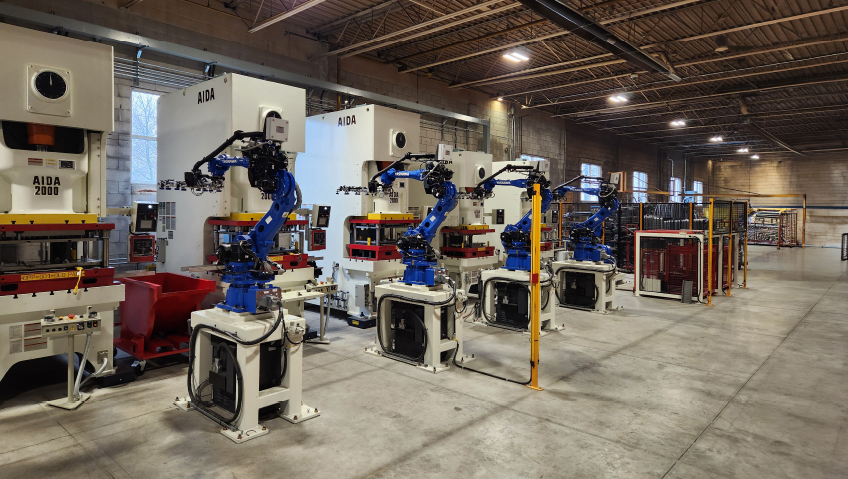
The solution came in the form of a fully automated step manufacturing line, installed in 2024. The new system allows the company to produce both perforated and diamond channel treads entirely in-house, using locally sourced steel coils.
This strategic shift delivered multiple benefits: shorter lead times, improved quality control, supply chain resilience, and reduced exposure to global disruptions. It also marked a major technological leap, introducing advanced automation into a process previously dominated by aging equipment.
Today, one operator can oversee the fully automated line, producing large volumes of precision-formed treads with remarkable consistency, a powerful example of how necessity can fuel innovation.
At the heart of Canway’s business lies its core product: rolling steel ladders, which account for roughly 70 percent of production. While ladders may appear simple, Canway’s engineering approach reveals a sophisticated blend of durability and ergonomic design.
One key differentiator is the company’s fully welded construction method. Unlike bolted systems that loosen over time, Canway ladders are welded into rigid, integrated structures that arrive fully assembled. “The main thing that differentiates us in the ladder world is that we feature all welded construction,” says Verhey. “Over time, it’s a more durable ladder because there’s not all these fasteners that will slowly loosen. It’s more sturdy, more rigid, and easier to install.” This design philosophy reduces on-site assembly and delivers a safer experience for end users, many of whom rely on Canway’s ladders in demanding industrial environments.
Some of Canway’s most successful products were not born in design labs, but in direct response to customer challenges. One standout example is the Safeguard Ladder, developed after a customer requested a safer platform solution that eliminated fall risk at the top of the ladder. Traditional chains and barriers proved cumbersome, so Canway engineered a double-gate system that automatically closes behind the user.
“Once you walk through the gate, it self-closes behind you. When you’re on the top platform, you’re safe, you can’t fall down the ladder section,” explains Verhey.
Originally created for a single client, the product quickly gained traction across multiple industries, ultimately becoming a full product line, a testament to the company’s customer-driven development model.
Indeed, customization lies at the core of Canway’s value proposition. Rather than forcing customers to adapt to standard equipment, the company engineers solutions around spatial constraints and safety requirements.
Cantilever ladders are a prime example. Designed for environments where obstructions prevent standard ladder placement, these models feature extended platforms balanced by counterweights at the base, enabling safe access beyond the ladder’s footprint.
Beyond ladders, Canway’s customization expertise extends into material handling solutions, including lift baskets, engineered bins, service carts, and specialty platforms. These products, too, often emerge from customer requests that reveal broader market needs, and the company’s in-house engineering and fabrication capabilities allow it to respond quickly and deliver highly tailored solutions without compromising quality or lead time.
For Canway, quality assurance is not an isolated checkpoint; it is embedded throughout the manufacturing process. Each ladder passes through multiple inspection stages, from component assembly to final packaging. Operators review parts at every station, while dedicated QA checks occur both before painting and after final assembly.
“A ladder must ensure the safety of its user,” Verhey emphasizes. “If there’s a missing weld and a tread fails, that could be catastrophic. We take quality in that sense very, very seriously.”
This rigorous approach ensures that every product leaving the facility meets stringent safety and durability standards, a non-negotiable expectation for customers in industries such as healthcare, manufacturing, construction, and energy.
Canway’s success is anchored in its people. With a workforce of approximately 40 employees, 30 in manufacturing and the remainder in engineering, sales, and administration, the company operates on a culture of transparency and long-term development. Rather than simply filling positions, Canway invests in career pathways, aiming to cultivate today’s operators into tomorrow’s leaders.
“We’re always looking at skilled labour and hiring for the future,” says Verhey. “The people we hire today, someday we want them to be lead hands and eventually leaders.” This philosophy extends into training programs and skills development, ensuring employees understand both current expectations and long-term opportunities.
As manufacturing technology evolves, Canway is embracing automation strategically—not to replace people, but to enhance efficiency and consistency. The automated step line marked a major leap forward, and future investments are already underway. Robotic welding stands out as the company’s next major frontier, offering opportunities to increase throughput while reducing physical strain on skilled welders.
In parallel, plant safety upgrades, including modern shears and press brakes equipped with light curtains, reflect Canway’s commitment to protecting its workforce through intelligent engineering. These investments signal a forward-looking mindset, positioning Canway to compete effectively in an increasingly automated global manufacturing environment.
Of course, distribution plays a pivotal role in Canway’s business model. With ladders that are large and costly to ship, the company relies on a trusted distributor network to provide nationwide reach and logistical efficiency. Rather than competing with its distributors through direct sales, Canway operates exclusively through these partnerships, a strategy rooted in trust and shared success.
Through distributor feedback, Canway also gains invaluable insights into customer needs and industry trends in real-world environments, which directly inform design improvements and product innovation.
Looking forward, Canway sees strong opportunity in expanding its material handling portfolio, particularly in service carts, dollies, and retail equipment, sectors where quality and customization remain in high demand. By leveraging its engineering capabilities and manufacturing expertise, the company aims to fill market gaps with domestically produced, high-quality solutions that outperform imported alternatives. At the same time, ongoing investments in automation and robotics will continue to enhance operational efficiency, enabling Canway to scale without sacrificing craftsmanship.
After 40 years, Canway Equipment Mfg. Inc. stands as a testament to what sustained innovation and operational discipline can achieve. From its origins in hand trucks and ladders to its present role as a technologically advanced manufacturer serving industries across Canada, the company’s journey reflects a deeper commitment to safety, quality, and solving real-world challenges.
As Canway enters its fifth decade, the mission remains unchanged: build better products and continuously raise the standard for what Canadian manufacturing can deliver.