Electronic Craftsmen (E Craftsmen Corp) celebrates its 70th anniversary this year, a testament to the value of its products and the company’s work ethic and business smarts. Based in Waterloo, Ontario, dubbed Silicon Valley North for its abundance of technology firms, ISO-certified Electronic Craftsmen designs and manufactures inductors and transformers for transmitting electricity.
While such components have been around since the 19th century, the company has a very modern mindset, as evidenced by its flexibility, creativity, and unique four-day workweek.
“Our products power the systems that everybody uses. Without transformers and inductors, you don’t have electronic devices or electricity to feed them,” notes President and Engineering Manager, Tom Bresele, P.Eng.
The Region of Waterloo is host to two universities, one of which, the University of Waterloo, is an engineering/computer science powerhouse. The area also boasts the Perimeter Institute for Theoretical Physics, a world-renowned research centre, and the company BlackBerry Limited (formerly Research in Motion), a pioneering smartphone developer. Google, Shopify, Honeywell, and OpenText all have a presence in the community.
Against this state-of-the-art technology backdrop, Electronic Craftsmen continues to thrive. In addition to producing quality products, it has endured by offering stellar client support and a spirit of humility.
“We have a very talented engineering team whose main focus is custom design,” shares Vice President of Finance, Kathy Hastie. “That seems to attract some of those niche markets that need the extra attention,” she says, adding that they “take the time to get to know our customers and what their specific objectives are. We take the opportunity to ensure that customer service is at the forefront of what we do. We’re in the tech centre of Canada, being in Waterloo, but we’re not a new technology. This kind of technology has been around since electricity distribution.”
Old-fashioned as the company’s products may be, the team is “always willing to adapt to the changing marketplace,” says Bresele. Electronic Craftsmen’s design work is all self-performed, with a company database containing thousands of unique designs for inductors and transformers. And even though the firm’s heritage dates back decades, it remains open to new concepts and ideas. “We’re always making new transformers and new inductors for new applications,” states Bresele.
In practise, this means taking a hybrid approach to manufacturing. Some of the company’s high-volume parts are made in China, while more complex components are produced in Waterloo, where it maintains an in-house machine shop that produces custom moulds and parts. Electronic Craftsmen can perform winding, soldering, and coil assembly, among other services, and can custom-grind ferrite to tolerances of 0.001 inches (a ceramic material commonly used in electronics magnetics).
The company sells its products across multiple sectors, with the aircraft parts and industrial controls markets generating the most business activity. Other sectors served include water treatment systems, induction heating, conventional and LED lighting, airport security, rail transportation power systems, and naval sonar systems.
As the company name implies, craftsmanship is central to everything it does. In the past, Electronic Craftsmen followed the Canadian Standards Association Z299 quality assurance guidelines. An ISO 9000 precursor, Z299 certification denoted an ability to achieve rigorous quality assurance benchmarks. Today, Electronic Craftsmen is an ISO 9001 and AS9100 registered operation, the latter being an aerospace standard.
Quality Manager, Otilia Vandici, M. Eng., ensures that standards are upheld and that the company stays up-to-date on regulatory changes and new quality assurance requirements. It undergoes a survey audit each year and a full audit every three years. Vandici “does a great job of making sure we’re adhering to and implementing the evolving quality standards,” notes Hastie.
The company was established in 1956 by Hugh Watt, whose last name seems entirely appropriate for the founder of an electronics company. Over time, there have been ownership changes and tweaks to the company name which was, for a while, called E Craftsmen; no matter the name, however, the importance of maintaining good workplace relationships has been a constant throughout the company’s history. “We really appreciate the employees we have,” says Hastie. “We take pride in the longevity of our team at Electronic Craftsmen. Many of our employees have been with us for more than 30 years, with some surpassing 40 years of service.”
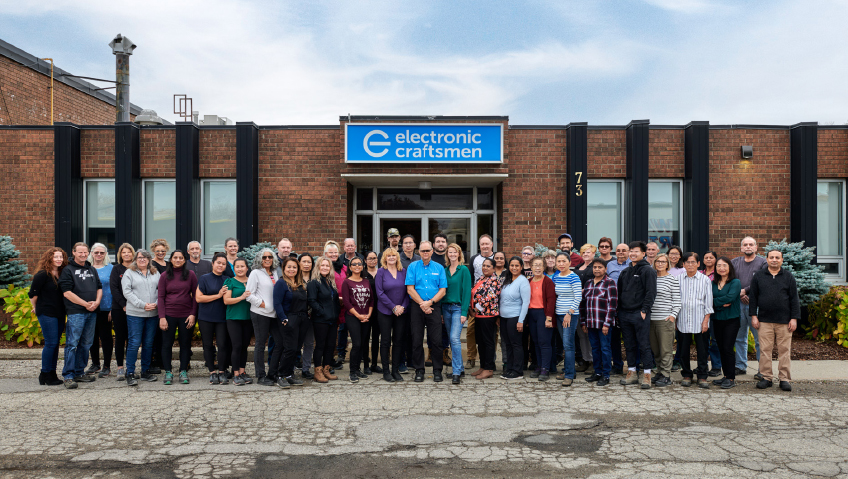
Electronic Craftsmen’s personnel—a team of 48 at present—enjoy some unusual perks such as a four-day workweek, a workplace benefit that stems from the company’s experience during the recent COVID pandemic. Even though the company stayed open as it was deemed essential in building parts for medical test equipment, management was concerned about COVID’s impact on its employees. Many other businesses had been closed by government order or had switched to remote work, making day-to-day life difficult. “We wanted to give our staff a little extra time to get out, get their groceries, while staying safe. So, we decided to close our doors on Wednesdays for our team to have an extra day,” explains Hastie.
The concept went over so well, high-level discussions were had about making the temporary measure permanent. Fueling these discussions was research about the positive benefits of a four-day workweek in the Netherlands. A decision was made to approach staff with an intriguing proposal based on their existing work schedules: employees enjoyed two paid 15-minute breaks a day, plus an unpaid lunch. “We asked for our team’s input and support. We needed to ensure that the change would benefit our employees without compromising our quality standards or customers expectations,” recalls Hastie.
Team members responded enthusiastically and a temporary measure instituted during a pandemic became standard company policy. Staff who perform their usual 32 hours of work a week do not have to come in on Fridays but still get paid for the time off. “We call it a bonus day,” she says. The company’s adoption of the four-day workweek is further proof of its flexibility and concern for its workforce.
The company received a huge promotional boost in 2019 when it was featured on the Discovery Channel’s How It’s Made show. Filmed in its facility at 73 Schaefer St. in Waterloo, the episode offered a step-by-step description of the inductor manufacturing process. Beyond this, promotion largely consists of word-of-mouth referrals from satisfied customers. In part because the company has been around so long and has such a good reputation, Electronic Craftsmen has a sizeable share of repeat customers, and universities around the world frequently contract it for various goods.
“We make parts, even one-offs, for research and development for University projects, and when those graduates go out in the field, they remember the company that made this one-off and we get repeat business that way,” explains Bresele.
When it comes to challenges, Electronic Craftsmen faces many of the same issues affecting other manufacturers across Canada. These include an aging workforce since, just as skilled industrial workers tend to skew older, young people are not flocking to apply for transformer and inductor jobs. Tariffs imposed by the United States on a variety of goods have also proven to be a major obstacle. The company is “taking a measured approach as it awaits further updates on export taxes,” says Hastie.
Most parts made at the Waterloo facility are CUSMA-compliant (the Canada-United States-Mexico Agreement being the latest iteration of a North American free trade pact). While this is helpful, many of the company’s customers are also reeling from international tariffs, adding to woes. For all that, Electronic Craftsmen remains “a Canadian-controlled, private corporation,” that serves an incredibly important function, notes Bresele with pride.
Staff members are optimistic and point out that new hires who do come on board are often familiar with cutting-edge technology, which bodes well for the future. Going forward, “I think we’re going to see a change in our staff, of course,” Hastie shares. “As some of our workforce considers retirement, we are focusing on attracting the younger generations to bring their new ideas and skillset into the industry. We’re going to see some interesting changes in the next five years.”
There are no plans, however, to allow robots and AI-controlled computers to run this venerable electronics firm. Bresele concludes: “As technology changes, we will adapt to use the tools to aid and design but manufacturing will remain hands-on here because of the custom work we do.”