Terradyne Armored Vehicles Inc. of Newmarket, Ontario plans to take part in a huge military procurement program and make a splash at an international trade show in Saudi Arabia. The company designs and manufactures armored vehicles—tough, sturdy, four-wheeled machines that offer maximum protection for occupants under dangerous conditions. The vehicles are popular with police special weapons and tactics (SWAT) teams, emergency response crews, and military personnel alike.
Terradyne Armored Vehicles was originally launched in 2011 as a segment of Canadian auto parts giant Magna International. The company, which focused on armored vehicle production from the beginning, was spun off as a standalone entity in 2014, and last year marked its eleventh anniversary as an independent business.
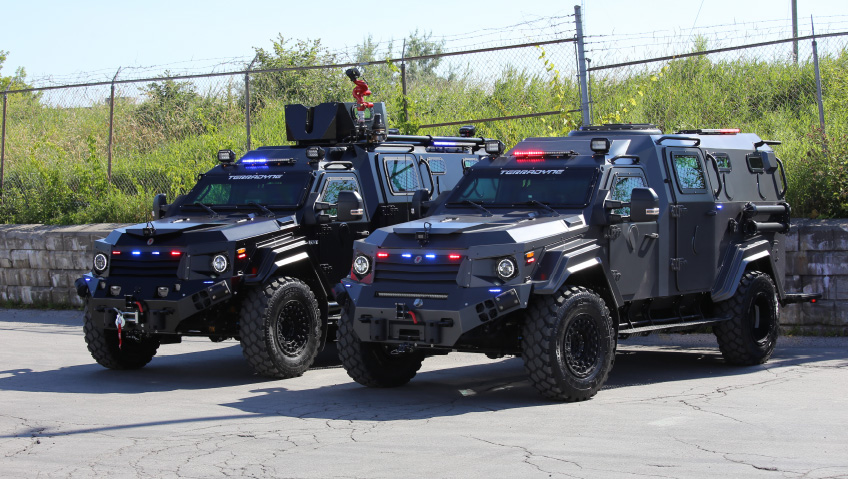
Terradyne offers four main models under its Gurkha line, named after the famously tough soldiers from Nepal who have fought for Great Britain since the 19th century. These models consist of a light armored patrol vehicle (Gurkha LAPV) which weighs 16,000 pounds (7,258 kilograms) and measures 6,116.9 mm x 2,454.2 mm x 2,645.6 mm; a rapid patrol vehicle (Gurkha RPV) weighing 15,500 pounds (7,031 kilograms) and measuring 6,207.5 mm x 2,454.2 mm x 2,499.2 mm; and a multi-purpose vehicle (Terradyne MPV) weighing 16,500 pounds (7,484 kilograms) and measuring 6,356.8 mm x 2,454.2 mm x 2,633.9 mm.
The company’s fourth model is a civilian limited-edition vehicle (Gurkha CIV) that weighs up to 13,500 pounds (6,123 kilograms) and is 6,207.5 mm long x 2,454.2 mm wide x 2,499.2 mm high.
The biggest change at the company since we last spoke in August 2024 has been the release of “a new variant of an existing model,” shares Sales Manager Lucus Witzke. The new variant represents “a first for Terradyne—an armored vehicle for law enforcement specific to EOD, which stands for Explosive Ordnance Disposal,” he explains.
The MPV FORT (Forward Ordnance Response Team) EOD recently made for the City of Tampa, Florida was a variation of the MPV for law enforcement, and will be used by a police bomb squad, Witzke says. The purchase was part of a two-vehicle deal, with the other being a standard law enforcement model. “We have delivered it and are now marketing it to other law enforcement agencies,” he says.
In addition to the FORT EOD, Terradyne has also tweaked another model to create a tactical emergency medical services (TEMS) vehicle which is “basically an armored ambulance,” Witzke says. The TEMS vehicle is also being marketed to law enforcement clients.
These models are built on Ford F-550 Super Duty truck frames and are fitted with a 10-speed automatic transmission, 4×4 shift on the fly, and V8 turbo diesel engines. “We use the Ford F-550 chassis for all Gurkha models, so we are limited to what direction Ford goes in. From what I’ve heard… for the Super Duty lineup, there are no electric or hybrid engines in the forecast,” Witzke says. Fuel capacity for all four models is 40 gallons (151 litres), and each model is equipped with a four-wheel vented disc anti-lock braking system.
All models save the CIV feature armor plating (with the armoring available as an option on the civilian model as well). The CIV is the only Terradyne vehicle that is available to the public at present. This is a brawny, dark machine that would definitely make an impression on city streets.
Witzke cites the materials that go into the company’s vehicles and its customer support as Terradyne’s points of difference in the market. Technical specifications state that armor plating on the LAPV, MPV, and RPV warrants a B7/STANAG 2 rating, a military standard set by the North Atlantic Treaty Organization (NATO). And Gurkha vehicles are subjected to intensive third-party testing involving live ammunition and explosive blasts.
Terradyne does not claim its vehicles are completely bullet- and bomb-proof, but simply well-protected against such threats. Plating on the LAPV, MPV, and RPV is fairly light as far as armor goes, and in addition to being well-fortified, Gurkha vehicles are relatively quick, which is an important factor when conducting police raids or rescuing wounded soldiers under fire. The wheels on Gurkha vehicles feature special inserts that keep the tires in workable condition even after they have been punctured by bullets or shrapnel, while the windshield glass is also tough and resilient in the face of gunfire.
In addition to producing top-of-the-line machines, Terradyne works hard to serve its clients. The company maintains a steady supply of spare parts and tires and can manufacture replacement components upon request. It is receptive to customer feedback and can customize its basic product line, as evidenced by the FORT EOD vehicle. “Something we’ve learned over the years is our customer service apparently is next-level compared to our competitors, so that has given us an advantage,” notes Witzke.
Design and manufacturing duties are handled in-house, with Terradyne employing roughly 50 people and producing around 100 vehicles each year. Each armored car takes between 20 and 24 weeks to complete—which seems a long time until you consider the standards each vehicle needs to meet. Not every truck on the road is designed to withstand a barrage of bullets or a grenade attack.
Gurkha vehicles are sold either through dealers or direct to customers, and the company’s most popular vehicle varies from year to year. For 2025, the MPV proved to be the most in-demand model, says Witzke.
Certainly, Terradyne takes pride in all its high-quality vehicles and holds both ISO 9000 and 14000 certification. It is also registered with the Controlled Goods Program, an initiative run by the Canadian government. Thanks to this registration, Terradyne is authorized to export its military-style vehicles.
Back in Canada, Terradyne is among a handful of qualified potential suppliers for a Canadian Armed Forces light utility vehicle (LUV) replacement initiative. Ottawa intends to spend up to $1 billion on a new “protected, lightweight, multi-role, and highly-mobile ground wheeled vehicle,” states the website of the Canadian Defence Review, a military journal.
Between 2,000 and 2,200 replacement vehicles are needed in total, “with up to four variants: command and reconnaissance vehicle; utility vehicle; military police vehicle; and cable-laying vehicle,” says the journal. The program also involves “ancillary equipment, integrated logistics support (ILS), and an in-service support solution.”
To be sure, Terradyne has a good shot at winning work with the LUV program, due in part to the amount of Canadian content that goes into its Gurkha line, says Witzke.
The company is also excited to be participating in the World Defense Show in Riyadh, Saudi Arabia in early 2026. This will be the first time Terradyne has attended this event. “There are a lot of Terradyne vehicles operating in the Middle East as of today,” Witzke says. “Other opportunities might be there. Our end-goal is to expand our presence from what we already have there.”
When it comes to promotion, the company relies heavily on trade shows to highlight its products. “We’re very particular,” says Witzke. “We do some print advertising with law enforcement in the U.S. and Canada, but a lot of [our promotional efforts] are trade shows. We find it’s a lot more effective to physically get a vehicle in front of somebody, as opposed to sending pictures.”
As for challenges, he cites tariffs and “increased prices in the supply chains.” The most consistent challenge, however, is simply the nature of the armored car business. “The sales cycle is very long; it’s a big-ticket item. There are a lot of hurdles that need to be overcome in that process.”
Going forward, Terradyne wants to stay in Newmarket and produce more armored cars from its core lineup in addition to interesting variants, such as the FORT EOD and TEMS vehicles. Witzke anticipates “further expansion of our footprint in key areas: Canada, the United States, Europe, and the Middle East,” while the company continues to hone its expertise.
In the early days, “we were the new kids on the block that nobody had ever heard of,” he says, adding that the client base “is a very tight-knit group, especially in law enforcement. They talk with each other and share reviews of what equipment is good. It takes a very long time to develop a reputation.” Terradyne Armored Vehicles is well on its way.