In an industry where brands rise, merge, and disappear from store shelves as quickly as trends change, Avon Food Company stands out as a rare constant, defined not only by its product legacy, but by the people and values behind it. More than two decades after acquiring the historic Christie’s brand at auction, this company continues to grow, adapt, and reinvent itself, all while maintaining a deeply rooted sense of family, craftsmanship, and responsibility to both customers and partners.
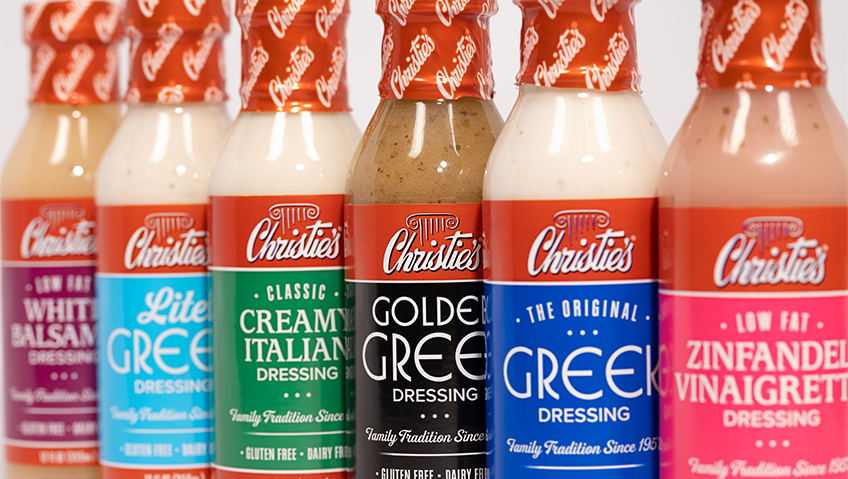
Today, Avon Food Company operates with two clear identities: a steward of beloved, multi-generational consumer sauce brands including Christie’s Salad Dressing, Porino’s Pasta Sauce, Medallion Teriyaki Sauce, and Javin Curry Powder; and a respected co-packer known for helping emerging and established brands alike scale with care.
Behind that dual mission is the Anastos family, led by second-generation leadership and proudly women owned. But perhaps most importantly, Avon Food Company’s story is still being written through continual reinvestment in advanced equipment, sustainability-centered processes, collaborative culture, and ahead-of-trend product development. The result is a business that honors where it came from while confidently charting a future all its own.
Many customers still associate Christie’s with its original family founders, and that connection is something Avon Food Company cherishes. The transition began when the Christie’s brand and several sister labels fell into private equity ownership that eventually ended in liquidation. When the business went to auction, Michael Anastos’ father—Stephen Anastos—who had not previously worked in food manufacturing—saw not only an opportunity, but a responsibility to preserve something meaningful.
Vice President Michael Anastos explains, “My dad had a friend in the business who asked him to attend the auction with him. And they were the lucky winner to carry on the Christie’s brand.”
Rebuilding the brand meant more than restarting production; it meant restoring trust. Those early years were spent returning recipes to their original form, rekindling supplier relationships, and regaining shelf placement. That effort worked and the family not only saved the brand but grew it. Now in its second generation of leadership, the company employs more than 25 people and operates four production lines, with both of Michael’s parents still actively involved.
Among the most defining features of Avon Food Company today is its woman-owned leadership. “My mom owns the company,” Anastos shares. “She has owned it since the beginning. She’s the principal owner, and she still supports operations day-to-day.”
In an industry often led by men, Avon Food Company stands out for its inclusive and empowering workplace culture, with mentorship playing a central role in day-to-day operations. This is a place where every individual is encouraged to grow, develop their skills, and advance within the company.
Sales and Marketing Manager, Carson Albright, highlights the significance of this presence: “In a predominantly male industry, it is nice to see and be a part of a business with women at the core.” This leadership identity has shaped a workplace that emphasizes collaboration and empowerment, a culture that’s equally felt on the production floor and in leadership meetings.
That spirit of mentorship extends beyond gender and titles. Longtime employees often describe the company as a place where ideas are welcomed, voices are heard, and innovation is encouraged. It’s a structure that blends small-company closeness with big-company capability, reflecting the same values that define Avon’s relationships with clients and suppliers.
While the heart of Christie’s products remains unchanged, with recipes preserved as they were decades ago, the equipment and processes used to make them have evolved dramatically. Over the past three years, Avon Food Company has invested nearly $3 million in production and facility upgrades. These include electromagnetic fillers, a technology typically only seen in major global manufacturers.
“Electromagnetic filling is the leader in sanitary design,” Anastos explains. “It’s the fastest, cleanest, and most efficient way to fill, but it’s usually something you only see in the Coca-Colas of the world, and we brought it down to a smaller scale.”
Along with electromagnetic filling, the facility hosts piston and pressure overflow filling lines, energy-efficient boilers and compressors, and dual-capability capping systems for both metal and plastic lids. These investments were deliberate, not just for efficiency, but to expand what Avon Food Company can offer and to make operations more sustainable.
Indeed, the company’s commitment to environmental responsibility extends beyond energy-efficient equipment. By focusing on reduced waste and local sourcing partnerships, Avon Food Company minimizes its environmental footprint while maintaining the quality customers expect.
The company now fills everything from 5oz retail bottles to gallon jugs and bulk pails, servicing both grocery shelves and national restaurant chains. In the co-packing segment, Product Specialist Natalie Steeves and the development team assist customers from formulation to scaling to distribution, making Avon Food Company a full-service partner, not simply a producer.
Though many co-packers simply replicate formulas and produce to spec, Avon Food Company takes a more experimental and collaborative approach. “The big driver for us is asking ‘why? Why is something done this way? Could it be done better?’ We ask that every single day,” says Anastos.
This forward-thinking mindset has driven the company to explore preservative-free and clean label formulations while helping partner brands rapidly scale and refine their products. Avon Food Company also experiments with emerging flavor trends and innovative ingredient profiles, all while guiding small-batch creators through the transition to large-scale production, ensuring their handcrafted essence remains intact.
Albright and the team closely track consumer shifts through trade shows, association involvement, distributor conversations, and on-the-ground feedback. As members of the Specialty Food Association, the team has a finger on the pulse of what’s coming, whether that’s plant-based innovations, functional ingredients, or nostalgic comfort flavors making a comeback.
This agility is one advantage of being mid-sized: large enough for industrial production, yet small enough to adapt to change quickly. Avon’s team thrives on this flexibility, often piloting new products or reformulations within weeks rather than months.
The company’s recipe catalog is a unique asset, a living archive of American flavor history. Some formulas trace back nearly 75 years, developed by original Christie’s founder and food scientist Dean Christie. Others were created only months ago in collaboration with rising brands or restaurant groups. Avon Food Company has produced award-winning barbecue sauces, marinades, wing sauces, Bloody Mary mixes, and private-label lines that many consumers know, even if they don’t realize where they’re made. Many partnerships are protected under NDA, but the pride in the work is unmistakable.
“It’s really neat to collaborate with our new co-packers,” Steeves shares. “Some clients start out making as little as a gallon at a time, and we can scale their vision to 2,500 gallons. That’s one of the joys of working at a manufacturing facility.”
That blend of innovation and respect for tradition has earned Avon Food Company a trusted reputation among both up-and-coming food entrepreneurs and long-established household names. From craft startups debuting their first product to national brands expanding into new markets, Avon serves as the quiet force helping them make it happen.
Last year, Avon Food Company earned its first SQF certification, one of the most recognized and comprehensive food safety standards in the world. This year, the company raised the bar again by adding the Quality certification component, a step that only around 12 percent of manufacturers nationwide have taken.
“We wanted to be proactive about quality—not just meet expectations, but exceed them,” says Anastos. “Some people get SQF just to have it; we went after it so we can sleep at night. It’s about integrity and transparency.”
The certification reflects not only Avon’s dedication to safety but also its holistic approach to quality management. Every stage, from ingredient sourcing to final packaging, is governed by strict standards and meticulous oversight, and clients benefit from the assurance that their products are being made in one of the most advanced, compliant facilities in the region.
Behind every bottle and batch are relationships that make the company’s success possible. Avon Food Company works closely with family-owned suppliers like Holden Fruit and Produce, which provides fresh produce and ingredients tailored to the company’s exacting specifications. As Steeves notes, “They have been incredibly supportive and flexible partners. Aside from having high quality ingredients, they are always helping us to refine our process.”
On the equipment side, partners like DTM Packaging have been instrumental in helping Avon design customized machinery for its unique production needs. These collaborations reflect a broader company philosophy that strong partnerships lead to stronger products.
Equally important are the people inside the facility. “It makes me really happy when we have a group of people that love what they do,” says Anastos. “Culture has been number one for us from the beginning.”
That emphasis on culture isn’t lip service. Michael Anastos is known for being out on the floor, working hands-on with team members, solving problems side by side. “He’s amazing with the machines. He works closely with the team to teach our machine operators how everything works,” says Albright.
Steeves continues, “It’s pretty rare to have leadership so involved in the day-to-day.”
Looking ahead, Avon Food Company is focused on scaling with purpose by expanding its range of natural, preservative-free products, strengthening co-packing partnerships, and growing the presence of its beloved Christie’s brand. At the same time, the company remains deeply committed to nurturing its people through collaboration, and to the hands-on leadership that keeps a family-centered culture at the heart of everything it does. That focus on balance between growth and grounding, innovation and integrity, may be what defines Avon’s next chapter most of all.
The company’s evolution is proof that food manufacturing doesn’t have to sacrifice humanity for progress. It’s a business model that values curiosity, transparency, and relationships as much as revenue. In a marketplace where so many legacy brands fade into corporate anonymity, Avon Food Company continues to do what it has always done best: make great food, made by good people.
Through legacy and leadership, Avon Food Company stands as proof that the best future for the food industry is one that honors its past, invests in its people, questions what’s possible, and cares deeply about what it makes.